
Swift action on the water use permit applications for the Lahaina Aquifer Sector groundwater and surface water management area is not the only thing members of the public are clamoring for.
“Where the heck is the shortage plan? I’m … about ready to make a bumper stick that says, ‘Show me the shortage plan.’ And I’m gonna slap that sucker everywhere, because I’m not the only person asking for a shortage plan,” Honokōhau kalo farmer and teacher Karyn Kanekoa told the state Commission on Water Resource Management at its November 18 meeting.
Under the state Water Code, the commission is required to create plans for designated water management areas that are implemented during water shortages.
So far, the commission has adopted only one such plan, that for the Pearl Harbor aquifer. As ongoing drought conditions have made clear, a plan for the Lahaina Aquifer Sector groundwater and surface water management area — which was designated in 2022 — is desperately needed.
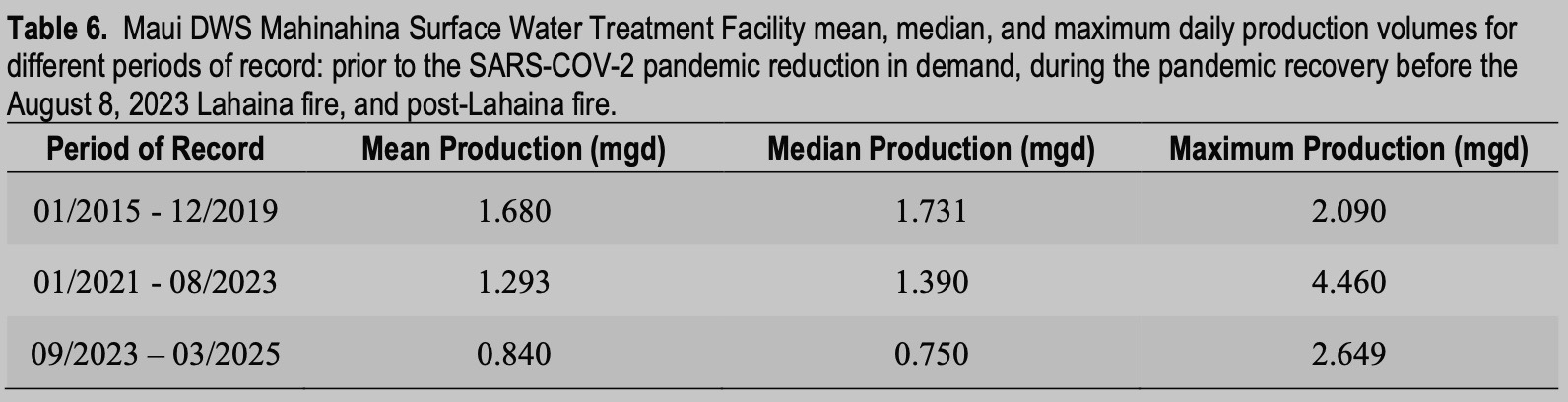
This past June, the Maui Department of Water Supply declared a Stage 1 water shortage for West Maui, restricting irrigation there to two days a week. The department then upgraded that to a Stage 2 water shortage in September, which required its customers to reduce their water use even further, allowing irrigation only one day a week.
The most glaring problem with those declarations: DWS customers’ water use is just a small fraction of that provided by privately owned utilities to their customers. These purveyors are not required to comply with the department’s water shortage restrictions.
At the Water Commission’s meeting last month, where staff briefed commissioners on its efforts to process the water use permit applications, Maui DWS deputy director James Kimo Landgraf asked for help.
“Something, I don’t know if the commission can look at, but when there’s a drought, the department will put out a Stage 1, Stage 2, or Stage 3 [declaration], but that only affects our customers. So it’s hard for us to say to the private guys, ‘Can you guys please cut back too, because it’s obvious everybody in West Maui is affected?’ I don’t know if there’s something the commission can do.”
If the commission were to announce a Stage 1 water shortage for all of West Maui, requiring everyone to comply, that would help the Maui DWS with enforcement, he suggested.
“It makes it easier for us. Even if you guys were to say, ‘Okay there’s a drought in West Maui. Everybody cut back 10 percent. If you don’t, you guys get fined,’” he said.
He also noted, “We have a conservation bill in council that we’re trying to get through that will increase our enforcement capability.”
That bill would make several amendments to the Maui County code’s chapter on water conservation and control of the use of water during a shortage. One of them would make the chapter apply not only to the county’s water customers, but also to potable water customers of private water system operators that “are subject to these conditions as a result of either an agreement [with] the county, or as a condition of a land use entitlement.”
Water Commission chair and director Dawn Chang suggested that the county should support the commission’s proposed state legislation regarding water shortages and emergencies.
“We actually had a bill (House Bill 510) to that effect,” she told Landgraf. That bill, which faced strong opposition from the Hawaiʻi Farm Bureau and the Land Use Research Foundation, failed this past session.
Commissioner Kathleen Ho, who represented the state Department of Health, asked Landgraf, “Are you just asking for a declaration on the part of CWRM that we are in a drought?”
“But that’s not enforceable,” Chang said.
“But he will enforce it,” Ho replied.
“Not on private purveyors,” Chang said.
Water Commission deputy director Ciara Kahahane interjected that she supported the suggestion that the commission declare a shortage.
“I would like to do this. I think it is within our capacity now that this area has been designated to do so, to say, for example, a Stage 1 restriction has been declared for West Maui. It should be applied to the private systems as well. That is something that I, as deputy, would recommend,” she said.
Under Hawaiʻi Administrative Rules, for the commission to declare a water shortage, it must find that water usage has caused or may soon cause 1) withdrawals that exceed the recharge, 2) declining water levels or heads, 3) water quality deterioration due to increasing chlorides, 4) excessive and preventable water waste, or 5) “a situation in which any further water development would endanger the ground water aquifer or the existing sources of supply.”
Kahahane noted that the legislation Chang had referred to would have allowed the commission’s drought declarations and associated restrictions to apply to areas that have not been designated as water management areas.
To this, board member Aurora Kagawa-Viviani argued that the commission already has the ability to impose restrictions in non-designated areas.
“It’s in the [Water] Code. … It hasn’t been exercised,” she said.
Kahahane said that is a matter “to be discussed with attorneys in executive session.”
Failed Bills
Under the Water Code section 174C-62(g), “If an emergency condition arises due to a water shortage within any area, whether within or outside of a water management area, and if the commission finds that the restrictions imposed [in accordance with the water shortage plan] are not sufficient to protect the public health, safety, or welfare, or the health of animals, fish, or aquatic life, or a public water supply, or recreational, municipal, agricultural, or other reasonable uses, the commission may issue orders reciting the existence of such an emergency and requiring that such actions as the commission deems necessary to meet the emergency be taken, including but not limited to apportioning, rotating, limiting, or prohibiting the use of the water resources of the area. Any party to whom an emergency order is directed may challenge such an order but shall immediately comply with the order, pending disposition of the party’s challenge. The commission shall give precedence to a hearing on such challenge over all other pending matters.”
That section suggests that a water shortage plan, at least, must be in place before the commission can issue any emergency orders.
In its 9-page written testimony against House Bill 510 of the 2025 legislative session, which got further than its companion bill in the Senate, LURF stated, “The fact that the proposed measure may prohibit and restrict any new land use or facilities – even those which have been fully approved and permitted by the state or counties but not yet built, is one of the most significant and serious concerns. Expanded unilateral authority of the commission and potential water use restrictions could lead to project delays and increased costs as developers may face difficulties in securing water permits or be forced to implement costly water conservation measures, thereby undermining the financial viability of projects and developments.”
LURF also urged legislators to note that a “very similar attempt made in 2023 by HB 1088 which proposed to amend the conditions, manner, and areas in which the commission can declare and provide notice of water shortages and emergencies was vetoed by Governor Josh Green on July 7, 2023.”
That vetoed measure would have stricken all of 174C-62(g) and added to the section on the commission’s powers and duties the ability to “declare an emergency if the commission determines, in consultation with the appropriate county and the department of health, that there is an absence of sufficient quantity and quality of water in any area, whether within or outside of a water management area, that immediately threatens the public health, safety, and welfare.” It would have also added language giving the commission the authority to “issue orders reciting the existence of the emergency and requiring such actions as the commission deems necessary to address the emergency be taken, including but not limited to apportioning, rotating, limiting, or prohibiting the use of the water resources of the area. An emergency order shall expire no later than one year after issued by the commission, unless extended by a separate or supplementary order.”
The bill would have also allowed the commission to declare that a water shortage exists within or outside a water management area.
The Kauaʻi County Department of Water and the Hawaiʻi County Department of Water Supply both submitted testimony asking that 174C-62 regarding the declaration of water shortages remain unchanged.
“This bill proposes to amend the State Water Code 174C-62, Hawaiʻi Revised Statutes (HRS), which currently requires that a water shortage be declared by rule in accordance with the water shortage plan before the Commission on Water Resource Management (CWRM) can declare an emergency. This proposed bill would allow CWRM to declare a water emergency without a prior water shortage declaration by rule,” both of their testimonies stated.
“Without an established water shortage plan, or criteria for an emergency, any such declaration would be arbitrary and could likely result in unintended adverse consequences,” the Hawaiʻi DWS wrote. Kauaʻi DOW manager and chief engineer Joseph Tait and deputy manager Michael Hinazumi added that those consequences could impact the public’s health and safety.
Both departments also recommended against amending subsection (g) of 174C-62 as proposed.
“If the intent is to allow CWRM to respond faster due to groundwater contamination or wildfires, HRS 127-14(c) could be utilized which would include input by other appropriate agencies and departments, i.e., Department of Health and Division of Forestry and Wildlife,” the Hawaiʻi DWS wrote.
“Overall, this bill is unnecessary and would effectively bypass procedural and substantive due process considerations and protections currently in the State Water Code,” they wrote.
The Honolulu Board of Water Supply also raised several other concerns about the proposed amendments in HB 1088.
“One of the initial requirements of the 1987 Water Code was that CWRM ‘formulate a plan for implementation during periods of water shortage.’ Indeed, CWRM’s formulation of a water shortage plan is long overdue, and its adoption would obviate the need for any substantive amendments to HRS §174C-62. Presumably, CWRM’s water shortage plan would also address the drought impacts from climate change and the impacts of water quality contamination reducing water quantity,” BWS manager and Chief Engineer Ernest Lau stated.
On HB 510, however, Lau submitted testimony in support, while the water departments for the other counties were silent.
CWRM director Chang stated in her testimony supporting the bill, “Water shortages impact all water users in a region – and since the counties and private utilities can only restrict uses of water under their control, it is vital for the commission to have expanded flexibility to respond to conditions anywhere in the state that threaten our water supplies when issuing water shortage declarations. Current language in HRS §174C-62, prevents the commission from declaring a water shortage in non-designated water management areas, and requires the commission to declare a water shortage by a lengthy administrative rulemaking process.”
LURF, however, repeated the argument that the proposed amendments to 174C-62 were unnecessary.
The Hawaiʻi Farm Bureau also testified against the bill, at first. After concessions were made in subsequent versions, it seemed more amenable to passage. Still, it found a number of faults with the revised bill.
Even with amendments to the bill made by the Senate to cap at 90 days the duration of any water shortage declaration (with the option to extend for additional 90-day periods) and to limit any resulting water restrictions to no more than 20 percent of a user’s last reported monthly use, Farm Bureau executive director Brian Miyamoto expressed concerns with how those provisions would be implemented.
“[W]e encourage further discussion with farmers about whether 90 days under reduced water access — particularly at 80 percent of typical use — is feasible for certain crops or production systems. For some growers, especially those with crops already in the ground, even a short-term reduction could result in significant losses,” Miyamoto stated in his written testimony.
He added, “If a farmer has not reported monthly usage within the past year, their usage is considered zero. This is problematic and does not reflect actual operational water needs. … We suggest considering a more stable benchmark, such as the average monthly water usage over the past 12 months, to better reflect the seasonality and fluctuations in agricultural water use.”
Earthjustice also opposed the bill, but for very different reasons.
“Earthjustice strongly supports reforming the Commission on Water Resource Management to improve the stewardship of Hawai‘i’s public trust water resources. However, we oppose H.B. 306 [relating to penalties for violations] and H.B. 510 in their current forms because these two bills propose piecemeal ‘tweaks’ to the commission that increase the risk of abuse of the commission’s authority without improving its operations or accountability to the communities seeking its help. Earthjustice would support these bills, if they were being considered in the context of critical structural changes to the commission, such as those proposed in Senate Bill 3.”
SB 3, which eventually failed, would have allowed the commission to declare a water shortage in non-designated areas. It would also have allowed the commission to retain its own legal counsel; separated the commission’s leadership — its administrator and chair — from the Department of Land and Natural Resources; and added an appointee of the Office of Hawaiian Affairs to the commission’s nominating committee.
The Sierra Club of Hawaiʻi supported HB 510, but only with amendments “such as those proposed in SB 3 SD1 from earlier this session.”
“[W]ithout HB 510 HD1, the Water Commission must continue to undergo time consuming, months-long planning and rulemaking processes and exhaust its water shortage authorities before taking action to preserve our fresh drinking water supplies in an unanticipated water shortage or emergency. This bill would allow the Water Commission to instead take more timely action to deal with unexpected water shortages in real time,” the organization stated in written testimony.
In the end, however, the House disagreed with the Senate amendments and the measure failed.
— Teresa Dawson