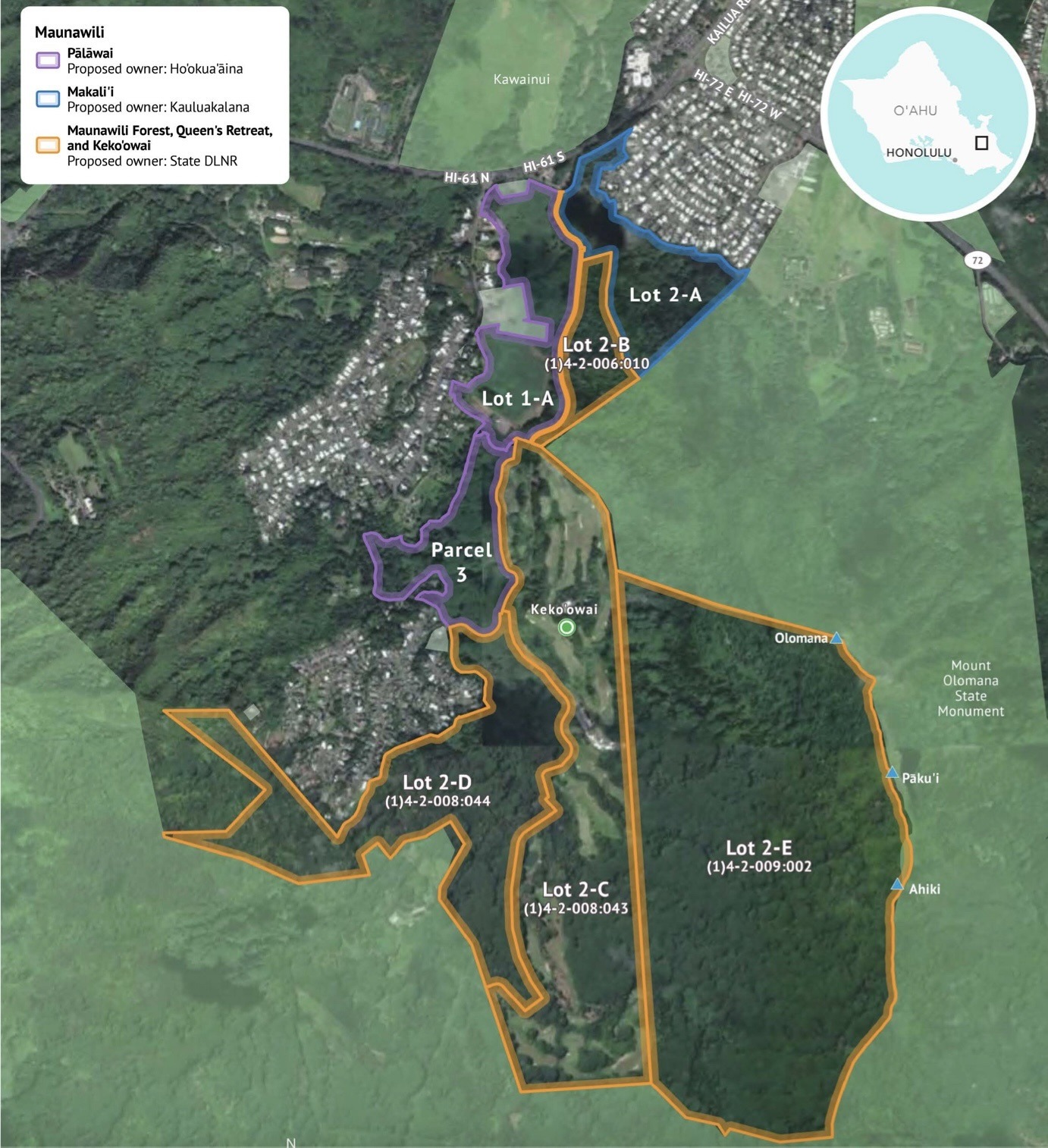
Above map credit: Trust for Public Land
We had a chance to buy it in 1983 for $6 million. … We got a second bite at the apple. We gotta do this,” David Smith said last month of a proposal to have the state acquire four parcels totaling 912 acres in Maunawili owned by the Harry and Jeanette Weinberg Foundation company, HRT Realty, LLC.
On June 12, Smith, as administrator for the Department of Land and Natural Resources’ Division of Forestry and Wildlife, asked the Board of Land and Natural Resources to give its preliminary approval of the acquisition, which will be brokered by the Trust for Public Land.
The Land Board approval would allow TPL to proceed with purchasing the lands from HRT for later transfer to the state. TPL is also planning to buy two other parcels in the area (Makali‘i and Palawai) from HRT, which will be transferred to two local non-profits, Kauluakalana and Ho‘okua‘aina, and will also be protected in perpetuity by a conservation easement held by the City & County of Honolulu and the Hawai‘i Land Trust.
The largest of the four parcels to be acquired by the state adjoins the Waimanalo Forest Reserve and is in the Conservation District. The other three are zoned for agriculture and include the Royal Hawaiian Golf Course.
“[T]hese coordinated acquisitions are intended to protect a continuous mauka-to-makai landscape extending from the Ko‘olau Mountains and Waimanalo Forest Reserve toward Kawainui Wetland and the Kawainui Marsh State Wildlife Sanctuary,” DOFAW’s report to the board states.
TPL project manager Aka Wedemeyer stated in written testimony to the board that the lands contain more than 50 springs and seven streams that supply most of the water flowing into Kawainui Marsh, “which once was the second largest fishpond and is now the largest wetland in Hawai‘i.
“The area is also home to significant cultural and historical resources, including heiau, intact stone-walled agricultural complexes, ‘auwai, habitation sites, burials, alanui, and petroglyphs, along with more recent, but nevertheless, important homesites for the Boyd and Irwin residences and the famous Queen’s Bath.
“Absent DOFAW’s efforts, these privately owned lands that would likely be listed for sale on the open market and critical forest and watershed resources, along with significant and important cultural and historical resources, would be under threat of subdivision and development,” he added.
“The purchase price will be the lower of: (1) the amount of funds raised and available for the acquisition; or (2) the fair market value of the property, as established by independent appraisals,” DOFAW’s report states. It adds that a total of $23 million in state and federal funds are available to complete the purchase: $7 million in state capital improvement project funds, a $4.95 million grant from U.S. Forest Service’s Forest Legacy Program, and $11.05 million from the buffer lands program of the Department of Defense.
There is still a lot of work that needs to be done before the state can take ownership.
In addition to the appraisals that need to be done, an April 2025 Phase I environmental site assessment identified a “dumping area, two leaking 500-gallon above-ground storage tanks, storage containers containing chemicals used for facilities operations, and evidence suggesting possible hazardous material releases or impacts to the property. Because the Phase I ESA identified the potential for hazardous materials releases, HRT and the seller will contract for environmental sampling and analysis and will complete required clean-up, remediation, abatement, disposal, or related work before closing, at no cost to the state,” DOFAW’s report states.
Portions of the land to be acquired also fall within the former Pali Training Camp, a formerly used defense site. DOFAW stated that it will work with the U.S. Army Corps of Engineers regarding those areas and “will incorporate appropriate safety considerations into forest reserve management planning to ensure that areas intended for public use are evaluated and managed appropriately.”
Also, final deed terms need to be worked out, as well as lease and management arrangements for the golf course parcel currently under lease to YHB Royal Hawaiian, LLC until 2041.
“Including the golf course parcel in the acquisition is important to the long-term integrity and management of the Maunawili landscape. The parcel provides infrastructure, access, revenue potential, and future management flexibility that may support the broader community vision for pono land management in Maunawili and Kawainui,” DOFAW states.
The division will return to the Land Board for final approval of the acquisition and expects the sale to close in December.
Smith stated that DOFAW requested preliminary approval last month to encumber the $7 million in state CIP funds that would otherwise lapse at the end of FY 2026.
He called the project “a super heavy lift,” adding that it was the division’s most aspirational and complicated acquisition to date.
“This just has a huge amount of upside potential … just an unbelievable project,” he said.
Land Board members James Carpio and Karen Ono expressed concern about the threat of unexploded ordnance on the lands.
Ono asked how much of the UXO would be cleared before the state takes ownership, “so we don’t have to have [warning] signs every so many feet.”
DOFAW O‘ahu branch manager Marigold Zoll and Smith explained that there is not much ordnance in area the state will be acquiring; it’s mainly up in the forest reserve that the state already owns.
Smith said that UXO cleanup in the area is “kind of an ongoing thing,” and more of a theoretical problem, rather than a practical one.
Zoll explained that the state’s management plan for the lands — a requirement of the U.S. Forest Service grant — will be reviewed by the FUDS program. With changes in land use, the FUDS program will be required to update its approach and do more cleanup, she said.
“We’ve been in discussions with them recently about that,” she said.
Board member Riley Smith recounted the military’s history in Hawai‘i of funding beneficial projects to mitigate its impacts.
“Their impacts will continue. We hope the benefits will continue also,” he said.
David Smith agreed and noted that the DOD’s buffer lands program has been providing funds for DOFAW acquisitions for more than a decade.
He added that the Maunawili project has garnered a lot of support, including from U.S. Marine Corps Colonel S.E. Detrinis, who called it a “a once-in-a-generation opportunity to protect vital cultural and natural resources important to the community and to the operational readiness of military forces in the Pacific.”
Zoll pointed out that the project has actually been driven by the community “for many, many years,” especially community leaders Oswald Stender, Paul ‘Doc’ Brennan, and Charles ‘Doc’ Burrows, all of whom have passed away in recent years.
“Their vision to better manage this land in the vision of the community has been long standing and we’re just carrying this forward with the lineal descendants,” she said.
In addition to the Marine Corps, the Hawai‘i Land Trust, Hui Maunawili-Kawainui and some of its members submitted written testimony on strong support. The hui is “a coalition of descendants and residents of Maunawili and Kailua and 11 respected Hawaiian cultural and environmental organizations based in Maunawili and Kailua,” its testimony states.
Hui member Mark Paikuli Stride of the Luluku Farmers Association and Aloha ‘Āina Health and Learning Center testified in person that he farms kalo on some of the lands.
The state’s acquisition will “allow us to care for our resources in a more managed and systematic way,” he said.
He added that he remembered sitting two decades ago with Brennan, Stender, Burrows and Kawika Burgess, when the golf course’s then-owner sought to develop it. “Our kupuna back then, this is what they were fighting for,” he said. “We have an opportunity to reset what it means to manage resources.”
O‘ahu Land Board member Denise Iseri-Matsubara asked Smith whether the division had money in its budget to support management of the lands. “I’m just thinking Maui wildfires, land ownership. With that comes obligation,” she said.
Smith said that the Legislature has provided very good support to the department and that the golf course will “also be spinning off a not insignificant amount of funds to manage” the lands.
“We only have one chance at this,” he stressed.
“We have a lot of adjacent lands. It’s not as though this is happening in a vacuum,” he continued. “It’s going to be somewhat easier to absorb into an existing financial system.”
Zoll said that the division may enter into stewardship agreements with community groups at some point to help manage the lands. “That is our intention,” she said.
“I think they really are going to carry the ball for us,” Smith added.
With that, Iseri-Matsubara made motion to approve DOFAW’s recommendation. It passed unanimously.
Board Pushes for Settlement
With Men who Picked ‘Opihi
In Closed Marine Reserve
Did or didn’t Brandon Carvalho, Ke‘au‘pililani Solomon-Lewis, Jr., and Kaipo Botelho-Matthey know that the 4,068 ‘opihi they harvested last September were from the Ka‘ūpūlehu Marine Reserve, where such gathering is prohibited?
On September 18, while on a remote stretch of shoreline fronting the reserve, Janine “Kara” Dumaguin, program director for the non-profit Hui Kahuwai, saw a yellow-hulled boat idling within the reserve’s boundaries.
“Because of my familiarity with the area, I knew that boats typically pass through rather than remain stationary. I contacted [the DLNR’s Division of Conservation and Resources Enforcement] and remained in communication with officers as the situation unfolded,” she stated in written testimony to the Land Board on June 12.
She saw three men carrying bags full of what turned out to be ‘opihi, a limpet and prized delicacy in the islands, along the shoreline.
After the men brought their full bags onto the boat, DOCARE officers tracked the vessel from the reserve to the Kawaihae Small Boat Harbor, where the thousands of ‘opihi were discovered upon inspection.
According to a report to the Land Board by the DLNR’s Division of Aquatic Resources, Carvalho acknowledged to DOCARE “that the group had gone out to gather fish and ‘opihi for family celebrations. Carvalho admitted awareness of the KMR’s general location but claimed that he mistakenly believed that the ten-year prohibition had expired. He further stated that the group was transported by vessel into the KMR and did not observe posted boundary signage until exiting the area and after gathering the ‘opihi.”
Botelho-Matthey “acknowledged that he had entered the no-take zone, harvested ‘opihi within its boundaries, and later exited northbound, passing the reporting party along the shoreline. He further confirmed that the group rejoined the vessel offshore by swimming out to it, then stopping outside the Hilton Waikoloa Resort to dive and spearfish. Solomon-Lewis invoked his right to counsel and declined to provide a statement,” according to DOCARE’s report to the board.
At the Land Board’s June 12 meeting, the Division of Aquatic Resources requested that the board fine each of the three men $1,000 for taking ‘opihi from the reserve, $835.41 in administrative costs related to the DLNR’s enforcement efforts, and $10 per ‘opihi taken. Because DAR could not determine how many each man took, it attributed their take equally, 1,356 ‘opihi each, for a total per-specimen fine of $13,560.
DAR proposed that each man pay a total of $15,395.41.
The division’s policy analyst said that the board had the ability to impose a maximum fine of $1,000 per specimen, but that would result in a “ridiculous” $4 million fine.
In their joint written testimony, read to the board by a friend of theirs, the men stated that they have “a great respect for Hawai‘i’s natural resources and that laws are intended to protect them. We were born and raised locally and understand the importance of preserving our marine resources for future generations. And at no time did we intentionally violate any law regulation.”
They asked for leniency, stating that none of them knew they were in a designated “no take” zone or marine reserve area at the time of the incident.
“We accessed the area by boat, rather than by land. While there may be signage along the trail for individuals entering from shore, we did not enter through that route and did not see any clear signs indicating that the ocean had entered a restricted area from that side,” they wrote.
DAR’s proposed fines were excessive, they claimed, stating that “this was not a deliberate disregard for the law, rather an honest mistake resulting from a lack of clear notice. … We were gathering food for our families.”
If the Land Board decided to penalize the men, they wrote, perhaps it could consider community service, educational programs or a substantially reduced fine “that better reflects the circumstances and unintentional nature of the incident.”
They also encouraged better signage to prevent future misunderstandings.
Board member Kaiwi Yoon took issue with the fact that their testimony did not seem to include any remorse or apology or accountability for their actions.
Speaking as “the person who sits on the board for cultural matters,” Yoon suggested that an apology was in order. “This was a kanawai (law) that was broken,” he said.
Botelho-Matthey said he was “super sorry.” “I’m all about the Hawaiian culture. My daughter goes to Kamehameha School. I really feel bad. I try to provide, not take. … I feel awful about this,” he said.
Several members of the public and community organizations testified in support of DAR’s recommendations and expressed their gratitude to DOCARE and DAR for pursuing the enforcement case. A criminal case against the men was dismissed with prejudice because, according to deputy attorney general Danica Patel, the county prosecutor mistakenly thought there were no criminal penalties available and filed a motion to dismiss. Patel told the Land Board that the prosecutor has since been educated that there are, indeed, criminal penalties for the men’s actions.
Dumaguin stated in her testimony that “these situations are rarely as simple as people imagine. Stewardship in Hawai‘i often takes place within communities that are deeply interconnected … people who have families, relationships, and ties to the same islands we all call home. That reality does not change what happened, but it does remind us that accountability and community are not separate from one another. …
“I take no joy in being involved in this matter. … The individuals involved do not have to agree with my actions, but I hope they understand why I made the decisions I did that day. I reported what I observed because I care deeply about Ka‘ūpūlehu and because I believe stewardship carries responsibilities for all of us.”
Hui Kahuwai executive director Rebecca Most testified via Zoom that she was part of a team that tried to return the illegally harvested ‘opihi to the shoreline. Most did not survive, she said.
She added that the case is an example of how much can be quickly taken, wiping out gains made over the past decade, when people treat the reserve “as an ATM, not the icebox that it is.”
Kaikea Nakachi testified, “I have a hard time believing that three people took 4,000 ‘opihi for their family and not to sell. Or that such a large number could be considered respecting natural resources.”
He said he also found it strange that someone — Carvalho — who was familiar with the fact that the reserve’s no-take prohibitions had been extended was “also simultaneously claiming they did not know there was a closure when they picked.”
Even if that were the case, Yoon said that claiming ignorance was unacceptable.
“We cannot operate that way. … We love you guys and we love our resources. That’s why I hurt. Four-thousand, boys. That’s a lot. We should be better than that,” he said through tears.
He encouraged them to be the fiercest advocates to protect Ka‘ūpūlehu.
“Had this been pre-contact, your punishment would be much more severe,” he said.
Hawai‘i Island board member Riley Smith lamented that DAR did not seek to penalize the vessel captain, Toby Carvalho. DAR had based its case on DOCARE’s actions and DOCARE cited Toby Carvalho only for boating violations.
Smith said he thought Toby was an accessory to the poaching and argued that if word got out that vessel owners could have their boats seized, such illegal activities might stop.
“With the coconut wireless, everybody’s going to know. … We need to make the fines and consequences severe enough so people who may not comply understand the risk,” he said.
After meeting in executive session to discuss legal matters surrounding the possibility of imposing non-monetary penalties, such as community service, Smith made a motion to defer voting on the proposed recommendations and enable the alleged violators “to communicate with DAR to consider the possibly of entering into settlement discussions.” He said the matter should return to the board in 90 days.
His motion was unanimously approved.
— Teresa Dawson

Leave a Reply