
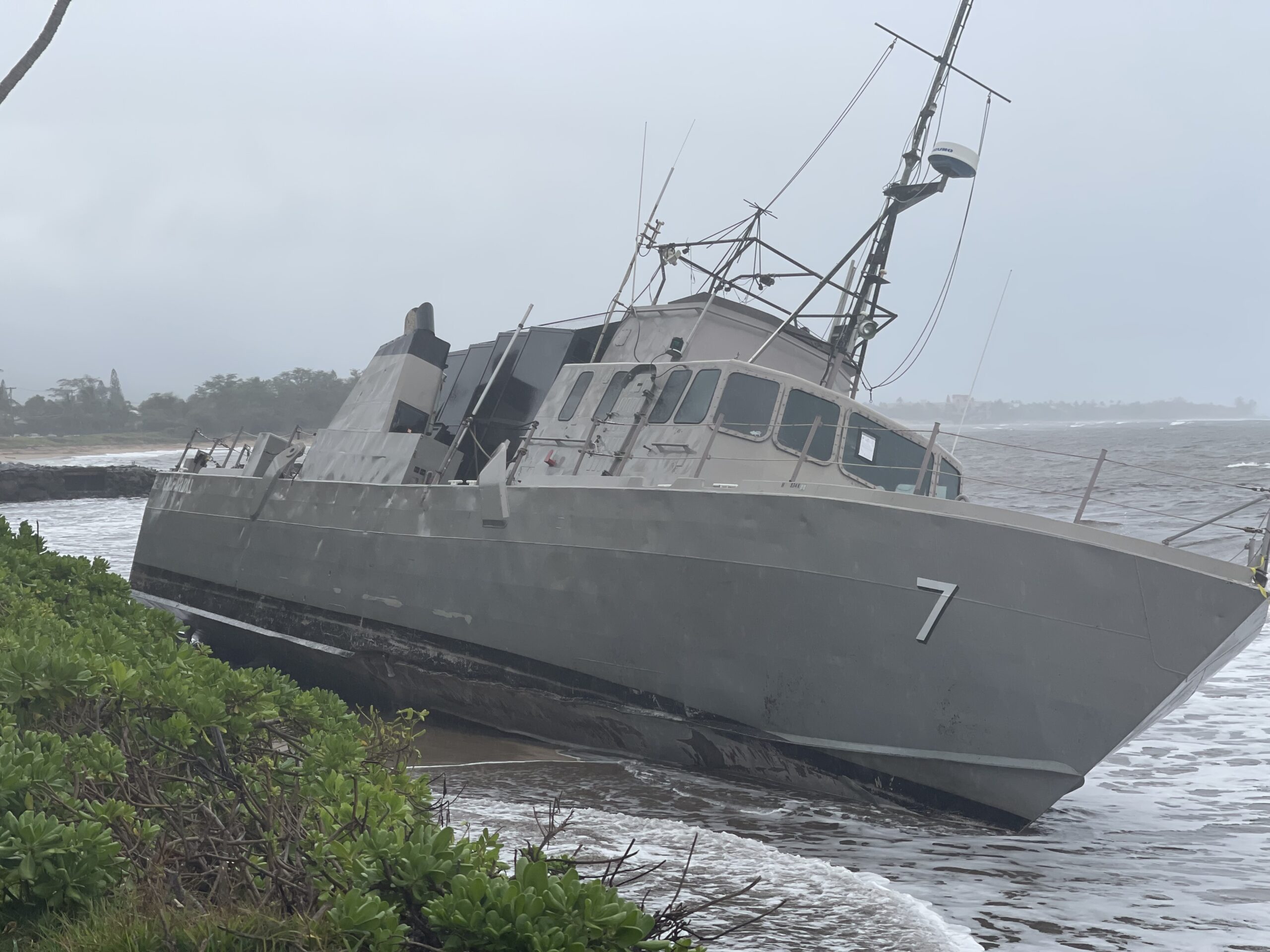
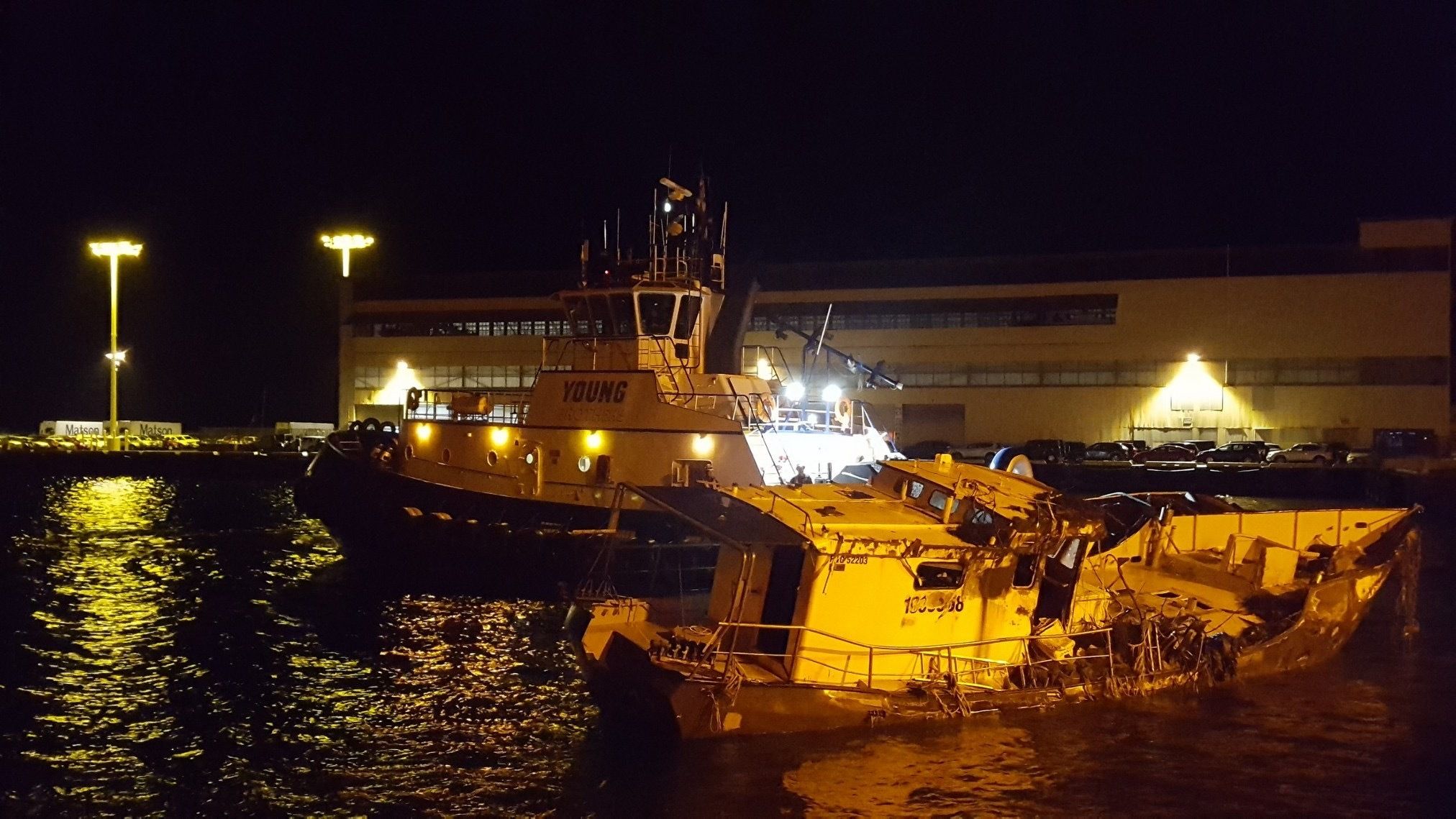
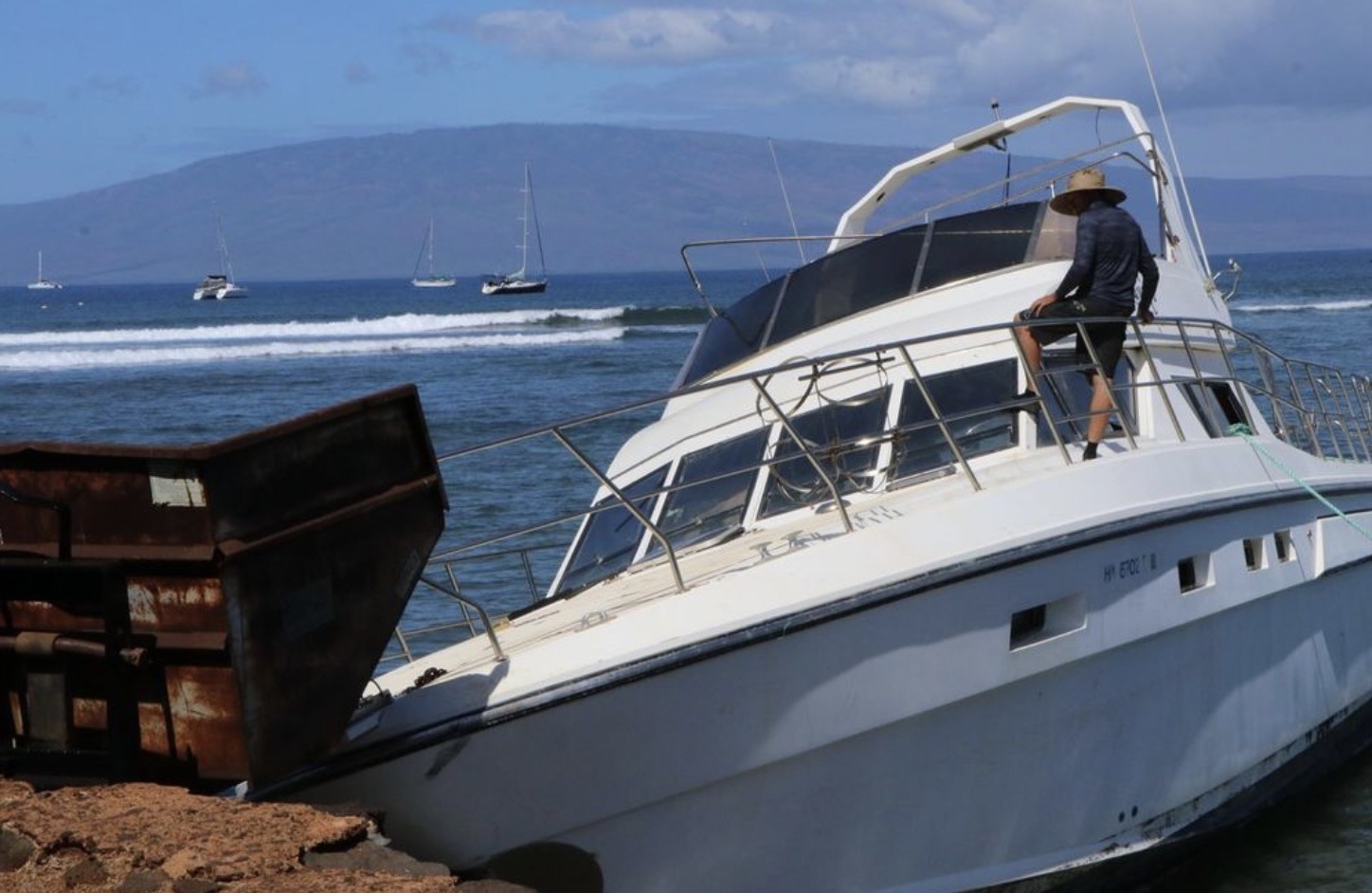
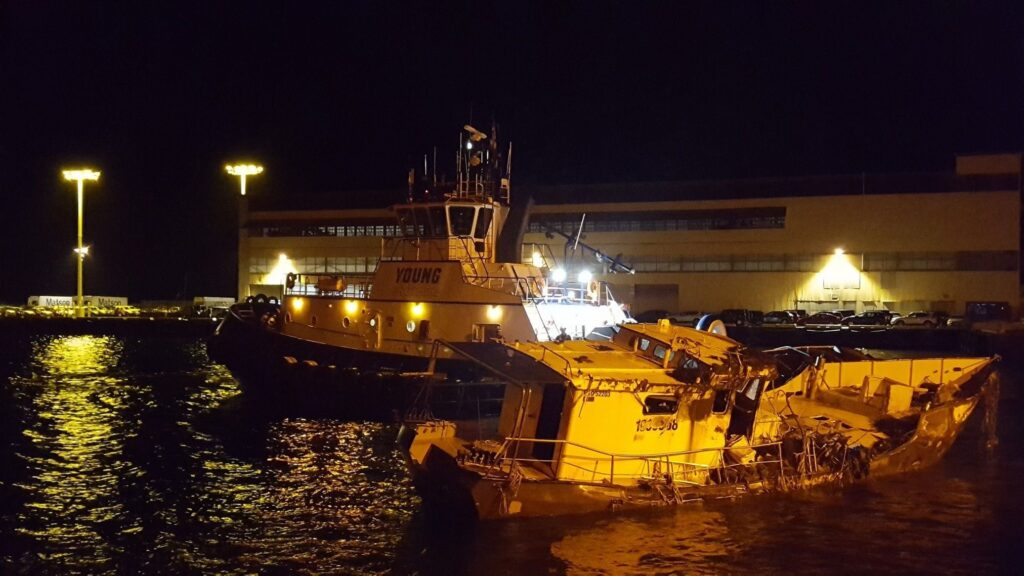
Early on the afternoon of November 9, 2022, a 77-foot-long former minesweeper berthed for two years at the Ala Moana small boat harbor began taking on water through a six-inch hole in its hull.
No one was on board the vessel, Princess Moana, at the time, according to a report of the Department of Land and Natural Resources’ Division of Boating and Ocean Recreation, which manages the harbor and which had become aware of the problem soon after it developed.
That evening, both the Coast Guard and the Honolulu Fire Department responded to the distressed vessel, placing pumps on board and attempting to contain any fuel.
By the afternoon of November 10, DOBOR reported speaking with someone on board who said the leak had been plugged, but as soon as the water was removed from the hull, the plug failed. That evening, the Princess Moana lay on the harbor floor.
On November 14, DOBOR staff asked the owner, Patrick Londo, for his plan of action. The next day, Londo reported that his insurer told him to do what needed to be done “and they will see what they can do in the end,” according to an agency account. A week later, Londo told DOBOR that the salvage companies he had contacted require money up-front. A letter DOBOR sent to Londo that recited the history of events reported him telling the agency that he did “not have the financial means to pay in advance.”
A few days later, Londo told DOBOR staff he was hoping to get a crane down to the harbor to raise it.
That never happened. Instead, the Princess Moana stayed where it lay for three more years.
Finally, last summer, DOBOR contracted to have the ship raised and removed to the dry lot at the Keʻehi small boat harbor, where it was to be destroyed.
The cost: $350,383. That doesn’t include the lost income from having slip 664 out of use for the duration – it had been rented out to the Princess Moana for more than $1,000 a month. Nor does it begin to account for the way in which the sunken vessel contributed to the overall derelict appearance of Ala Moana harbor. Although Londo had insured his boat for $500,000 in “watercraft liability,” the state recovered nothing.
DOBOR’s removal of the Princess Moana is not the only, or even the most expensive, salvage it has paid for in recent years. That title goes to an 85-foot former Navy weapons retrieval vessel, Chaparral.
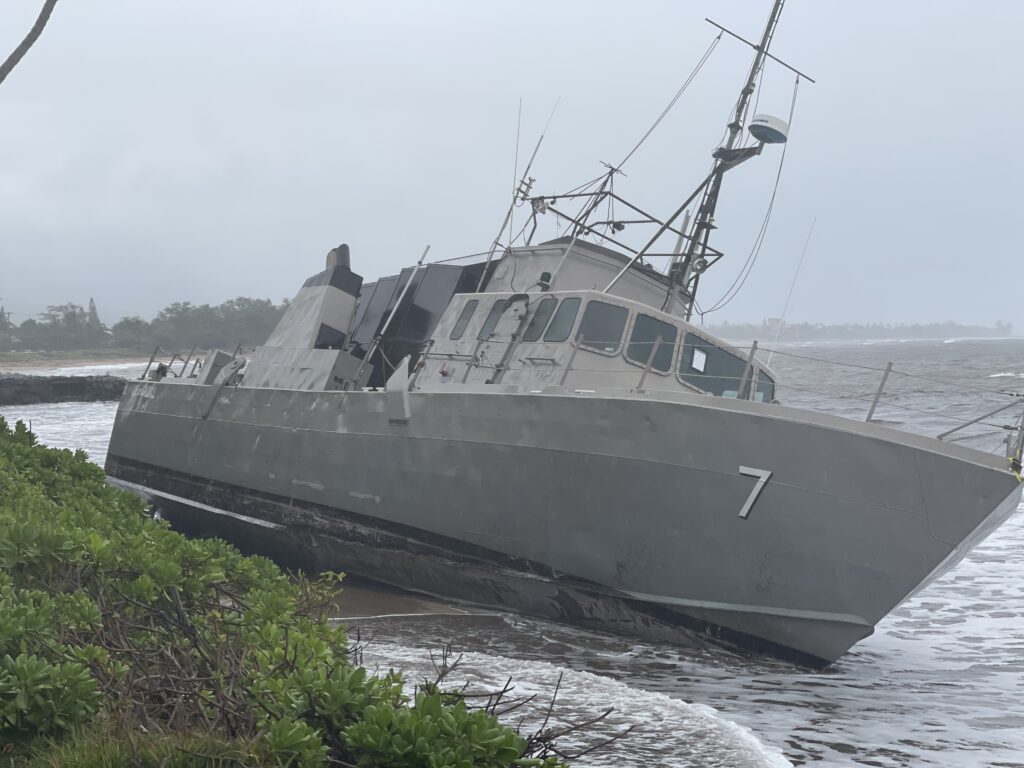
In October 2020, the vessel was sold as surplus for $17,500 to Justin Moore, also known as Justin Aoki. Before the year was out, Moore had arranged to berth the vessel at the Ko Olina marina, agreeing to pay more than $2,000 in monthly rental fees.
Two years later, after a history of late payments and delinquencies, the marina sued Moore to recover what he owed and also to force his boat out of the marina. The litigation took nearly a year, but finally, in August 2023, the court was informed that Moore had agreed to pay $29,692.58 to settle his delinquent account, with the Chaparral to be out of the marina by August 8.
For the remainder of the year, the Chaparral was a sort of Flying Dutchman around the islands. By late December, now outfitted with a hot tub on its stern deck and a retractable canopy, it was moored off the Kihei coast.
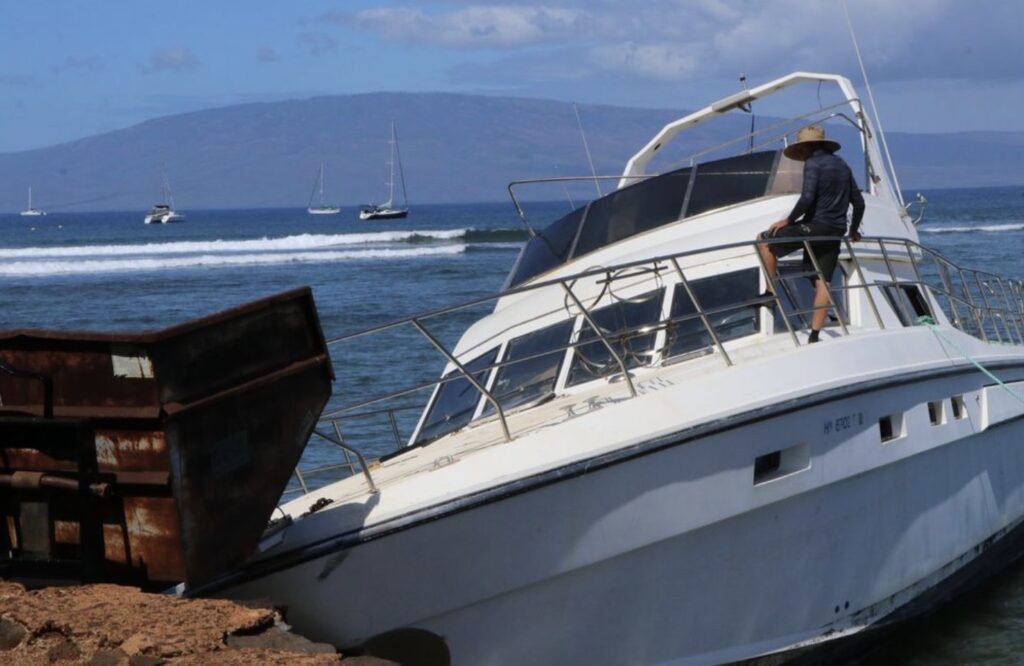
On January 8, 2024, a Kona front moved in. Strong winds and heavy rains blew onshore of Maui from the south and west. The next day, with no one aboard, the Chaparral broke free of its mooring and ran aground off Sugar Beach just north of Kihei. The Coast Guard responded early on January 10, deploying a boom and removing fuel.
Once the emergency response was completed, and with Moore having walked away from the problem, it was left to the state to pay to have the Chaparral removed from the shoals. The salvage contract cost DOBOR $841,830.
Just two months earlier, another vessel owned by Moore, a two-masted 50-year-old fishing boat, the Ka Imi Kai, ran aground in the same area. The boat broke loose from its anchor in Maʻalaea Bay and drifted more than a quarter mile before grounding on Sugar Beach.
The boat was moored illegally at Maʻalaea, according to Dan Dennison, at the time communications director for the DLNR. “He owes the state money so he hasn’t been able to obtain a permit,” Dennison said.
For removal of this wreck, the state was left holding the $97,000 tab.
Moore reimbursed the state nothing, according to the DLNR. He did, however, offer an apology on KITV News.
A Toothless Law
Since 2020, the Division of Boating and Ocean Recreation has spent more than $3 million from the Boating Special Fund to pay for the removal of grounded private boats, according to summary records of contracts maintained by the state Procurement Office. Over and above that, DOBOR has paid contractors nearly $1.3 million to remove abandoned and impounded boats at the state’s small boat harbors.
The agency may have recovered some part of that from vessel owners or their insurers, but, according to a recent report from the Office of the Auditor, it has no way of tracking this. In light of the auditor’s findings, it seems unlikely that any significant recovery has been made. The report, published in February, found that the agency puts minimal effort into attempts to collect from owners of grounded vessels.
The audit was undertaken last year to determine the impact of a law, Act 94, passed by the 2019 Legislature that requires owners of vessels 26 feet in length or longer to carry at least $100,000 in insurance “in a form and content to ensure that removal and salvage of a grounded vessel are covered” and to provide the department with proof of coverage.
The law has had little effect. According to the audit, the division “has done little to hold owners responsible for the costs that the department paid to remove and salvage their vessels, both before and after Act 94.”
The report notes that from the outset, the division was vague as to the purpose of the legislation. “The risks DLNR was trying to address through the insurance requirement are unclear,” it states. “DOBOR’s testimony in support of HB 1033 as well as DOBOR’s explanation to us — by both the former and current division administrators — reflect a confusing myriad of concerns, not all of which relate to the risk of vessels grounding in state waters and, more importantly, not all of which are likely addressed by the insurance required” under the law.
As explained in the report, one of the original goals was to require owners of trailered boats to be insured against damages their vehicles and vessels caused to facilities such as ramps, poles, and utilities at state-owned boat launches. But it soon became focused on allowing the state to recover costs of groundings.
Testimony from Suzanne Case, director of the DLNR at the time, said, “Since 2002, the department has recorded 373 vessels, either grounded, sunk, or abandoned, that it would have been responsible for. Of those 373 vessels, the department’s Division of Boating and Ocean Recreation removed 91 vessels and expended $2,263,440.45 from the boating special fund to address the 91 vessels because the vessels were uninsured.”
Case supported requiring $500,000 insurance of all boat owners, which, she said, the state’s Risk Management Office had estimated would cost vessel owners about $1,000 a year.
By the time House Bill 1033 passed into law, the minimum insurance had dropped to $100,000, and it was to be imposed only on owners of vessels 26 feet in length or longer and to any vessel owner who had a history of vessel grounding. The length requirement was imposed, the DOBOR administrator told the auditor, “because a then-legislator’s family members owned boats under 26 feet in length.”
The audit continues, noting that the former DOBOR administrator — Ed Underwood, not named, but in the job until July 2025 — said the length restriction “significantly diluted DOBOR’s intent.” The trailered vessels, which DOBOR wanted to be insured against damages to DOBOR facilities, did not really need insurance against groundings, he was reported to have said. “In reality, DOBOR rarely got involved in groundings of trailered vessels because those boats are small,” the audit states. “They go around Kaneʻohe Bay, end up on the reef flats, and they just get a tow back to the harbor and they put it back on the trailer,” he was quoted as having told the auditor.
The contract summaries Environment Hawaiʻi was able to review bear that out. Not every record of every contracted salvage operation posted on the HANDS website includes vessel length, but of the five dozen or so salvage contracts issued since Act 94 took effect, at least 35 were to deal with vessels that should have had insurance against grounding. The total payout for these salvage operations came to $2,634,253, while payouts for recovery of vessels that were shorter or for which no length was provided came to just $511,655.
Legal Liability
Regardless of Act 94, owners are legally liable to repay the state any expenses associated with addressing grounded vessels. The state’s “Vessels aground” law, Section 200-47.5, states, “All vessels grounded on state submerged lands, shorelines, or coastal reefs shall be removed immediately by the owner or operator at the owner’s or operator’s expense.”
The law goes on to state that the DLNR “may immediately assume control of any vessel that is grounded,” but “[a]ll costs and expenses related to removing the vessel and damage to state or private property shall be the sole responsibility of the vessel’s owner or operator. The department may take legal action to collect any costs or expenses incurred by the department.”
Liability is also expressly provided for in another section of the law limiting private use of state waters, HRS Section 200-6. That bans the sinking of any watercraft or other “sizeable object” in streams or the ocean. “If any person fails to remove the same within the time limit set by the department, the department may effect the removal and charge the person with the cost thereof. The department may enforce compliance with this section by the use of any appropriate remedy, including, but not limited to, injunction or other equitable or legal process in the courts of the state.”
DOBOR rule §13-234-20, Salvage fee, also provides for owners of salvaged vessels to reimburse the department “for services and materials based on prevailing commercial rates plus ten percent.”
Finally, DOBOR’s Harbor Tenant Handbook states that tenants are required to have a minimum of $500,000 in boat liability insurance, naming the state as additional insured, and, taking note of Act 94, adds that boats 26 feet and greater in length need to have at least $100,000 in insurance. “To acquire and maintain a mooring permit in a DOBOR facility and operate your vessel in state waters, a permit holder/vessel owner must satisfy both insurance requirements,” the handbook states. “Be sure that your insurance policy covers the ($500,000) minimum to satisfy the mooring permit requirement AND the ($100,000) minimum to ensure removal and salvage of your grounded vessel or you will be held responsible for the cost of removing your vessel if it is left in state waters. You should not assume a $500,000 policy (for protection and indemnity) also covers removal and salvage.”
Relaxed Enforcement
Despite the strong language in the law, rules, and handbook, DOBOR generally takes a relaxed view of the requirements, according to the audit.
Neither the administrator nor the acting assistant administrator knew how many of the vessels DOBOR has paid to remove and salvage were 26 feet or more in length, the audit states. “Without an automated process to generate the information, DOBOR would have to manually compile the data,” the audit says the administrator acknowledged. “The administrator said that she didn’t know if DOBOR could figure that out: ‘We don’t have the staff to do that.’”
Efforts to make vessel owners reimburse DOBOR are minimal, per the audit: “We found DOBOR’s efforts more akin to an honor system than a collections process: upon receiving an invoice from the contractor that addressed the grounding, DOBOR sends a single demand letter to the vessel owner, which generally returns unclaimed, we were told. ‘That letter is sent to the individual, and 95 to 99 percent of the time, it is not recoverable. … We don’t see any funds coming back.’ The administrator told us the division will not send another letter … unless the division is provided with a new address.”
A redacted copy of a demand letter sent to the owner of a vessel that grounded off the Ala Wai harbor in February 2025 is included in the audit. It bears the date of May 20, more than three months after the grounding, and seeks the actual cost of the removal ($18,155.75) plus $916.70 owed for the time the vessel was moored without a permit.
The letter concludes: “[A] report of your delinquency with the division will be submitted to the Attorney General’s office and/or a collection agency.”
“That appeared to be a toothless threat,” the audit notes, “given that, at the time of our audit, DOBOR was not using a collection agency and, as we were told, the Department of the Attorney General is unwilling to pursue collection actions against vessel owners to recover DOBOR’s costs. ‘We have not had a way to capture funds that we’ve expended,’ the administrator said.”
Notwithstanding the laws, rules, and handbook advice, and ongoing payouts to salvage wrecked vessels, DOBOR does not enforce any insurance requirement. The audit reports: “The Acting Assistant Administrator, who oversees vessel registration, told us that, since 2021 or 2022, DOBOR had stopped requiring evidence that an owner had the insurance required … as a condition of registering a vessel. According to the Acting Assistant Administrator, insurers were not wiling to provide the coverage: ‘[T]here’s nothing out there in the insurance market that people can go to in order to comply with the law,’” the audit reported the official as saying.
Yet the auditor discovered that vessel registration staff on neighbor islands “said they continued to ask for proof of the required insurance as a condition of registration – and apparently owners are providing them with something that is acceptable evidence of that insurance.”
As far as the availability of insurance goes, the audit reports that DOBOR was informed that insurers “would not provide salvage coverage of $100,000 if a vessel is worth less than that amount; more specifically, according to DOBOR, the amount of salvage coverage is limited to 10 percent of the hull value, meaning a vessel must be valued at $1 million or more to obtain the required salvage coverage of $100,000.”
This severely limits the availability of insurance, the auditor notes, since “only a very small percentage of the nearly 14,000 vessels registered in Hawaiʻi are worth $1 million or more. The former administrator estimated that about 80 percent of the registered vessels, including those moored in the small boat harbors, are ‘borderline. I mean they’re junk,’ he explained.”
A Response
Then-acting DLNR director Ryan Kanakaʻole responded to the audit with something less than full-throated endorsement. Addressing the finding that DOBOR was unaware of how much it was paying to address grounded vessels when it proposed salvage insurance in 2019, Kanakaʻole says this is only “partly accurate.” Referring to a “grounded vessel report,” which is cited in the audit but which is not publicly available, Kanakaʻole stated that this report “tracks the total cost” paid by the Boating Special Fund in dealing with grounded vessels. “If an amount is reimbursed in full, it will be reflected in the grounded vessel report,” he writes, but this report wasn’t intended to function as “a net-cost accounting tool or track outstanding balances for each incident.”
“The absence of a single consolidated report should not be interpreted as a lack of awareness regarding the fiscal impact of grounded vessels, but rather as a limitation of a legacy accounting system.”
As to the finding that DOBOR “makes little effort to recover its salvage costs,” Kanakaʻole says the department “respectfully disagrees with the framing of this finding and believes it reflects a myopic assessment that insufficiently accounts for DOBOR’s statutory responsibilities. … Without prompt state intervention, these grounded and sunken vessels would likely remain in place for an extended period of time, constituting a hazard to vessel navigation in ocean waters, adversely impacting public health and safety, and adversely affecting the wellbeing of natural and cultural resources.”
“That said,” Kanakaʻole concludes, “the department acknowledges that additional efforts could be taken to strengthen cost recovery practices. … To this end, we have begun developing a plan for pursuing collections … including evaluating the feasibility of working with the Department of the Attorney General and/or procuring collection services applicable across divisions.”
And a Rebuttal
The Office of the Auditor responded to Kanakaʻole’s comments, writing: “We disagree with the department’s comments, most of which are directly contradicted by statements made to us by DOBOR management and staff.”
Among other things, Kanakaʻole’s statement that any reimbursements DOBOR receives is reflected in the Grounded Vessel Report “contradicts the DOBOR administrator and acting assistant administrator. They told us that the purpose of the Grounded Vessel Report was only to track groundings and that the report did not correlate to whether vessel owners had paid DOBOR.”
The audit also takes issue with Kanakaʻole’s blaming a “legacy accounting system” for the agency’s failure to track payments and reimbursements. “That statement is patently inaccurate,” the audit states, “and seemingly ignores both the department and division management’s responsibility to prevent the unnecessary depletion of the Boating Special Fund and waste of public resources.”
Then there was Kanakaʻole’s comment that underlying financial data existed even though there might not be a “management-level summary report.” This too the audit described as misleading. “DOBOR management did not know the net amount that DOBOR paid to remove and salvage grounded vessels, did not know whether a boater repaid DOBOR, and did not know whether an insurance mandate was needed. Contrary to the department’s statement, DOBOR simply does not know whether the Boating Special Fund, its primary funding source, is being depleted, unnecessarily, to address groundings.”
The audit concludes: “We do not fault DOBOR’s use of the special fund to address grounded vessels; we determined that DOBOR is not sufficiently protecting the Boating Special Fund because of its limited efforts to pursue collection of amounts it paid to remove and salvage a grounded vessel from the vessel’s owner.”
Into the Weeds
Online, DOBOR has posted quarterly revenue and expense ledgers since the first quarter of fiscal year 2026 (starting July 1, 2025). According to the FY 2025 report, vessel removal expenses totaled $1,326,141 for the four quarters. If the agency received any income to offset that – funds, that is, recovered from vessel owners reimbursing DOBOR the salvage costs – it is not logged as such. There is no line in the ledger for that. If that income is logged as “misc. non harbor” revenue, it amounted to just $15,413 for the entire year.
For the first three quarters of FY 2026, vessel removal expenses came to $257,352, according to the posted financial ledgers. Yet according to the record of contracts issued for vessel salvage, a single contract for multi-vessel removal of abandoned vessels on Oʻahu, issued January 7 of this year, exceeded that amount, coming in at $296,980. Contracts issued for salvage of grounded vessels in the same period came to $571,515. Adding these together, for the first three months of FY 26, DOBOR contracts posted on the state HANDS website that relate to salvage of grounded and abandoned vessels amounted to $868,495, more than three times what DOBOR posted in its ledgers.
In the first two and a half months of the fourth quarter of FY 26, DOBOR issued an additional $108,230 in three salvage contracts, bringing the total for the fiscal year as of press time to $976,725.
In contrast to the 2026 records, where contracts posted on the state website exceed in value the amount reported on the DOBOR ledgers, expenses related to vessel salvage in 2025 as reported on the DOBOR ledgers far exceed the contracts reported on HANDS.
Per HANDS, contracts issued for salvage and multi-vessel removal came to $508,327 that year. Per DOBOR, total vessel removal costs for the same period totaled $1,326,141.
There may be a good explanation for the discrepancies. Sometimes contracts can be let in one quarter and not be paid for until much later. For example, work on a contract issued May 1 for removal of a vessel that grounded off Wahikuli Park in West Maui was still ongoing as of press time. According to DOBOR staff, as related by the DLNR’s Communications Office, “the contractor is currently working on obtaining the necessary county permits. The contractor is unable to start until they have those in place. DOBOR has followed up with the contractor and Maui County and asked to expedite permits.”
As noted earlier, the audit referred to a “Statewide Grounding Report” maintained by DOBOR, which reportedly has data going back to 2014 on the number of vessels grounded and the respective costs to DOBOR. As reported in the audit, in that time frame, around 130 vessels less than 26 feet in length grounded in that 12-year period, while 216 vessels 26 feet and longer grounded. The cost to DOBOR was reported as $184,900 to deal with the smaller vessels, but $1,784,000 to deal with the larger ones.
Environment Hawaiʻi filed a formal request for information to obtain the Statewide Grounding Report, but it has not yet been provided by the DLNR.
Yet the completeness of the report, as shown in the audit, has to be questioned. According to data posted on the HANDS website, in the period 2020 through 2025, contracts issued for salvage of individual vessels came to $2,992,747, with $2,431,421 of that paying for grounded vessels 26 feet in length or longer. This does not include $988,691 in contracts issued over the same period for disposal or removal of abandoned or impounded vessels. Adding up the reported contracts for dealing with grounded, abandoned, or impounded vessels, all drawing from the Boating Special Fund, DOBOR paid $3,981,430 in this six-year period.
That amount, nearly four million, is more than double the total of $1,978,900 reported in the Statewide Grounding Report for the 12-year period of 2014-2025.
The Boating Special Fund receives revenue from a wide variety of sources: mooring fees, commercial permits, percentage rents, ramp fees, fuel taxes, parking fees, vessel registration, cruise ship revenue rental of land at small boat harbors, to name a few.
According to DOBOR’s ledgers for the last couple of years, its annual revenue regularly tops $20 million. Yet in 2025, its expenses exceeded income by $2,496,187. More than half of that deficit is attributable to vessel removals.
The details of contracts reported to the state Procurement Office versus the data posted in DOBOR’s ledgers would seem to support the auditor’s statement: “DOBOR simply does not know whether the Boating Special Fund, its primary funding source, is being depleted, unnecessarily, to address groundings.”
— Patricia Tummons
Gene
Sometime in the mid 1950’s I met a guy in CA who had just then fled HNL because he was taking a boat out of the harbor, the engine failed, the boat sunk in the channel, he got on a plane that night to SFO. So, this is an old story, and I supposed ultimate responsibility rest with the Boating Branch (and State gov in general) to check all moored boats periodically for sea-worthiness, etc. But, maybe when issuing licenses, the State needs real financial proof of liability insurance, and maybe that is a large cash deposit to the state. These pirate boaters have been getting away with too much for too long. Why is the State so lax? Why is Hawaii seen by these pirate boaters as a safe haven?