
Last month, when Ayron Strauch, hydrologist with the Commission on Water Resource Management, was giving commission members a summary of water use applications received, he described the challenges. Applications were not uniform. End uses were not well matched with sources.
“It gets fairly complicated quickly,” he admitted. “I will say in some situations we were quite surprised with the applications, particularly in Kapalua.”
Although Strauch promised to return to the issues in Kapalua “in a second,” he never turned back to address it in his presentation.
But Environment Hawaiʻi did take a close look at the data for just one Kapalua subdivision, Honolua Ridge, served by Hawaiʻi Water Service, which distributes potable and non-potable water to Kapalua.
With the caveat that the figures provided by the utility are such that they generated “surprise” among CWRM staffers, here’s what those figures show:
Vacant lots in Honolua Ridge sell for millions of dollars, and lots with houses are offered at prices several times that. Monthly homeowner association fees are in the range of $1,500.
Phases I and II of the subdivision have 41 house lots ranging in size from about three to under nine acres. There are several larger lots of 15 acres or more, plus a 231-acre lot held by Maui Land & Pineapple at the very top of the long and narrow development and small lots for roads and utilities. Excluding those, the total acreage of the house lots comes to 202 acres.
According to a report prepared by CWRM staff, this subdivision accounts for around 39 percent of the daily potable water demand of the entire Kapalua community. Table 11 in the report shows that the subdivision has 89 meters, but the list of meters in a separate appendix shows just 40 meters for the whole subdivision. Six of the house lots and six of the larger lots are apparently unmetered. Also, the meters listed are for potable water only. There does not seem to be a separate list of meters for non-potable water.
The groundwater and surface-water use permit applications don’t show the number of meters a given lot may have, but they do purport to show the total potable and non-potable (surface) water demands for each discrete property identified by tax-map parcel number.
The Lots with Houses
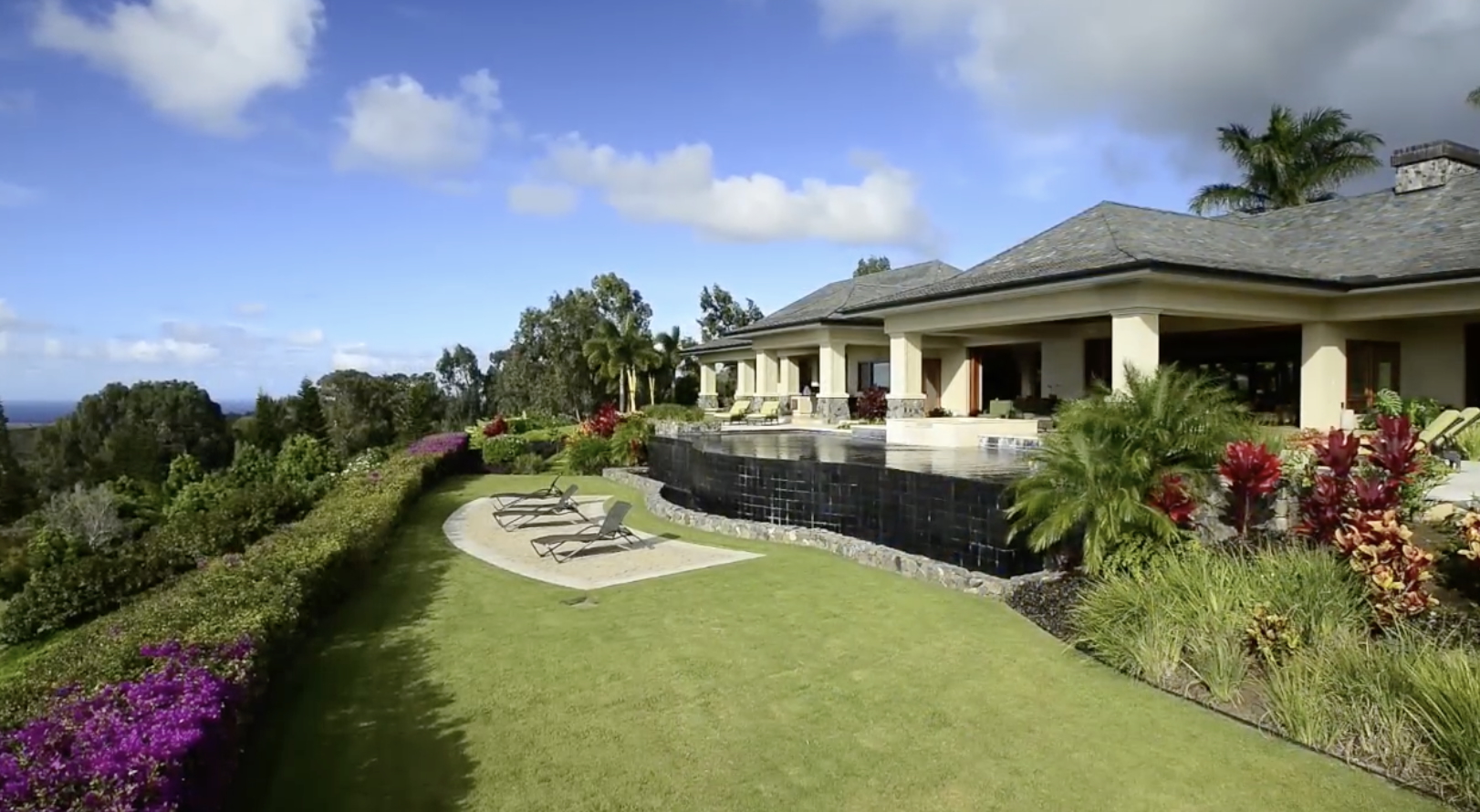
Environment Hawaiʻi added up the reported water uses for each house lot in Honolua Ridge and found that the average daily potable-water use, including vacant lots as well as those with houses, came to 71,716 gallons, or 5,794 gallons per lot. The total surface-water use (non-potable) for the house lots came to 112,389 gpd, for an average of 2,741 gpd per lot.
Eight of the lots are shown on tax records as being owner-occupied. All have houses, with four of them having smaller second residences built or in the process of being built. Those lots have main houses that are on average more than 5,760 square feet. The four smaller dwellings are around 1,000 square feet each.
Total average potable water consumption for the owner-occupied homes comes to 514 gallons per day. Average non-potable use is eight times that, or 4,137 gpd. Total daily water use for just these eight lots comes to 37,217 gallons, or 4,652 total gallons per day per owner-occupied house lot.
The average size of the main houses on the non-owner-occupied lots is 4,185 square feet — still large but somewhat smaller than the average owner-occupied house. Using the information provided by Hawaiʻi Water Service (HWS) in its applications, the water consumption for each of the lots in this category averages 426 gallons per day – a figure that is almost certainly low, given that for four of the 12 house lots, the potable-water use application provides figures that are either missing (in one case) or unlikely (in the case of three others, where potable water use is reported as 19 gpd, 16 gpd, and 5 gpd). Excluding those four lots, average potable water use by the non-owner occupied lots comes to 640 gpd.
Non-potable water supplied to the 10 non-owner-occupied lots with houses comes to a total of 57,590 gallons per day. Excluding two properties for which HWS provided no or improbable numbers, average use is 7,186 gallons per day, non-potable water. Average total water use, potable and non-, comes to 7,826 gpd for lots with homes that are not owner-occupied.
Adding up potable and non-potable uses reported by HWS for the lots with houses, both owner-occupied and non-owner-occupied, the total comes to 99,827 gallons per day. That’s an average consumption of 4,991 gallons a day of potable and non-potable water for each lot where residences have been built.
The Vacant House Lots
Twenty-one Honolua Ridge house lots are vacant, according to county property tax records. HWS reports these lots use a total of 62,489 gallons a day of potable water and an additional 21,800 gpd of non-potable water. The total water use – 84,289 gpd of ground- and surface water – approaches the usage of the 20 lots that have houses built on them.
The HWS figures of water use on vacant lots suggest that these could be place-holders for future use rather than reflective of current demand. Thirteen of the vacant lots are reported to have consumption rates of 940 to 950 gallons per acre per day, with a fourteenth reporting a per-acre consumption rate of 600 gpd. These fourteen lots account for a total potable water use of 62,489 gpd on average. Five of the vacant lots are owned by Honolua Ridge I RE LLC of Colorado. No surface-water use is reported for any of these 14 lots.
One lot shows no usage of either potable or non-potable water.
Six vacant lots are reported to use only surface water, with consumption ranging from as low as 1,093 gallons per day to as high as 5,076 gpd. Total non-potable water usage for these six lots comes to 21,800 gpd.
Challenged Numbers
In advance of the November 18 CWRM meeting, one of the residents of Honolua Ridge, Michael Gronemeyer, brought the utility’s misinformation to the attention of the commissioners.
“I focused on the 103 homeowner lots and 5 roadway lots in my neighborhood,” he stated, “because I am very familiar with those lots….
“I was shocked to see the amount of disinformation, errors and omissions still existing in the material provided for these TMKs. The information represents a high degree of inaccuracy with a major impact on outcomes.”
According to Gronemeyer, “over 85 percent of the groundwater usage shown for these TMKs is ‘projected usage’ and is not consistent with actual usage. These erroneous assumptions were spelled out in the notes in the HWS material and apparently accepted without question.”
“Based on what I have seen so far (an error rate approximating 50 percent) I regret to say that the data CWRM is presenting at this time has very little credibility. If this is even remotely representative of the full set of data, this is appalling.”
Also disputing the HWS data is John Stufflebean, the director of Maui’s Department of Water Supply and a homeowner in Honolua Ridge.
According to HWS, Stufflebean and his wife, owners of a 3,532-square-foot home with a pool and jacuzzi, use just 74 gallons a day of potable water. Consumption of non-potable use comes to 6,887 gpd.
But in response to a question about his use, Stufflebean says these figures are incorrect. “I have a potable meter and a non-potable meter,” he told Environment Hawaiʻi.
According to Stufflebean, based on his monthly billings over the last two years, “I used 210,000 gallons plus 310,000 gallons, or 520,000 gallons. You divide that by 730 days, and you get 722 gallons per day.
“Assuming my household use is 144 gallons per day, my outdoor use is 578 gpd, or 192 gallons per acre per day.”
He added, “Since I bought the house, I have removed over half of the grass (turf). I have been planting edible plants and crops. I water as efficiently as I can. The watering is needed for fire prevention. (It also provides a greenhouse gas benefit, of course.)”
— Patricia Tummons