
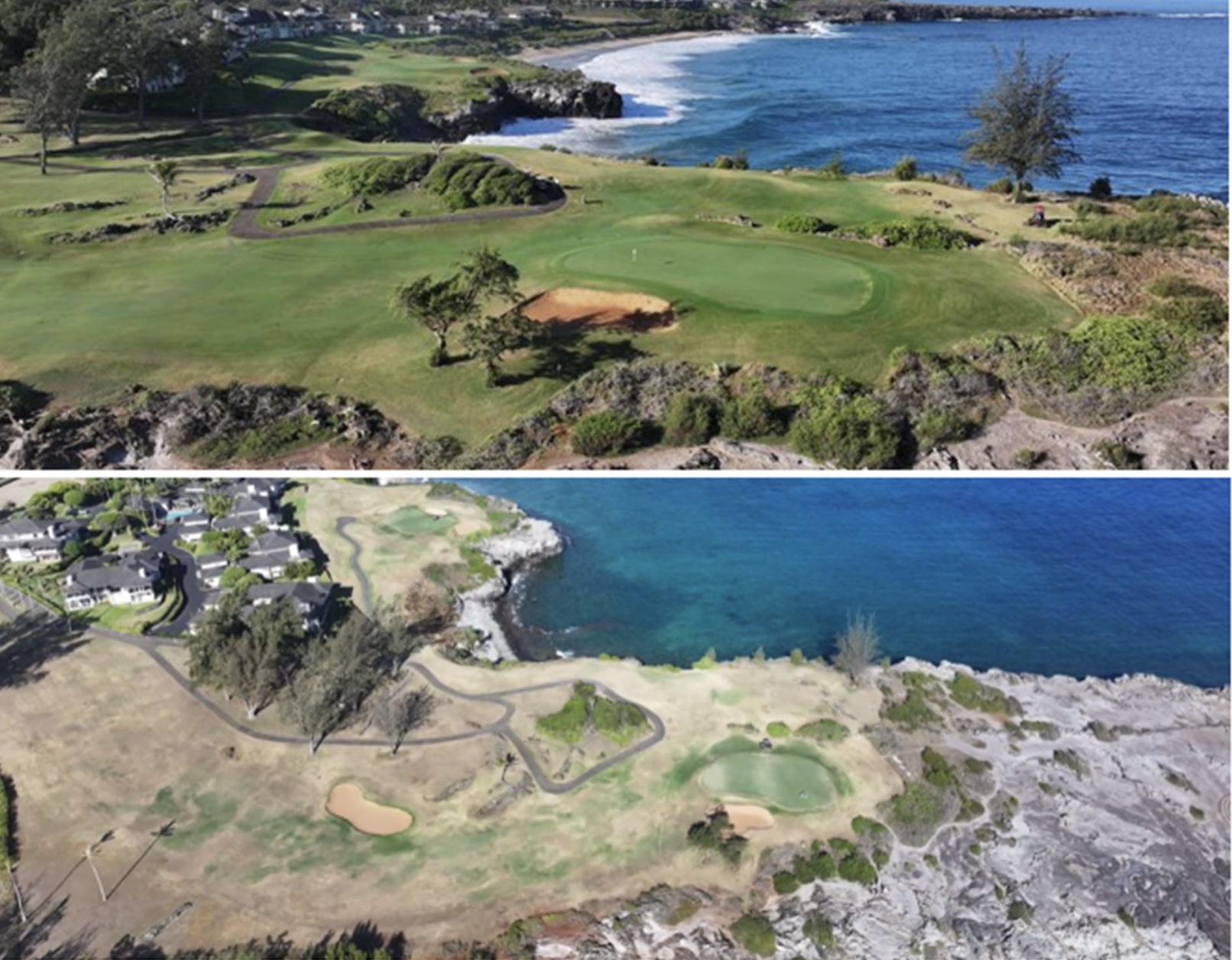
The allocation of water in west Maui is a complicated issue. In 2022, the state Commission on Water Resource Management voted to designate both stream and surface waters as management areas, with all existing and new users required to apply for water use permits – a process that is still ongoing, with no permits issued to date.
The Public Utilities Commission is involved as well, with an open docket in which the owner and operator of the two Kapalua golf courses – TY Management – seeks to require Maui Land & Pine to be regulated as a water service utility.
Now the courts are involved. On August 18, TY Management, associations of owners of homes in Kapalua, and Hua Momona Farms, LLC, collectively sued MLP in 2nd Circuit Court. They allege that MLP has been negligent in managing the legacy ditch system that supplies their irrigation water, breaching its legal obligations to them and causing them real harm.
Or, as the complaint states, “the Honokohau Ditch System, on which residents, farmers, and businesses in Kapalua and parts of West Maui all depend, is owned by an often-struggling, once-nearly-bankrupt, former plantation company. … MLP is doing a terrible, actionable job of complying with its responsibilities. … This must stop; water users cannot bear MLP’s incompetence any longer.”
Representing TY locally is the firm of Lung Rose Voss & Wagnild, as well as the Washington, D.C., firm of Perkins Coie, recently in the news as a result of being targeted by Donald Trump for having represented Hillary Clinton’s campaign in 2016.
Among other things, the lawsuit alleges that MLP is not abiding by its agreements with the plaintiffs to distribute water in a “non-discriminatory fashion.”
For most of the last year, the users of non-potable water supplied by MLP have been under restrictions, including, for much of the time since March, “Tier 4” restrictions, allowing water to be used only for fire-fighting purposes.
“As of the filing of this complaint,” the lawsuit states, “plaintiffs last had access to water for irrigation on July 24, 2025.”
Yet “simply looking at properties owned by MLP, as well as at properties like the Ritz-Carlton, Kapalua, reveals grounds that are lush and green. Those properties must still be receiving water, even though there has been no allowable use of irrigation water since July 24, 2025, for any of Kapalua’s businesses or residents,” the complaint states.
“Thus, MLP is not reducing irrigation water for existing users in Kapalua in a ‘nondiscriminatory manner’ as required by the water delivery agreements.”
TY alleges substantial financial harm as a result of curtailed water delivery. Because of the deteriorated state of the golf courses, the complaint states, “TY has had no choice but to reduce the rate it charges,” from $279 to $99 at the Bay Course, and, at the Plantation Course, from $469 to $199. In addition, it says, “Due to the deteriorating condition of the courses, TY also expects that it will have no choice but to imminently close the courses.” In addition, it states that should the water not be restored to the courses, the PGA might decide to cancel its 2026 The Sentry tournament in Kapalua, scheduled to be held in early January. According to the lawsuit, this event “generates more than $48 million for Maui’s economy, supporting small businesses, local jobs, and nonprofits.”
As for the other plaintiffs, they, too, allege that MLP has been negligent in maintaining its water delivery system and has breached its agreement with Hawaiʻi Water System, the purveyor that purchased MLP’s water and wastewater services in 2021. As HWS customers and “third-party irrigation water users,” they have also experienced harm by MLP’s curtailment of irrigation water, they state.
MLP had not filed a response to the complaint by the time Environment Hawaiʻi went to press.
Meanwhile, Courses Closed
In late August, TY announced it would, indeed, be closing both courses to play, starting September 2. The closures are expected to last at least two months.
In mid-July, Hawaiʻi Water Service, the privately owned utility serving Kapalua and other communities statewide, announced it would be lifting Tier 4 restrictions – the most restrictive, prohibiting all irrigation – in light of weather forecasts calling for rain. Tier 3 restriction allowed for irrigation at levels up to 40 percent of normal. By July 4, Tier 4 limits were in place once more, prohibiting all irrigation with non-potable water.
On August 23, the company announced that the Commission on Water Resource Management “has allowed the temporary use of groundwater as a substitute for surface water during low (stream) flow periods, pending commission action on Hawaiʻi Water’s water use permit application.
“Due to the above confirmation, we will be lifting our Tier 4 water conservation requirement and moving into a Tier 2 water conservation status, or 40 percent reduction of normal water use. We will be allowing non-potable water irrigation at Tier 2 until further notice.”
By August 29, the company said that, based on its meter readings, the restrictions were not being observed by all customers. “Unfortunately,” it said, “if customers do not immediately observe the conservation guidelines, we will be required to restrict irrigation to zero usage until the reservoirs can be refilled.”
Two days later, with ongoing non-compliance, the company issued the following announcement: “Due to serious drought conditions, we are currently in the Tier 4 stage of conservation, which restricts ALL non-potable outdoor irrigation to zero usage. In order to provide adequate water supply for fire protection, we will interrupt the flow of water to any property that is not in compliance.”
Before the PUC
As Environment Hawai‘i reported in May, TY Management had complained to the PUC about the sudden and drastic increase in rates that MLP had proposed. Since then, the PUC has opened a docket into the complaint, and both Maui County Department of Water Supply and Hawai‘i Water Service have requested to participate in the docket. At issue is whether MLP should be regulated as a public utility, a proposition that MLP has vigorously disputed. It also has objected to the participation of Hawai‘i Water Service and Maui County DWS in the PUC proceedings.
— Patricia Tummons