
The 2025 Keiki Construction Zone event is a go after a one-year hiatus.
The inaugural one-day event was held in December 2023 on state agricultural land in Whitmore Village controlled by Scott Wong of Ohana Hui Ventures, LLC, under a license agreement with the state Agribusiness Development Corporation. Event sponsors included a variety of companies involved in construction-related activities, from towing to trucking, hauling, earth moving, and more. BZ Services LLC organized the event, which was attended by some 3,000 people, according to reports.
In 2024, Ohana Hui Ventures sought approval from the ADC board to hold another Keiki Construction Zone event in November. However, at the same meeting where the board took up the matter, it also found Ohana Hui Ventures in violation of its license for holding a large, unauthorized drag racing event on the agricultural property.
At the ADC’s October meeting, then-board chair Lyle Tabata asked Wong, “Given the multiple violations, do you still want the board to proceed on this Keiki Construction Day, which has nothing to do with farming?”
Wong replied that the construction event was, in fact, related to farming. It was “a way to do a community event to show what farmers do to clear the land and expose young farmers to this industry,” he said.
“It’s a true educational event. Last year, probably three thousand people showed up and had positive comments. There were no complaints from the community. There was not much traffic. It was a great family day. … It fell within our agricultural education activity that we have in our contract with ADC,” Wong continued.
Board member Dane Wicker, representing the state Department of Business, Economic Development and Tourism, stated that ADC was working with the University of Hawaii Community Design Center on designating field space for events.
Until ADC had a designated space, such community events should not be held on agricultural land, he said. Other board members added that “these events should not take place on lands that should be in active crop production,” the meeting minutes state.
The board unanimously denied the request.
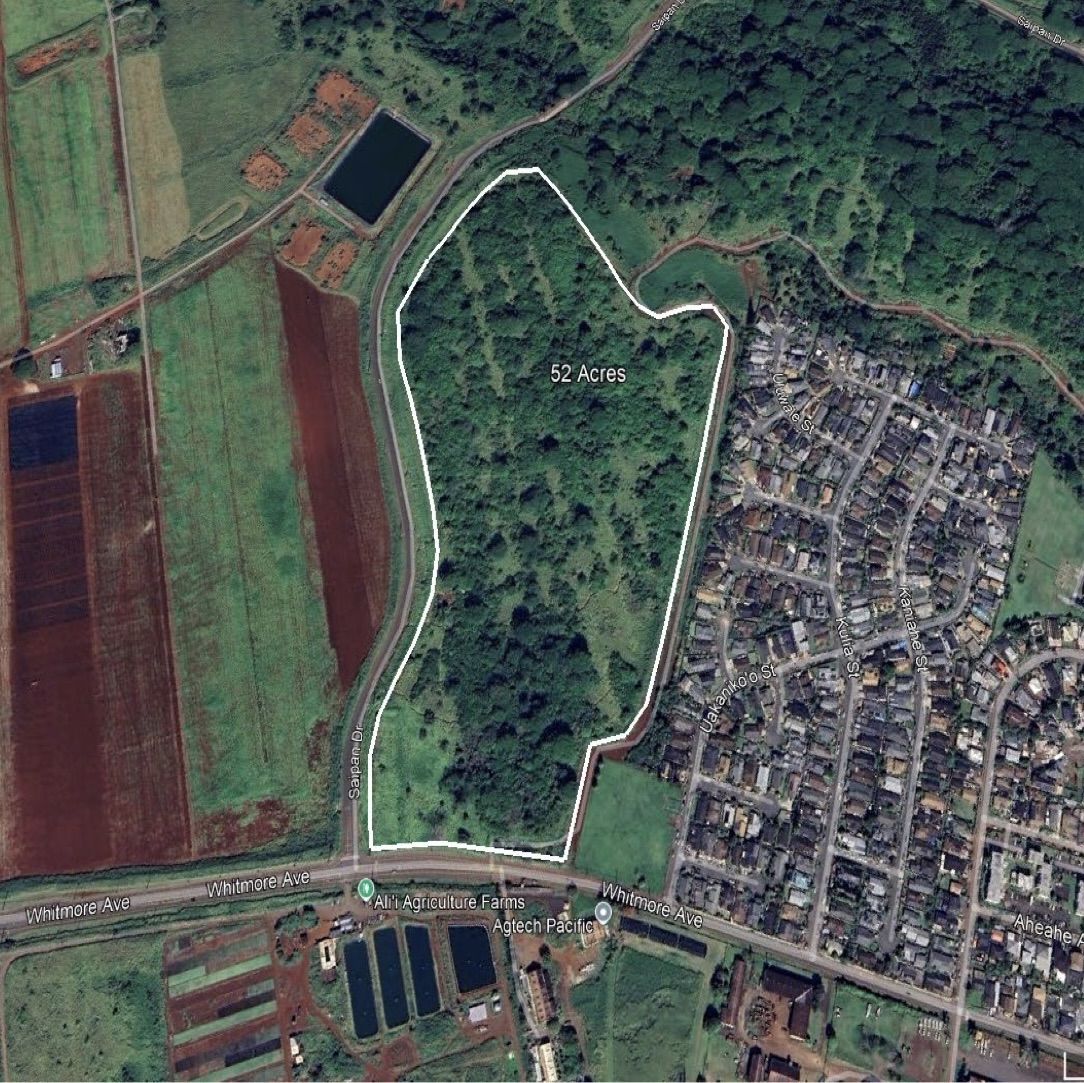
This year, however, the request for the Keiki Construction Zone event came from its organizer, BZ Services LLC, rather than Wong. The land to be used, totaling about 52 acres, is held by the ADC, which proposed a rental fee of $1,200.
A report to the board by ADC project manager Ken Nakamoto notes that the state’s environmental review law requires an environmental assessment for actions, that propose the use of state land
“In accordance with the Comprehensive Exemption List for the Agribusiness Development Corporation dated May 1, 2018, the subject Request is exempt from the preparation of an environmental assessment pursuant to Exemption Class No. 10, item 9, which includes ‘Creation or termination of easements, covenants, or other rights in structures or land[.]’ The request is a de minimis action that will probably have minimal or no significant effect on the environment and should be declared exempt from the preparation of an environmental assessment,” the report states. It does not elaborate on how the claimed exemption applies to the event.
“The property proposed has already been prepared to host outdoor events and agricultural activities, which include land clearing and preparation, and water meter installation,” it states.
Nakamoto told the board at its July 18 meeting that the event would be in the same area where the 59th annual farm fair had been recently held.
He asked the board to approve a Memorandum of Agreement with BZ Services setting the duties and responsibilities of the company and the ADC with regard to the Keiki Construction event.
Earl Yamamoto, representing the state Department of Agriculture on the board, asked how it should determine what uses of ADC land have a sufficient connection to agricultural activity or education.
“The MOU seems to automatically renew on an annual basis. What’s that threshold that makes the application, the proposal, a reasonable one?” he asked.
Board member Nathan Trump of Hawaiʻi island said that on his farm, they use heavy equipment for agricultural production and processing. The significance of learning to operate heavy equipment with regard to agriculture is “not obvious at first glance,” he said, but “it’s vital.”
“I’m not sure if it meets a minimum threshold, but that’s what I would say,” he added.
Nakamoto agreed.
Board member Jason Okumaha added that he has seen heavy equipment featured at farm fairs on the mainland.
Board member Glenn Hong, was a bit more skeptical and said he saw the event as a commercial venture.
“Is there any degradation to the land? Maybe, made not. Is there a nexus to ag? Maybe there is. They’re displaying their equipment to the public for purposes of advertising, if you will. There’s that commercial element to it.”
Board member Jayson Watts said he shared Hong’s concerns.
“It is a commercial activity,” he said. However, he added that he did see a connection between the use of heavy equipment and large scale ag production.
Okuhama said this year’s event agreement should be a test run, rather than something that’s automatically renewed.
Nakamoto agreed.
In the end, the board approved the MOA, on the condition that it not be automatically renewed. Board member Hong and member Karen Seddon voted in opposition.
ADC Board Defers Action On Long-Delayed License
Four years ago, the ADC solicited applications for five agricultural parcels in the Whitmore and Mililani areas totaling more than 1,000 acres. Even though some of the parcels did not have access to water, the agency received dozens of applications.
The top five applicants received right-of-entry permits to begin assessing and clearing the lands.
According to a report to the ADC board last month, “It is worth noting that of the five ROEs issued pursuant to the March 2021 land solicitation, only two parcels have been licensed due to issues receiving water. The Law Brothers (230 acres) were able to proceed to crop production through use of a reservoir. Ohana Hui Ventures (416 acres) were able to proceed to crop production through use of water tanks and access to City and County of Honolulu, Board of Water Supply water lines. Cedar Grove (511 acres) and Malama Aina Collective (91 acres) asked to have their ROEs’ rescinded due to the inadequate supply of water.”
The fifth permit holder, Hawaiʻi Sustainable Agriculture Products, has been waiting for years for Dole Food Company, Inc., to come to an agreement with the ADC to provide water to the 162 acres in Waialua the company hopes to farm.
In the meantime, the ADC board approved a minimum $1,800/acre/year for its new Oʻahu licenses. When Hawaiʻi Sustainable Agriculture Products applied for the parcel, however, the starting rent had been advertised at $100-200/acre/year.
Last year, Dole and ADC finalized its water agreement for the Waialua parcel. And last month, the ADC board weighed whether or not it was still in its best interest to enter into the 35-year license agreement that the HSAP had requested, at an initial rent of $100-200/acre/year. The company also agued that only 123 acres on the property were usable, not 162.
Board members debated whether it was more fair to rent the land at the rate originally advertised, or to charge the same rent that new farmers will have to pay. When would rent be raised and by how much?
The board did agree that the term of license agreement should be just 2.5 years with an option to extend, should the company demonstrate its ability to clear the land and get crops in the ground within that time.
At the meeting, Dr. Nick Azari of HSAP testified, “Any investor likes to have certainty. [I] can’t be in a position, first and foremost, of spending millions of dollars, and at the end of two and a half years be at the mercy of the [ADC]. And what would the rent be?”
He added, “Obviously, we would like to have this land in production as soon as possible…. Nobody needs to tell us we need to bring this and to production”
The board ultimately voted to defer the matter to give Azari time to discuss his plans for the property with ADC staff.
Kekaha Ag Assocition Wins Permit To Stay In $6 Million Building for Free
At its July 18 meeting, the ADC board granted the Kekaha Agriculture Association a month-to-month right-of-entry permit to allow it to continue occupying a building and property formerly leased by Beck’s Superior Hybrids, Inc., then transferred to the state Department of Education in 2023.
Although the DOE paid Beck’s $6 million to take over its property in Kekaha, the agency never followed through with its plans to turn the building there into an “innovation center.” For the past few years, it has been occupied by the KAA.
The ADC terminated the DOE’s lease for the 10-acre property in Kekaha on January 31.
The ADC, wanting to keep the property from falling into disrepair or becoming inundated with homeless people, agreed to let the KAA use the building for free instead of the ADC having to pay for utilities and maintenance.
The ADC would also retain one office space and one drying room, as well as access to the building’s conference rooms.
KAA’s Mike Faye asked the ADC board at its meeting last month to consider sharing the utility costs, since the permit reserves about 25 percent of the space for ADC’s use.
Before voting to approve the permit, board member Ciara Kahahane, deputy director for the state Commission on Water Resource Management, said she was concerned about how a recent decision by the Intermediate Court of Appeals in a case (Frankel v. BLNR) regarding the management of ceded lands might apply to the permit to KAA.
“It does appear to be ceded lands. That decision from the ICA came out at the beginning of this year. The Supreme Court denied our petition for review. … This board might need to make findings of fact that the use is reasonable and beneficial,” she said.
ADC property manager for Kauaʻi Alison Neustein supported the permit, but not the KAA’s request that it be allowed to use the property for staging of material for various projects.
The ADC plans to eventually transform the building into a processing facility. “I don’t want to have tons of pipes and soils [that have to be moved] when we are about to embark on a construction project to turn this into a processing facility,” she said.
She said ADC project manager Ken Nakamoto was working on a proposal for the facility and would soon start accepting bids from architects and engineers.
Nakamoto said it would be another eight to 12 months before work would begin on the building. Design and planning, as well as a site assessment, would need to occur first.
Although the board approved the permit, member Karen Seddon opposed it, stating that she felt the ADC could get more income from the property. Kahahane opposed it, as well.
— Teresa Dawson