
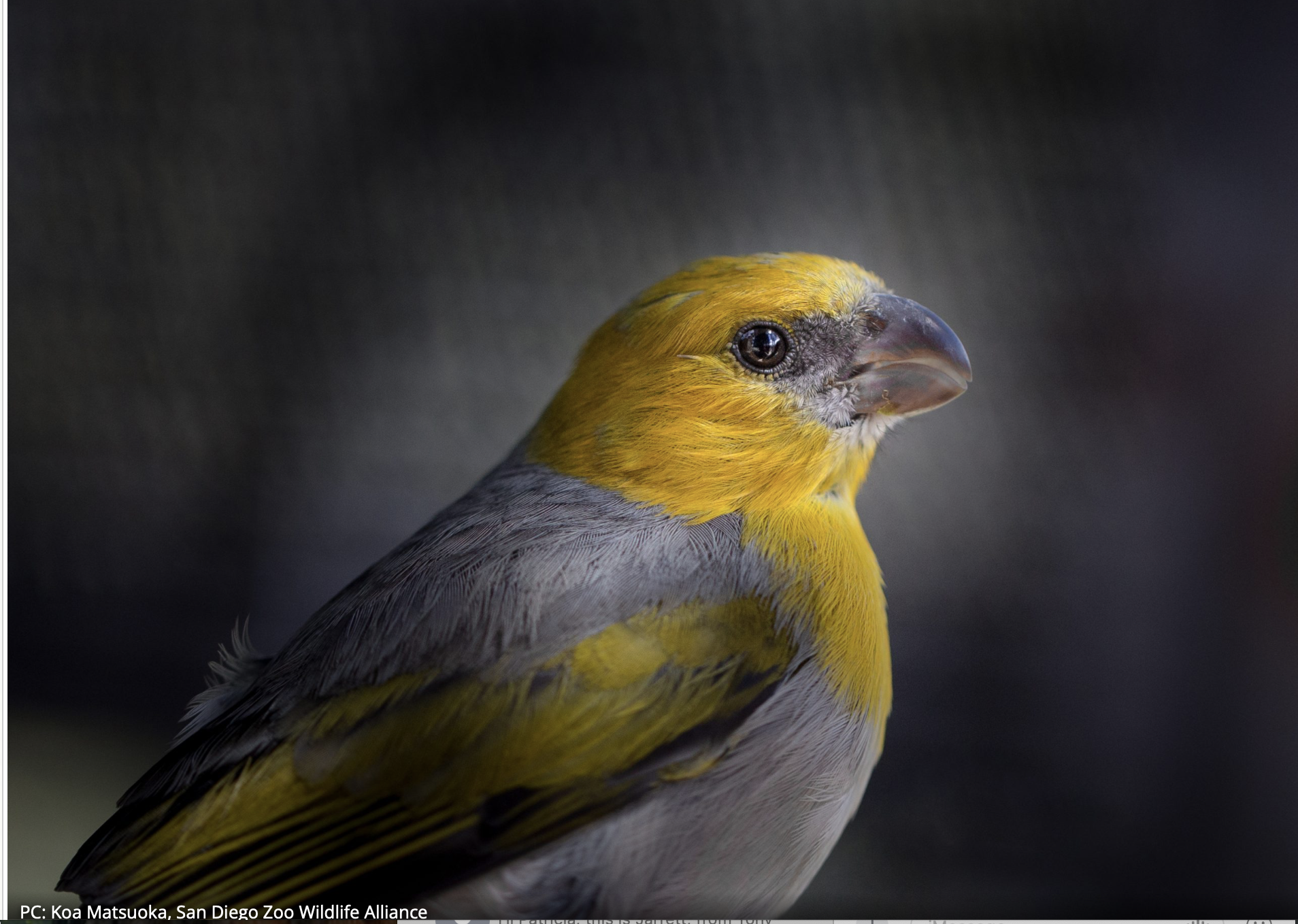
In a period of just over two decades, the population of palila, the endangered Hawaiian honeycreeper that feeds on the seed pods of māmane, has declined 89 percent.
That is the sad conclusion of a recent published report by a team of researchers who studied past palila surveys and who also have conducted surveys over the last three years (2022-2024). The estimated population in 1998 was between 4,895 and 7,253 birds, with the most likely number being around 5,952. By 2021, the most likely number had fallen to 679, with the low and high ranges being 444 and 956, respectively.
As of the most recent (2024) survey, the population most likely numbered just 666 individuals, with a lower range of 412 and maximum of no more than 970.
CREDIT: HUNT ET AL., “2022-2024 STATUS AND TRENDS OF THE PALILA (LOXIOIDES BAILLEUI),” HAWAI‘I COOPERATIVE STUDIES UNIT, UNIVERSITY OF HAWAI‘I AT HILO.
The paper, “2022-2024 Status and trends of the palila (Loxioides bailleuiI),” was authored by Noah Hunt at the University of Hawaiʻi at Hilo (lead author), with Chauncey Asing, Lindsey Nietmann, Paul Banko, and Richard Camp.
Palila were once found on the islands of Hawaiʻi, Oʻahu, and Kauaʻi, at the very least. As the report notes, they “evolved to feed almost exclusively upon the seed pods of endemic māmane, which contain compounds toxic to most other species.”
By the late 18th century, following the introduction of cattle, sheep, and goats, palila were found only on the island of Hawaiʻi, with populations on Mauna Loa and Hualalai as well as Mauna Kea. Eventually, the only population remaining was that on Mauna Kea.
“A nearly successful attempt to eradicate feral livestock from Mauna Kea in the 1930s and 1940s evolved into a sustained game management plan by the 1950s,” the paper notes, citing a 1984 report by Jim and Sonia Juvik. At that time, palila had been reduced to just about 5 percent of their historical range.
“Feral sheep were allowed to proliferate and were even augmented by mouflon in the 1960s, which reversed any recent forest recovery. This precipitated a series of lawsuits which eventually obligated the state of Hawaiʻi to remove livestock from palila critical habitat,” the paper goes on to say.
While this allowed some recovery of māmane, the researchers write, “palila numbers fluctuated moderately between 4,000 and 6,800. … After 2005, palila population estimates declined steadily through 2010. During 2014-2024, estimates fluctuated moderately … with a local peak in 2019. The observed mean decline during 1998-2024 has been 203 birds per year.” This level of annual loss resulted in a decline of more than 90 percent in the population over the 26-year monitoring period, the report says.
The authors discuss what could have led to “abnormally low estimates, as in 2000, 2006, 2010, and 2015” – declines that they say, “appear biologically unlikely.” These “can sometimes be an artifact of differences between detection probability related to environmental conditions or surveying effort,” they wrote. But weather conditions did not vary that much, so that was not seen as a factor. Nor was there any difference in survey effort. These earlier low estimates, they write, could be attributed to sampling error.
“However, unlike the 2000 estimate, the 2021 and 2022 estimates were followed by similarly low estimates in 2023 and 2024, … and therefore we think this represents a true population decline.”
In discussing his paper at last month’s Hawaiʻi Ecosystem Meeting at the University of Hawaiʻi at Hilo, Hunt cited as contributing factors to the palila’s decline changes in climate and fire regime, introduced vegetation, loss of habitat, reduced seed production, and feral cats.
He added that the population now is near the minimum viable population size of 500. That’s the smallest number of a population that is thought to have a probability of ensuring its long-term survival.
The Department of Land and Natural Resources was asked what steps were being taken, if any, to address the decline. Bret Mossman, natural resource management specialist with the DLNR’s Natural Area Reserve System, responded.
The recent population trend, he said, follows patterns seen with a lot of native birds. “As things have changed in the landscape, things are going to decline. There’s been 250 years of basically unmanaged grazing. So the habitat has been really damaged. It’s going to take a long time to recover,” he added.
“In the 1990s, we had a really bad drought, which caused the population to fall under 2,000 individuals. At that time, the palila probably became susceptible to other threats, such as feral cats.
“And every year we are getting new threats — from the naio thrips to Russian thistle, which is now invading the Saddle region, increasing fire risk. There’s just new threats coming in on top of the threats they’ve been experiencing over the last few hundred years.
“We’re learning more, and so we’re able to take more action, but it’s really a devastating impact. But we have the tools and the assets to be able to do something about it. It’s rough. It’s hard to see. But if we keep protecting the habitat, if we keep addressing predators, if we keep trying new things, eventually we’re going to figure out what is the key recipe for making sure we keep palila around and hopefully build them towards recovery,” he said.
Mossman acknowledged the very low numbers seen in the early 2020s. But, he said, “we got a few more raw detections in 2025 than in 2024, so hopefully we’ll see an increase from there.” He attributed this to the “high-intensity management that the Mauna Kea Forest Restoration Project has been engaging in, particularly the expansion of predator control and the wildlife program in East Hawaiʻi.”
“Only time will tell,” he added. “We’re trying to implement a bunch of new strategies. We’re hoping in the next few years to do what we’re calling rear-and-release. We’re going to try to collect eggs in the wild, bring those into captivity, raise them up to fledgling age, so just for a few months, then release them back out with the wild flock, so they can learn their wild behaviors before they get stuck in captivity for too long.”
Mossman identified feral cats as the major predator on palila. “From the coast to the summit, feral cats are just about everywhere. They typically prey on nestlings, but they may prey on adults more often than we realize. When adult birds are sleeping, they’re completely susceptible to a predator coming to get them.
“Cats are definitely being addressed. There’s a much larger effort across the mountain to control feral cats, rats, and mongoose. The teams with the Mauna Kea Forest Restoration Project are really working hard to catch as many cats as they can. They’re removing dozens of cats a year from the palila core habitat.”
Federal Court Involvement
In late May, the state announced a scheduled closure of palila habitat areas on Mauna Kea. This was to allow aerial and ground-based hunting of sheep, goats, and mouflon. The operation was scheduled for July 1 and 2.
“Aerial shooting is required to comply with the federal court order mandating the removal of sheep and goats from critical habitat for the palila,” the announcement said.
That federal court order requiring the state to remove sheep and goats from palila habitat was issued 46 years ago, on June 6, 1979, by Judge Samuel P. King of the U.S. District Court for the District of Hawaiʻi.
Since that ruling, the state has conducted periodic aerial shoots, with limited effect. In a 2014 article, Paul Banko and others reported that despite the aerial shoots, “our analysis indicates that ungulates have increased over time. … Although culling ungulate populations has allowed some habitat improvement, their complete removal is necessary for palila to recover, especially given the potential for continued drought.” (See “Evaluating the long-term management of introduced ungulates to protect the palila…,” in Arctic, Antarctic, and Alpine Reseaerch, Volume 46, issue 4.)
Despite scientific consensus on the harmful effects of the ungulates, the Department of Land and Natural Resources’ webpage on management of natural resources on Mauna Kea continues to state, “It is likely that the remaining palila on Mauna Kea are there in part due to sheep hunters. Hunting activity is heaviest in the area palila still occupy because this area also provides the best vehicular access to Mauna Kea due to a good network of 4wd roads. While browsing damage still occurs here, it is reduced by hunting pressure that temporarily pushes sheep away from the area.” (See: https://dlnr.hawaii.gov/restoremaunakea/management/sheep-eradication/)
Environment Hawaiʻi asked the DLNR for numbers of animals taken during the aerial hunts. No reply was received by press time.
However, documents filed by the state with the federal court claim that from 1987 to June 30, 2024, a total of 25,929 animals were removed. Aerial staff shooting, which did not begin until 1998, took out 10,745 animals. In the entire first decade of Judge King’s absolute order to the state to remove ungulates from critical habitat, the state conducted no aerial hunts or staff shooting and informed the court that hunters alone took 4,083 animals.
Since 1998, staff hunts account for 10,745 animals taken, while hunters took 11,101. In the six-month period from January 1 through June 30, 2024, the DLNR informed the federal court, “a total of 1,757 hunter trips resulted in the harvest of 282 sheep from the Mauna Kea Forest Reserve and the Kaʻohe Game Management Area … a success per unit effort of 16 percent.” Staff hunting took out 124 animals.
As for predator control efforts, that same report to the court stated that there were “87 total captures, including 39 feral cats and 48 mongooses.”
That report, for the first six months of 2024, was filed with the federal court on April 25 of this year, nearly 10 months after the reporting period ended. Since then, the state has not made public any further information on compliance with the court order.
— Patricia Tummons
For Further Reading
Environment Hawaiʻi has reported on the status of palila in past issues, including:
- “Palila Recovery Lags Behind Habitat Restoration Efforts,” November 1998;
- “Judge Shoots Down Hunters, State, on Efforts to Keep Sheep on Mauna Kea,” November 1999;
- “Hunters Block Saddle Road Work, Professing Concern for Palila,” October 2000;
- “State, Environmentalists Argue Over Fencing as Palila Population Declines,” July 2009;
- “New & Noteworthy: Petrels and Palila,” May 2013;
- “New & Noteworthy: Aerial Hunting Lawsuit… Meanwhile, Palila Decline,” January 2015.