
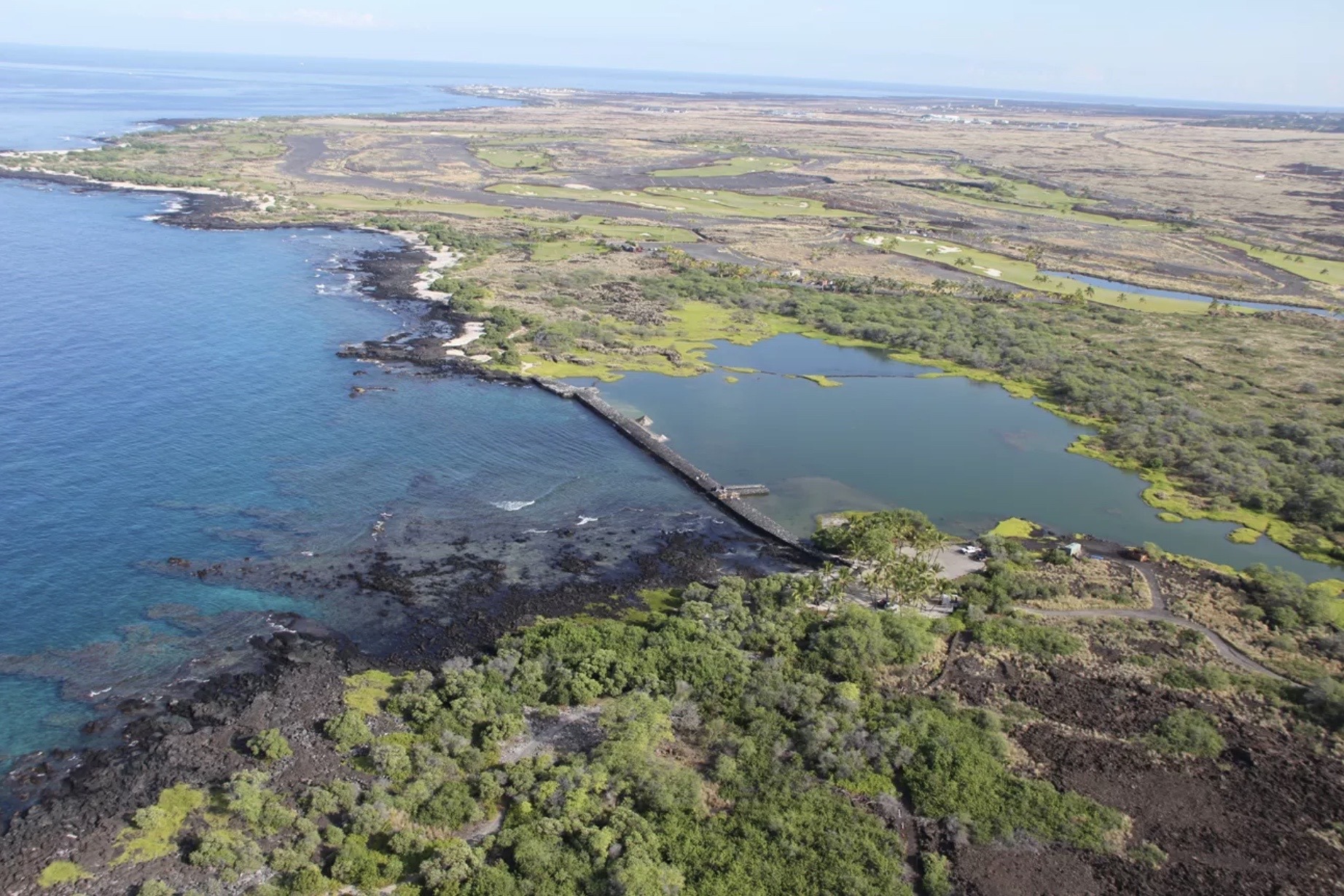
Environment Hawaiʻi editor Patricia Tummons recently interviewed Ciara Kahahane, the deputy director of the Department of Land and Natural Resources and effectively the executive director of the Commission on Water Resource Management. The focus of the discussion was the way in which the Keauhou Aquifer Sector Adaptive Management Plan interfaced with the Hawaiʻi Water Code, Chapter 174C, Hawaiʻi Revised Statutes.
In 2017, the commission denied a 2013 petition by the National Park Service to designate the area to protect the inflow of fresh groundwater into the Kaloko-Honokohau National Historic Park in the face of growing development.
Modeling by the USGS has predicted that groundwater recharge in the Keauhou aquifer system will decrease significantly in the coming decades under both “wet” and “dry” climate scenarios.
For now, the Water Commission has opted to implement the adaptive management plan rather than designate the area as a groundwater management area, which would require water users to obtain permits.
What follows is a lightly edited transcript of the interview.
EH: I have a question about the interface between the Adaptive Management Plan for Keauhou and Chapter 174C. I’m not seeing how they work well together. If there is a mismatch, does CWRM anticipate amending 174C?
Kahahane: The adaptive management plan and the application of adaptive management principles are actually called for in the 2019 update to the commission’s Water Resource Protection Plan. The guiding policy adopted in that plan, one of the guiding policies adopted, was to apply adaptive management principles in the face of scientific uncertainty. And that’s something that we try to do with things like instream flow standards already. This [Keauhou] adaptive management plan is trying to do that in the context of groundwater management. And there are a few different ways that we see it fitting within the existing framework of 174C and the broader Hawaiʻi state constitution and the public trust doctrine.

So, one of the ways is when the commission makes a permitting decision right now, particularly when it assesses resource impacts and impacts to traditional and customary practices under the Kapaʻakai framework, it’s really looking at the impacts on a well-by-well basis. And it often lacks information about the cumulative impacts of those groundwater withdrawals. So that’s one way that it’s working within the existing framework.
Another way is by directly informing our sustainable yield updates in the Water Resource Protection Plan. Of course, the Water Resource Protection Plan is where sustainable yields are actually set statewide.
And right now, Keauhou has only one sustainable yield number for the entire aquifer, even though we know that there are at least three different aquifer bodies out there: the basal lens, which is a thin, mostly brackish lens closest to the coast; the high-level water, which is mostly above the Mamalahoa Highway, which seems to be a little bit more resilient to pumping than the basal, though we’re not quite sure; and then there’s also the deep confined, which is way, way beneath the water of the basal aquifer.
One of the things we’re hoping to do with this adaptive management plan is set three different sustainable yields and really start to manage those three aquifers separately.
So that’s one way that the [adaptive management plan] is going to directly inform the Water Resource Protection Plan, which is something that 174C already calls for.
And finally – this is something we may want to figure out how we’re going to implement, we may want to implement a statutory fix, or administrative rules somewhere down the line, to better implement the adaptive management plan.
But right now, we’re very early in the plan development process overall. And so, we haven’t made any final determination regarding what kind of adjustments, if any, we would make.
EH: What efforts are being made to assess current usage and planned usage in the adaptive plan management of Keauhou? Why have these estimates of current and planned usage not been discussed so far?
Kahahane: So, we have actually, if you’re talking about authorized planned use, we’ve been discussing that with the County of Hawaiʻi and trying to find a unified way across all four counties of determining what authorized planned use is and how it’s measured. So those conversations are ongoing between staff and all four of the county planning departments.
EH: It doesn’t appear in the adaptive management plan at all.
Kahahane: No, currently, it’s not a part of the AMP. It’s something that was separately required as a condition of non-designation by the commission and it’s something that is separately required under the state Water Code.
And so we’re proceeding, not necessarily including it within the AMP itself, but still, that is definitely something that we’re looking at and that we are working to track.
EH: Should it not be included in the AMP? It seems to be a pretty important element.
Kahahane: Well, one of the things with the AMP, we’re trying to keep the AMP really focused on specifically monitoring, managing, and adapting to changed conditions. Those changed conditions may include how much use there is, how much development there is.
But one of the struggles that we’ve had with the AMP so far is a little bit of scope creep. We’re trying to keep the AMP very focused on this first generation, and I’m mindful that it has so much potential as a tool that we do want to keep throwing more stuff into it.
But extras, like building in a more specific consideration of authorized planned use, that’s probably not going to come in until later generations of the plan, if at all.
EH: If the purpose of the AMP is to monitor water levels and manage on that basis, then I have several questions. What enforcement power does CWRM have in areas that have not been designated as management areas by the commission? How can CWRM require that pumpage be reduced in areas that might be showing increased salinity or lower water levels?
Kahahane: So the enforcement is one that, again, we’re really early in the stages of the plan development. We haven’t necessarily decided what the final triggers for action thresholds for protection are going to be, and what the management actions are.
So the conversation about enforcement is really not going to come in until later on in the planning process.
EH: How can you keep tabs on water usage and water salinity and water levels if you don’t have 100 percent reporting – as I don’t think you do in the case of Keauhou, or even statewide?
Kahahane: So, our reporting compliance, you’re right. There are always a certain percentage of folks who are not reporting. Our staff follows up with people if they haven’t received well reports from them.
And for Keauhou, I don’t have the specific updated numbers as of January 2026, but the percentage of wells that were reporting is contained in one of my briefings to the commission – I can’t remember the exact month.
But actually, most of the non-reporting, all of the non-reporting wells were smaller individual wells. We actually have very good compliance in Keauhou from the larger well operators. So, yes, we have some non-reporting wells. Generally, when the commission makes a permitting decision, we take those non-reporting wells, and we assume that they’re pumping as much as they possibly can, right? So if someone’s not reporting their water use to us, we take the pump capacity and we multiply it as if they’re pumping it 24-7.
EH: How recent was the latest permit you issued in the Keauhou area?
Kahahane: We have not issued a pump installation permit in Keauhou since the commission declined to designate the area as a groundwater management area.
EH: Has there been any penalty applied for lack of reporting?
Kahahane: No. We have not gone after anyone for a penalty at this time.
EH: A while back, Keith Okamoto, director of the Hawaiʻi County Department of Water Supply, told the Board of Water Supply that you had said the county did not need to complete the Keauhou Water Use and Development Plan, a draft of which was published in 2017. Keith said that he hadn’t worked on it since then, on your advice.
Kahahane: My conversation with Keith was really focused on our planned update to the Hawaiʻi Water Plan framework. So that’s been something that commission staff started on before my time – I think in my predecessor’s time, they started updating. This is the framework that governs all of the different components of the Hawaiʻi Water Plan.
The Water Use and Development Plan is, of course, part of that. And my word to Keith at the time was, let us figure out what we’re going to do as far as updating this framework, because he didn’t want to start a plan and an entire planning effort, bring on a contractor, if we were just going to change the requirements midstream.
That was months ago, and we’ve had subsequent conversations where I think that we’ve been able to give Keith enough certainty with regard to where we’re going with the Hawaiʻi Water Plan Framework update that my last conversation with him on this was that they were going to start, at least, the planning process for the Keauhou Water Use and Development Plan.
EH: How would the framework process change the way in which the county water use and development plans are developed?
Kahahane: One of the major things that we’re thinking of updating is, one, clarifying the method for calculating authorized planned use. And two, building in specific consideration of impacts on traditional customary practices at the macro scale. There are a lot of different things.
But one of the major updates for the Water Use and Development Plans is really requiring the counties to at least get an idea of what kinds of practices are happening in a given area and how they might potentially be affected by its plans for source development.
This is still pretty early in the process. We’re still discussing internally these framework updates.
And while we’ve had preliminary conversations with the counties about them, we don’t have anything official documented in writing that we’re really ready to roll out.
But this is going to come before the commission when we’re ready to announce it publicly and start accepting public input.
EH: It seems that there’s a bit of a circularity here. How can you update the Water Resource Protection Plan if you don’t have the county Water Use and Development Plans, and vice versa? They’re really dependent on each other.
Kahahane: They are, they absolutely are. And in a way, the circularity is kind of by design, to have the plans talk to each other, back and forth, and not necessarily have one informing the other one.
So, yes, absolutely, the county’s plans for source development are going to inform what the commission does, including in the Water Resource Protection Plan, and that, in turn, is going to inform what the county does. So it’s really sort of by design to have the plans feeding into each other.
EH: When was the last update to the county’s Water Use and Development Plan – the last one that was approved by the County Council?
Kahahane: The Keauhou Water Use and Development Plan was actually not approved by the council.
EH: Do you know how far back in time the last approved Water Use and Development Plan for the county occurred? I think it was back in the 2000s.
Kahahane: That sounds right.
EH: About 20 years ago. And can that be relied on moving forward, trying to assess water use? Trying to determine questions of designation?
Kahahane: It’s the best thing that we have right now. So, at a certain point, we don’t have more from the county that we’re able to rely on. Of course, we’re working with the county to update the Keauhou and certain aspects of the Water Use and Development Plan.
That’s why this Adaptive Management Plan effort is so important, to bring in some of those unanswered questions, like, what are the cumulative impacts of withdrawals in the Keauhou aquifer?
EH: Are you displeased with the 2017 update?
Kahahane: I think, actually – I may be misspeaking here – but that was before my time. But I believe that it was actually approved by the commission. It just didn’t receive County Council approval. And there’s a lot in there on review that I think is good and is going to stay.
My understanding is that one of the objections from the public was that it didn’t contain enough consideration of traditional and customary practices and the impacts of those. And that’s something that we’re actively working to fix.
EH: I had a question about the monitoring well, the deep monitoring well that you’ve mentioned as having been financed by the Legislature. It seems like that’s planned to go on the very same site that the county already has a deep well. Is that correct?
Kahahane: If you’re talking about the Kaloko well, that is on a county site. They don’t already have a deep well there, so that’s its own separate thing. The other two deep monitor wells that we got funding for this past year from the Legislature, we haven’t decided where we’re going to site them yet.
EH: There was one that was to be sited right next to an existing county well. Is that the same monitoring well that needs to be resealed?
Kahahane: If we’re talking about Kaloko, yes.
EH: That is, then, what we’re talking about. Why is that on the same site as a county well?
Kahahane: Well, it’s difficult when we’re looking for a place to site a deep monitor well. We’re really constrained not only by where we would optimally like to put it, but where there’s land available. The county has been a very good partner to us in letting us site wells on their property.
I assume that when staff sited that well, they looked at what state lands were available and couldn’t find anything that was a good candidate, and so went to a county site instead.
EH: What is the status of the Ota well? You say that no wells have been permitted in Keauhou since roughly 2017-18, but I know that this proposed well has been rather contentious.
Kahahane: It has been rather contentious, yes. Its last trip to the commission was back in April of 2025, and action on that well construction permit was deferred.
Before that, the most recent time that they were up to the commission would have been before me. They actually did get a pump installation permit but, of course, they challenged and requested a contested case hearing.
So as of this moment, I don’t have an idea when the Ota well is going to be back up to the commission. It is one of many wells that people are interested in constructing out in Keauhou.
EH: Going back to the deep confined aquifer … I’m concerned if that is included as one of the aquifers that can be tapped for future well development, it seems awfully deep, for one thing.
The county already has many, many problems keeping its existing deep wells operational. At any given time, there may be up to, like, 40 percent of the deep wells that are offline because of problems. They’ve maybe dropped equipment to the bottom of the well and need to figure out a way to fish it out, or they have problems with pumps that can’t be easily accessed. If you read the minutes of the Board of Water Supply, every meeting includes a discussion of the Kona deep wells. And it’s expensive. The county Department of Water Supply is the largest electric consumer in the county, and its in large part because of these deep wells.
So if you have an aquifer that is even deeper than that, I don’t know how you expect to make that feasible and why that should be considered as part of the available supply of fresh water.
The other reason why I think it’s maybe inappropriate to consider as a source of fresh water is that most of the research that has been done to evaluate the existence of this has been done offshore. And if you have offshore wells, then that raises another question of the feasibility of using this aquifer as a source of fresh water.
Kahahane: Yeah, I definitely understand your concerns. That’s more policy stuff that wouldn’t necessarily be a decision that’s made by staff, though I’m sure that considerations like those that you just raised would be weighed by the commission if they were to make a determination regarding a proposed deep well into the deep confined aquifer, especially one that was actually going to pump instead of just a monitoring well.
Ultimately, the reason that it’s being included within a potential update to the Water Resource Protection Plan and to the Adaptive Management Plan is we know that there’s interest. People have already proposed wells into the deep confined, so we need to put information before the commission on the potential impacts and how much we expect to be in the aquifer, and any considerations like those you raised. But also what people are saying in favor of exploring the deep confined. That’s all stuff that we’re just trying to make visible and give the commission the information it needs to make a good decision.
EH: A few years ago, I went to a discussion. I was not an invited participant, but I busted the party. There was a lot of discussion at the meeting, which was led by the Natural Energy Laboratory of Hawaiʻi Authority, advocating for the Ota well. They were saying that there wasn’t any problem addressing water supplies in the Keauhou region because we have this basically unlimited deep confined source.
So I think by including it as an aquifer, you have sort of given succor to the people who think that we don’t need at all to be concerned about freshwater availability.
At the very least, there should be some kind of an asterisk attached to every mention of this deep confined aquifer so as not to get people’s hopes up that this is a viable and reasonable and feasible and practicable and economical means of acquiring fresh water.
Kahahane: That’s not my intent to lead people towards considering it to be just a free, fresh, and available supply of freshwater. It is something that we have to look at, especially as we think about what recharges it. Where’s the recharge area? How much water that would otherwise be going to the high level or the basal is actually in the deep confined, and how these aquifers interact with each other.
EH: That’s fine, but if you think of that as a third aquifer that can be folded into the Water Resource Protection Plan, which identifies the sources of available water, I think that’s another step. I don’t know why you would include something which doesn’t have any kind of proven availability.
Kahahane: Well, understanding the availability is something that we’re looking to do, we’re actively exploring. Whether we decide that there is a sustainable yield for the deep confined aquifer, or if we determine that it’s not suitable as a water source remains to be seen.
EH: Now that the contract with Guild Consulting has expired, has it presented to the commission a final plan or a final report on the Keauhou Adaptive Management Plan it was to prepare?
Kahahane: So, the final report – let me back up just a little. The Guild contract had multiple phases, culminating in the preparation of a plan.
Due to a number of factors, including just the length of time it took to herd together all of these groups, it ended up not proceeding to the final phase of that contract.
So the final deliverables for the contract are going to be reports of discussions from the expert groups that are going to form, really, part of the foundation of the final adaptive management plan. But as we explore preparing that final plan, we’re thinking it’s going to be a while longer down the road than we had previously anticipated. There’s just a lot of discussion, I think, that we still need to have. And so, that final plan is probably going to be prepared either in-house by commission staff or we’ll seek another contract.
EH: So, basically, Guild didn’t deliver its final deliverable?
Kahahane: We decided to pause before the final phase of the contract. So there were deliverables for each contract phase. We’ve stopped at phase – I think it’s phase two of the contract, which was to convene these expert groups and prepare a report of the proceedings.
So we’ve gone up to that phase, but we didn’t complete that final phase, which is to prepare successive drafts of the Adaptive Management Plan, present them to the commission, and eventually, for commission staff to propose one as final.
EH: Did they get full pay on their contract?
Kahahane: They’re only being paid for the phases of work that they actually completed. So not the full amount, no.
EH: What did they get paid?
Kahahane: I don’t have that off the top of my head.
EH: Basically, the plan is not complete at this point?
Kahahane: That’s correct. We’re still very early, very early stages of the plan.
EH: How useful will it be if it’s always going to be in flux?
Kahahane: I think it’ll be useful. It will always be in flux, and that’s the beauty and the struggle of adaptive management.
But ultimately, everything the commission does is in flux. We might make a decision one day that, because of sea level rise or climate change, becomes outdated in a few years. That’s just the reality of water management, and so I think, I hope that this will be useful. I believe that it truly will be useful. And it’s something that I would like to see us do in places like, for example, Lahaina, where we know that there are resource impacts, that climate change is changing the amount of rain that we’re seeing there, the amount of recharge to the aquifer.
This sort of adaptive management strategy, while it might not take the exact form that we’re thinking for Keauhou, it’s something that I would like us to see and like us to use statewide one day.
EH: I do have a couple more questions. At one point, you were discussing with the commission plans for developing monitoring wells in Keauhou. And you said something to the effect of, if the Legislature did not give you the funds, then you could go to other sources in the community. Do you remember saying that?
Kahahane: Yes.
EH: And this has me a bit concerned, because I think that there’s always a quid pro quo when you are getting money from private sources to develop a public resource. There’s the expectation on the donor’s part that they will get some benefit from it. And if it turns out that they don’t have it, then I think that really puts everybody in an awkward position. So when you mentioned that, who did you have in mind? What did you have in mind?
Kahahane: No one specific in mind, but I will say, for quite some time, folks have been advocating for the commission to find its own reliable and renewable source of funding. According to a study done by USGS a few years ago, the full cost to fund a water manage-monitoring network in Hawaiʻi is something like $170 million. And our budget for the commission is now about $5 million a year.
So we have a substantial shortfall in terms of being able to do everything that we know needs to be done to responsibly manage and monitor our water resources.
And I totally understand your concerns about the quid pro quo aspect of seeking private funding. It is something that I think, you know, we already have a watershed management fee for DOFAW [the Department of Land and Natural Resources’ Division of Forestry and Wildlife] that is imposed on certain applicants. So, I think of it as being similar to that.
And it really follows from the concept of, if you have a well in an area and you’re taking out water, you’re causing the commission staff to actually have to expend time and energy and effort monitoring the impacts of what you’re doing. You should pay some of the cost to defray what the commission staff are doing. And that actually was similar to one of the conditions that was imposed on the Ota well permit.
EH: Going back to your funds: you have a pretty high vacancy rate. And how is this being addressed. I mean, it’s really, really high.
Kahahane: We do. So our current vacancies, we have 13, no, sorry, 15 positions that aren’t filled right now. Someone just retired at the end of December. We’re lucky to have a staff who’ve been with the commission for a very long time, but that also means that a lot of them are retiring all at once.
Only five of our current vacancies are actually positions that are ready to be filled right now. The other 10 are new positions that actually have to be established before they can be filled. There’s a process for this.
Right now, we’ve completed a reorganization that is enabling us to actually work on filling those positions right now. We’re actively writing the position descriptions for five of those positions. For some of the remaining positions, we actually need to seek additional legislation to enable us to hire exempt staff. Because all of our hydrologists right now are civil-service exempt. We would actually have to create an entire new civil service class if we wanted to fill some of those positions as intended.
And that just – for many reasons I won’t go into right now – is not going to work.
For five of the positions, we just need to update the position descriptions and get them into recruitment. For five of the new positions we need to write brand new position descriptions for them.
And for five of those positions, we actually need to seek a legislative fix.
EH: Why so many exempt positions?
Kahahane: Well, it is very difficult to find qualified hydrologists who are willing to take a civil service position. And that’s for a number of reasons. The amount of scientific expertise that they are bringing to the commission, having positions be exempt allows us to hire at a higher rate of pay and be more competitive with the private sector and with federal government, which is where most of our competition comes from.
EH: As I understand it, the Adaptive Management Plan grew out of the commission’s decision to deny the National Park Service’s petition to designate the Keauhou aquifer as a groundwater management area. The petition was denied in 2017, I believe, and then there was a symposium on ground-water dependent ecosystems and the Park Service prepared an adaptive management plan for the commission.
That plan seems to have been largely shelved. Then suddenly, seven, eight years later, there’s this Adaptive Management Plan that doesn’t really seem to have much in common with what the Park Service had proposed. And it seems to kind of come out of the blue.
You know, the commission itself was really unclear about the utility or the procedures that would occur under this plan. I don’t believe that at any time before the actual engagement of Guild that the commission was asked to approve that. Is that not right?
Kahahane: That’s accurate. Commission staff had been working on that draft plan for a few years. The most recent draft that I have is from December of 2022, so they had continued working with the National Park Service on it for a while.
The concerns that we were hearing from the community were really broader than the area of the National Park itself. There are a lot of really valuable resources in other places, like Kailua Bay, that are not within that plan.
This effort to expand and have a more regional focus is designed to serve across aquifer systems and we are using the National Park Service plan as part of our jumping-off point, as well as the report from the groundwater-dependent ecosystem symposium.
In addition, the Water Resource Protection Plan does direct us specifically to build on the work that the National Park Service did and to propose a set of actions and triggers, and a suite of possible management actions to the commission for their decision-making.
So, while that’s quite a ways down the road, and we have a lot of consultation with the community and other stakeholders to do before we get there.
That’s the general framework of what was set out in the Water Resource Protection Plan and what’s in the National Park Service plan is still our guiding star in working on this broader plan.
EH: And you’re not worried at all about enforcement or requiring water well operators to cut back on their usage if you determine that there’s a need? You’re not concerned about enforcing the plan?
Kahahane: I’ve considered a lot of different mechanisms for how this plan could be enforced. Ultimately, what we choose is going to be something that’s determined after we get to the end of the planning effort.
But I see a lot of ways that we could potentially enforce something like this, with or without designation as a groundwater management area, which the plan doesn’t assume one way or the other.
I think a plan like this is necessary both before and after designation.
EH: Thank you very much.
Two New Appointments to Water Commission
In December, Governor Josh Green announced the appointment of Moses Kalei Nahonoapiʻilani Haia III and Juanita Reyher-Colon to fill vacant seats on the Commission on Water Resource Management.
Haia is an attorney whose career included years with the Native Hawaiian Legal Corporation, where he advocated strenuously for the management of natural resources in accordance with state and federal laws.
Reyher-Colon is executive director of the Hawaiʻi Rural Water Association, a member of the Maui County Board of Water Supply, and chair of the executive board of the American Water Works Association, Hawaiʻi section.
With these appointments, the Water Commission is back up to the full complement of nine members.
Aurora Kagawa-Viviani, whose term expired last June, had continued to serve on CWRM in a holdover position. Her tenure will be remembered for her probing questions and diligent preparation. She had applied to serve a second term but was passed over.
The appointments of Haia and Reyher-Colon are subject to confirmation by the Senate.
— Patricia Tummons
Designate the WMA
CWRM should be operating within the confines of its statutes and administrative rules instead of making it up as they go along. Seems like this Adaptive Management Plan might be a form of illegal rulemaking, and shirking of CWRM’s public trust obligations for the benefit of developers.
Christopher Rathbun
The “problem” with the Hawai’i Water Code is that it puts in stream uses and appurtenant rights (which is to say native species, taro farmers, and recreational users) ahead of the needs of developers. Faced with choosing between powerful interests and following the law, COWRM has clearly decided that simply not acting is the preferred alternative.
“A while longer down the road”, “very early stages”, “hoping to do”, “may want to figure out how to implement”, “somewhere down the line”, “haven’t made any final determination”, “haven’t necessarily decided”, “thinking of updating”, “don’t have anything official”, “when we’re ready” – I could quote more, but how many times does she have to say it before you get the picture? Nothing is going to happen.