
By law, the Land Use Commission has nine members. Five are at-large, four are representatives of their respective counties. One of these is to have expertise in Hawaiian culture and traditions.
At present, one seat is vacant. Two current members are hold-overs. Their terms expired June 30, 2025, but they have continued to serve since then.
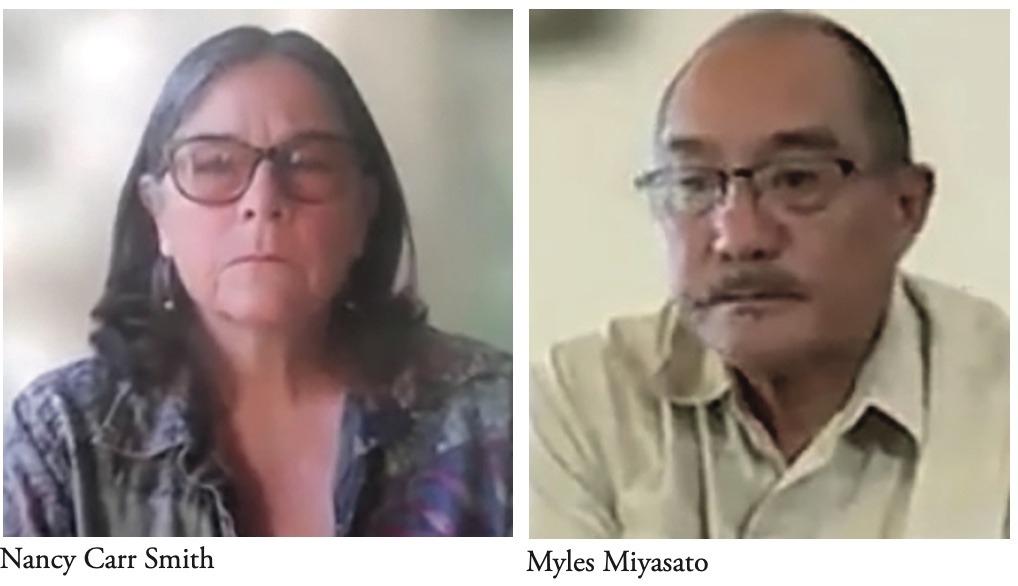
These two are Nancy Carr Smith, from the Big island, and Myles Miyasato, an at-large member. Both have been renominated by Governor Green for terms that are to expire June 30, 2029.
There are three members whose terms are expiring on June 30 of this year. They are Kuʻuleiokalani Kamakea-ʻOhelo, an at-large member who also is the designated expert in Hawaiian culture and tradition; Michael Yamane, an at-large member; and Melvin Kahele, an at-large member.
Of those three, only Kahele so far has been nominated for a second term on the commission. The governor has indicated he would likely submit the name of Kamaka-ʻOhelo for a second term, although this had not been done by press time.
Just one of the four nominees is a new face: Kuʻuleialoha Santos, who works in construction on Kauaʻi.
Should the governor’s nominees be approved by the Senate, that would mean that as of June 30, the LUC would have just one new member, Santos.
As of July 1, then, again assuming Green’s nominees pass Senate muster, the LUC would consist of seven members not serving as holdovers: Brian Lee (term expiring June 2027); Carr Smith (June 2029); Bruce Uʻu (June 2028); Santos (June 2030); Ken Hayashida (June 2028); Kahele (June 30); and Miyasato (June 29). Should Kamakea-ʻOhelo be reappointed, that would be the eighth.
The one member whose term expires June 30 but who has not been proposed for a second term is Yamane.
For the last several years, development interests have been heavily represented on the LUC. Carr Smith is a real estate agent. Kahele is affiliated with the Teamsters union. Miyasato also is affiliated with organized labor, most recently serving as a lobbyist for the Hawaiʻi Operating Engineers Industry Stabilization Fund.
Yamane, an electrical engineer, was appointed in 2022 to fill the Oʻahu seat but the LUC website identifies him as an at-large member.
Hayashida, whom the LUC identifies as holder of the Oʻahu seat, is a civil engineer and founder of KAI Hawaiʻi, Inc., an engineering firm. Although he is not a registered lobbyist, he has submitted testimony this session more than two dozen times on behalf of NAIOP, an organization that represents the interests of developers and owners of commercial real estate. Hayashida is president of the Hawaiʻi chapter of NAIOP.
Among the bills he has testified on is House Bill 1844, one of the measures that the LUC considered February 11 that would require LUC approval of lands designated as urban in county planning documents. At that time, Hayashida abstained on a vote that would have had the LUC support the measure. In his testimony March 19 before the Senate committees on Water, Land, Culture and the Arts and Energy and Intergovernmental Affairs, however, Hayashida, testifying on behalf of NAIOP provided lengthy testimony in support. He has not registered as a lobbyist.
Bruce Uʻu, who occupies the Maui seat on the commission, has long been affiliated with the Hawaiʻi Regional Council of Carpenters.
Commission chair Brian Lee, holding an at-large seat, is a registered lobbyist for the Hawaiʻi Laborers-Employers Cooperation and Education Trust.
Since 2024, Kamakea-ʻOhelo has been the director of ʻOiwi Wellbeing and ʻAina for the Office of Hawaiian Affairs.
A Contentious Commissioner
Just one of the sitting commissioners is a woman, Carr Smith. Her presence on the commission has been contentious. Environment Hawai‘i has received credible reports that she is the subject of formal complaints by LUC staff.
Carr Smith confirmed that she was the subject of complaints of harassment, but added that the investigation into them had not yet concluded. “I was accused of violating a the commission chair and that individual commissioners could put requests for items to be placed on the agenda through the chair.
At this meeting in particular, commissioners were instructed that they were not to address staff directly but rather put all questions to the commission chair.
“Isn’t it true that you, chair, asked for an item to be posted today, a training which would include protected classes and harassment, and this was not put on the agenda?”
Carr Smith asked Chair Lee. Apparently referring to executive officer Daniel Orodenker, she stated, “He just made it sound like if you ask, then it’s there. So I thought that there had been a request for that, and it didn’t come to fruition, so if somebody could explain, please.”
Lee responded, “I think in that situation, we have to try to work with the deputy attorney general’s office, and I didn’t hear anything back.”
Orodenker weighed in: “Yeah, staff is not expert on that, and neither is our current deputy attorney general, who is present today. It would take a special – or a different division of the Attorney General’s office to handle that type of information, or our Human Resources Department. Our Human Resources Department at the Department of Business and Economic Development has indicated they’re uncomfortable with presenting that to the commissioners. All of us who work for the state, whether supervisors or non-supervisors, we go through several different training sessions on human resources, harassment, all of those things. And they didn’t have a presentation that they felt would be appropriate for commissioners or that they were comfortable giving. …
“So I guess the answer to the question is sometimes, even if it’s requested, it’s not possible, you know. We do the best that we can. If there are legal reasons or, for lack of a better word, an inability to develop the right person to come and talk to us on an agenda item, we can’t schedule it. And there are some agenda items that are difficult for us to schedule because we can’t find a way to deal with them under the Sunshine Law.”
Lee added, “Yeah, it’s a continuing thing we have to work with the deputy attorney general’s office on, scheduling some of these touchy agenda items.”
Carr Smith replied that that was not a very satisfactory answer. “If the state employees are trained on a variety of things, as was just mentioned, I would think that volunteers on boards and commissions could be trained equally. And especially if we’re subject to complaints, we should be able to be trained so that we are aware of the things we shouldn’t do. Thank you.”
– Patricia Tummons