
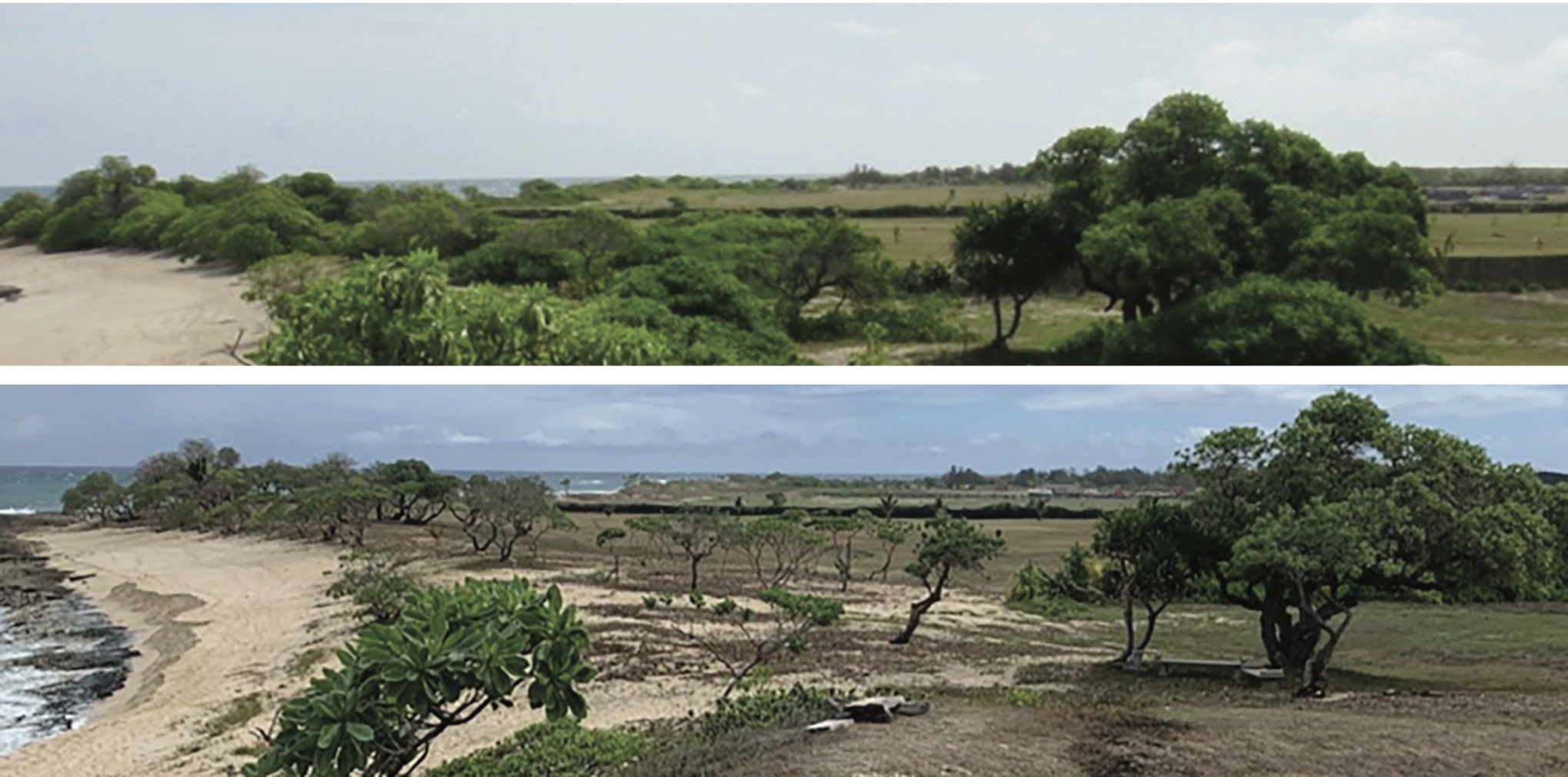
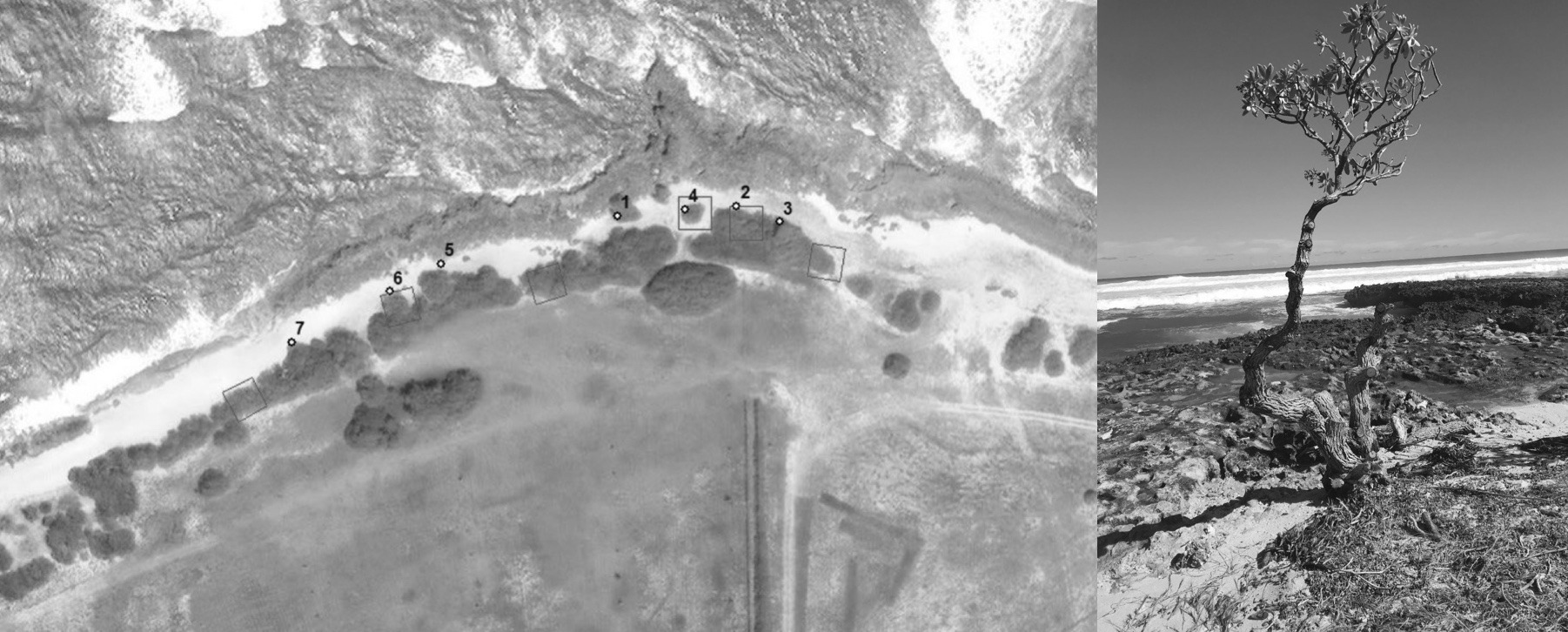
Facing fines of more than $3.1 million, the landowner who paid for the unauthorized clearing of coastal vegetation — including endangered Hawaiian yellow-faced bee habitat —at Marconi Point in October 2023 has tried to shift the blame onto his contractor.
The Department of Land and Natural Resources has drafted a settlement agreement with the contractor, Ben Lessary, although this has not yet been brought to the Board of Land and Natural Resources for approval.
During a contested case hearing held earlier this year on violations stemming from the clearing work that occurred in the Conservation District fronting the Marconi Point Condominiums project, unit owner Sushil Garg claimed he never called for coastal vegetation to be cut, merely for tall grass further inland to be mowed and dead brush to be removed, in part, to reduce what he saw as a fire risk.
Garg’s attorney, Kalani Morse, asked if he ever gave Lessary explicit instructions to cut down plants near the beach. Garg said he had not. When asked what he told Lessary to do, Garg replied, “When we bought the [coastal] lots in July of 2023, I — again, we don’t live here, so we visit here every so often. We visited in August, although we bought the lots in July. So we went to the property, and I looked at the lots, and the lots had this overgrown grass and, you know, weeds up to your knees all dried up. And this is about the time of the Maui fires, so I went out there and I said, ‘Hey, Ben. Why is this all grown up? Why are you guys not taking care of it?’ And he said, ‘Because Jeremy [Henderson, the condo project developer] wasn’t paying us, so we weren’t taking care of his land,’ because I bought the lots from Jeremy … I said, ‘We have to take care of it. We have to cut this as soon as we can.’ He said, ‘We’ll take care of it.’”
Garg’s Greystone HI Investments, LLC, purchased four units in May 2022. Garg admitted that during a walk of his land near the beach that year, he had asked about maintaining the area and that Lessary and the nursery manager for the condo project, Henry Fong, had advised him that he could not cut the coastal vegetation within the Conservation District.
Garg had responded, “But the plants are on my property,” he testified. Then he added that both Lessary and Fong advised him, “No, no, no. Your property is conservation land.”
Garg testified that he never had another discussion with them about cutting the beachfront vegetation, “[b]ecause they already told me the first time, so what was the point?”
Garg said that on October 11, 2023, he and his wife, Lorene, visited the property. He said they were unaware of any vegetation trimming at the time.
“They were showing us some of the work they did on the [historic] buildings, primarily the hotel, which is a two-story building. We were on the second story of the building looking out, and Ben said, ‘I wanted to surprise you guys. You’ll see something.’ And we looked out and we said, ‘No.’ We saw some birds. We thought he was talking about the albatross, and he said, ‘No, no, no. Look at the beach.’ And we looked at the beach and said, ‘I hate to tell you this, but we don’t really see what you’re saying.’ He goes, ‘No, I cleaned it. The beach is much cleaner.’ …
“[W]e got into an ATV, I guess, and we drove down to the beach, and we walked around on the beach, and he showed me. … He showed me what he was trimming, and I asked him, I said, ‘I thought we couldn’t do cutting on the beach,’ and he said, ‘No, we’re not cutting. We’re trimming it. This is what we have been doing since 2013, all these years, and we’d still be doing it if Jeremy was paying, and I wanted to give you a surprise, a pleasant surprise to see how we’re cleaning up this.’”
Morse asked Garg, “And did you think anything of it at this time?”
“No. I just thought it was okay,” Garg replied. He later testified that he had FaceTimed that day with the boyfriend of Yue-Sai Kan, who then owned condo unit 1.
“I showed him, ‘We’re on the property. It looks nice, pretty clean, and by the way, there was —Ben did some cleaning on the beach,’ and I just kind of showed him on FaceTime what that looked like.”
Garg said he next heard from Lessary on October 16, when he said that someone from the U.S. Fish and Wildlife Service wanted permission to come onto the property.
“He said there were some crybabies who were complaining about him cutting on the beach,” Garg said.
He admitted that he paid Lessary for the work he and his crew did along the coastline.
“It was part of a normal bill. He sent me a bill, and I paid him for it,” Garg said.
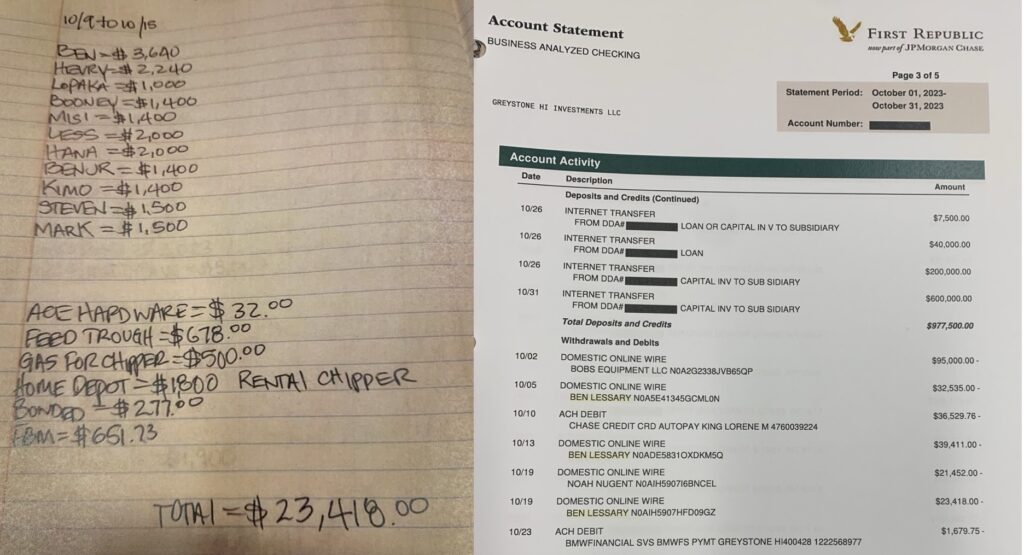
Exhibits submitted in the contested case include Lessary’s handwritten ledger detailing what Garg owed for labor and material or equipment costs incurred in a given week (such as rental of a wood chipper, gas for the chipper), as well as the time around which the clearing occurred. Also included were bank statements from Greystone HI Investments, indicating that on October 19, shortly after the clearing work was completed, it had paid Lessary the exact amount that the ledger said was owed.
Fong and Lessary’s testimonies have contradicted some of Garg’s account.
Fong testified in a written statement to the Land Board and during the contested case hearing that the Gargs had directed Lessary to cut the coastal vegetation and had discussed it on three occasions. Fong said he had warned them that the work would violate Conservation District rules. Even so, he testified that they ordered it anyway and were pleased with what they saw as the work was being done.
“They came to the property. We rode on the red golf cart out to Yue-Sai’s lot. They were happy the way it was looking. They said it looked terrific,” he testified.
“Did they mention anything about fire?” asked deputy attorney general Danica Patel.
“No,” Fong replied. He also testified that the discussions with the Gargs about clearing the coastal area occurred before the August 2023 fires on Maui, and, in any case, the coastal vegetation posed no fire risk.
“It was in perfect condition. … I mean, there wasn’t, like, dead branches falling all over the place,” Fong said.
Fong also noted that the some of the equipment used, including a wood chipper and skid-steer, were rentals that Garg had paid for before the work started.
Fong said after the work had been done, he told Lessary, “They’re going to get fined because it was a violation. For one, they don’t have a permit to even do the work on the shoreline, and they went below the vegetation of the high-water mark, so that is a big no-no already.”
“So you didn’t warn them?” asked Morse.
“Oh, I warned Sushil them,” Fong replied.
“Did you warn Ben?” Morse asked.
“Well, he was there, but, I mean, they got to take orders from their boss, and they took orders from their boss,” Fong said. He added that had he refused Lorene Garg’s request that he and another nursery worker cut the naupaka on the beach and that after the work was done anyway, he told that worker, “Lorene should never have even ordered that work to be done because it’s against the rules and regulations.”
Lessary testified that the discussions that led to the clearing done in October 2023 focused on getting the area cleaned.
“Did you think it was not clean?” Patel asked.
“Yeah,” Lessary said, noting that the area had not “been touched since I got let go from Jeremy Henderson in 2019.”
“What did he tell you — what did Mr. Garg tell you he wanted done?” Patel asked.
“Wanted to get it cleaned up,” Lessary said.
He explained that he understood that this meant the kind of work he had done for Henderson about a decade ago, when they cleared invasive species from the property.
“So did you understand him [Garg] to want you to take all the vegetation out?” Patel asked.
Lessary said they were taking out all the dead debris.
“There were a lot of dead debris in the naupaka. … So that’s what the — all the other working employees were doing. I was on the skid-steer only. I didn’t cut no trees,” he said.
The skid-steer had a mulcher on the front of it and the crew would bring cut material over to a pile “and then I would just come right over and mulch it down,” he said.
Patel asked how they discussed what the plan was.
“We just went out there and everybody just started to do their thing and say, just, ‘We’re all here to just cut out all the dead debris,’ and that’s what they did,” he said.
“Okay. But it seems like a lot of live vegetation was cut too, right?” Patel said.
“I cannot say. I was inside the skid-steer,” Lessary replied.
“My intention and everybody’s intention was just to prune and rejuvenate the trees,” he said.
None of the other owners of condo units along the coast instructed him to clear the vegetation. And, in fact, one of the unit owners did not want the vegetation fronting their property cleared, he added.
When Patel asked Lessary whether he remembered Fong saying that he told people about the Conservation District rules, Lessary replied, “I can’t answer that.”
She then asked what followed after the Department of Land and Natural Resources had issued a letter on October 19 to all of the landowners at Marconi Point Condominium about the unauthorized clearing and potential violations.
Morse immediately objected. “Lacks foundation. Speaking to an unspecified letter the witness hasn’t seen.”
Patel to Lessary: “Do you know what I’m talking about?”
Lessary said he remembered.
Patel asked, “Do you remember what happened after everybody got their letter?”
“Objection. Vague and ambiguous,” Morse interjected.
After Hearing Officer Lou Chang overruled the objection, Lessary said that Garg called him.
“He said, ‘You need to go and check your [e]mail.’ … and then I called him up and he said, ‘Did you see what you saw in the mail?’
“I said, ‘yeah.’
“So then he told me, ‘Okay, I need you to go down to Kalani’s office and go meet with him and I’ll pay for your legal services,’ and so that’s where I went.”
“Were you comfortable with that arrangement?” Patel asked.
“At first I was, but after — after a couple of days, I wasn’t feeling right,” Lessary replied.
“And is that when you got Mr. Rivera as your counsel?” Patel asked.
Yes, Lessary replied.
When Patel asked whether Garg ever told him why he wanted the vegetation cleared, Lessary said, “He wanted to build homes for his kids on the beachfront lots. … We did talk about fire risk. … That was some sort of reason because of the Maui fires. And then, you know, we walked the shoreline and we saw a lot of dead brush inside the naupaka.”
“Did he ever tell you he wanted to see the ocean,” Patel asked.
“Yes, he wants to see the ocean,” Lessary replied, although he said he did not think it was a big reason why Garg wanted the vegetation gone.
When Patel asked whether Garg had ever asked him to check if he needed permits to do the work, Lessary said no.
“But I did discuss to him about if we don’t have any permits and we do proceed with any work, we will get complaints,” Lessary said.
“And is that what happened here?” Patel asked.
“Yeah. I believe on the first day we worked out there, I — the bird people was out there that day, and there were three of them, older man, older ladies, and I’ve been working with them prior when Jeremy Henderson who owned the property prior to Sushil Garg. And then they wasn’t happy what they saw that day.
“So when they came, approached me, they asked, ‘Hey, what’s going on?’
“I told ‘em ‘We just clean. We’re pruning, we cleaning.’ But I could see in their face that they wasn’t happy. So they walked away, so I called Sushil and I told him, ‘Be ready for the first complaint.’”
Respondeat Superior
In the pre-hearing brief for Garg and his companies, their attorneys argued that Lessary was not their employee, but merely an independent contractor.
“Sushil would typically outline the scope and end-goals … and then rely on Ben’s experience and judgment to organize and execute such projects. Sushil … was not present enough to provide supervision, direction, or exert control over the manner in which Ben accomplished the work needed to complete each project,” they stated. (Garg went so far as to suggest that Lessary and Fong were lying about their conversations and about the scope of work to be done at Marconi Point. “Maybe they’re trying to put a blame on me instead of themselves,” Garg testified.)
They wrote that after the Notices of Violation were sent out, a distraught Lessary sought advice and reassurance that everything would be fine.
“During that conversation, Ben sought clarity from Sushil regarding his role in managing and executing the maintenance, repair, and improvement projects at Marconi. Sushil clarified that Ben’s work at Marconi, like the work Ben performed for others besides Sushil, was work that was completed as an independent contractor, not to be confused with a licensed general contractor,” they continued.
Patel addressed this in her cross-examination.
She asked Garg whether he was aware that, under Hawaiʻi law, a worker is presumed to be an employee unless the hiring party can prove otherwise.
Garg said he was not.
In her pre-hearing brief, she explained that under the theory of respondeat superior, “an employer may be liable for the negligent acts of its employees that occur within the scope of their employment.” (The term is Latin for “let the master answer.”)
She noted that according to the state Supreme Court, “Conduct of a servant is within the scope of employment if: It is of the kind he is employed to perform; it occurs substantially within authorized time and space limits [and] it is actuated, at least in part, by a purpose to serve the master.”
To recover fines from Garg and his companies, the DLNR “must establish that the alleged violations were the negligent, at the very least, acts of petitioner Garg’s employees and that the negligent acts were within the scope of petitioner Garg’s employees.
“While the department finds that petitioner Lessary actually committed the alleged violations, the evidence will demonstrate that the alleged violations were only conducted pursuant to petitioner Garg’s instruction in an employer-employee relationship. The department has no evidence that will show that petitioner Lessary and the other workers conducted the work for personal benefit, other than the money they received for doing work for petitioner Garg,” she wrote.
Absence of evidence
In connection with the October 2023 clearing event, the DLNR’s Division of Forestry and Wildlife is seeking $1,482,500 in administrative fines for the destruction of 296 endangered Hylaeus bees. That’s $5,000 in administrative fines per bee plus $2,500 for taking the bees.
The DLNR’s Office of Conservation and Coastal Lands is seeking $1,625,000 for the removal of 105 trees in the general subzone of the Conservation District, as well as clearing and spreading mulch over more than one acre, and damaging, killing or removing 40 trees on state-owned submerged land in the resource subzone.
In total, the agencies seek $3,107,500.
Morse stated in his brief that Garg did not dispute “that the pruning and trimming occurred in the Conservation District without proper permits. The general instruction for Ben to clean up the property did not include specific requests or instructions to trim or prune any foliage on or near the shorefront at Marconi.”
In any case, he continued, the unauthorized work “did not result in a loss or destruction of the shoreline foliage and habitat for the bees. Sushil of course regrets that a lack of clear information and miscommunication led to the misunderstanding which resulted in the trees and shrubs being trimmed without proper oversight, guidance, and permits. Nevertheless, these regrets and the lack of a permit for the work done does zero to establish the veracity or accuracy of the erroneous and overestimated fines calculated and levied against petitioners.”
Although DLNR staff had used GPS to record the locations of trees cut, Garg’s expert arborist Douglas Demoss stated in a January 23 declaration that after surveys he did of the entire beach strand at Marconi between December 2025 and January 2026, “I was unable to identify anything close to 105 dead tree stumps. I also scoured the beachfront area below the wash of the waves and was unable to identify all but a few dead tree stumps in that area, nowhere near 40, though I did find some that appeared to have been cut more than just a few years ago.”
He stated the beach heliotrope across most portions of the beach strand appeared to be growing and thriving.
“I cannot agree with the statement that the foliage on the beach at Marconi was killed, lost, or destroyed,” he stated, adding, “If the bees living in that foliage are using the heliotrope flowers for pollen and nectar, the shrub prunings appear to have multiplied the number of heliotrope branches and this significantly increased the number of flowers on the shrubs on the shorefront.”
Garg’s bee expert, biology professor Joseph Wilson from Utah State University, also prepared a report for the contested case hearing. Among other things, he stated that the available scientific knowledge and evidence was “far from sufficient to support the DLNR’s claims that the October 2023 vegetation clearing at Marconi Point: a) killed a number of endangered Hawaiian yellow-faced bees and/or their nests/eggs/larvae, b) eliminated/decimated the bee population at Marconi, or c) resulted in any quantifiable take. Furthermore, the numerical estimates of bee mortality presented by DLNR cannot be independently verified and are not scientifically defensible given data currently available and the unsubstantiated and unsupportable assumptions utilized when calculating such estimates.
“First, there is no clear evidence to establish that any endangered bees were actually killed as a result of the trimming. No bee specimens, carcasses, destroyed nests, or other physical indicators actually verifying mortality were documented.”
In contrast, Patel noted that shortly after the clearing was done, University of Hawaiʻi assistant researcher Paul Krushelnycky and entomologist Cynthia King assessed the damage to the bees, conducting standardized bee count surveys “to compare to the relative abundance of Hylaeus bees at that moment in time to other known sites where the species occur.”
Bee monitoring plots were established near bee locations documented in 2020.
According to a November 2023 take statement by Dr. Sheldon Plentovich of the U.S. Fish and Wildlife Service, “The ‘Marconi Station’ area was a known hot spot with high densities of Hawaiian yellow-faced bees. I visited the area regularly to monitor Laysan Albatross chicks from November – July and made a point to stop and watch the bees on most visits because they are so rare.”
Krushelnycky’s final assessment included several photos of mostly naked trees where the bees had been known to occur. It also noted, “Many bees, both males and females, were observed congregating on and around the cut tree heliotrope branches shown. The females may have been searching for nests in the downed branches.”
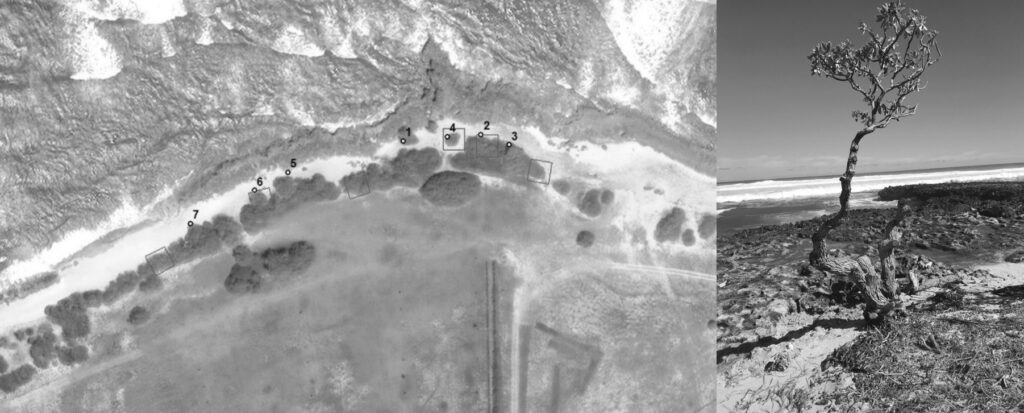
Patel’s brief argued that Krushelnycky “used the best available scientific techniques to estimate the number of Hylaeus bees, including their nest, eggs, and young, taken during the vegetation clearing event in October 2023.
“The ‘absence’ of exact evidence to establish the number of animals, including eggs, larvae, and nests, taken by petitioners’ activities was caused by petitioners’ actual destruction of all evidence. Dr. [Karl] Magnacca, Dr. Krushelnycky, Dr. Plentovich, and entomologist King agree that any and all Hylaeus bee adults, eggs, larvae, and nests would have been destroyed when processed through a mulcher, as their habitat was by petitioners. It would have been impossible to sort through the mulched vegetation to look for Hylaeus bee adults, eggs, larvae, and nests. The destruction of the vegetation was also the destruction of any evidence of the take of the Hylaeus bees,” she wrote.
Henderson testified that he knew of the bees’ presence, but Lessary and Garg testified that they didn’t know until after the clearing. Patel pointed out that they might have known had they sought permits. Despite Garg’s testimony to her that he never tried to develop vacant land before, he appeared to have done just that in California. She presented to him a 2020 survey, prepared as part of a permitting process, that discovered an endangered gnatcatcher on property he was trying to develop.
“They live in a specific plant, and we had a lot of plant on this property, so they [USFWS] wanted to make sure that there was no gnatcatcher there, and if there is, those gnatcatchers were — the plants were relocated so gnatcatchers can be fine,” he said.
“So in California, it seems like you were aware that you needed to follow certain permitting procedures to accomplish your goals on that property, right?” Patel asked.
“Yes, and we followed them,” Garg said.
“So what research did you do about Hawaiʻi permitting procedures to accomplish your goal on the Marconi Point Condominium units?”
“I didn’t do any research here,” Garg replied.
The evidentiary portion of the hearing concluded in April. The parties await recommendations from hearing officer Chang.
— Teresa Dawson