
On March 2, Ryan Kanakaʻole, acting chair of the state Commission on Water Resource Management, did what members of the public clamored for him to do at the commission’s meeting last month: He rescinded an August 21 email then-commission chair Dawn Chang had sent to Maui Land and Pineapple Company that stated, “This letter confirms that temporary use of groundwater as a substitute for surface water during low flow periods is allowed for irrigation uses, including at the Bay and Plantation golf courses, pending commission action on Hawaiʻi Water Service’s water use permit application.”
In a letter this month to MLP, which owns the Honokōhau ditch in West Maui; to ditch system operator Hawaiʻi Water Service Company; and to TY Management Corporation, which receives its water from HWS and owns the Bay and Plantation golf courses, Kanakaʻole stated that Chang’s email “was based on Hawaiʻi Water Service’s representation that, prior to designation, groundwater was used as a substitute for irrigation purposes,” including on the golf courses.
“I am now writing to clarify that the burden of establishing that a use may continue under Hawaiʻi Revised Statutes § 174C- 48(a) pending commission action on a water use permit application, rests with the applicant. This is consistent with the approach adopted by the commission during contested case proceedings in In the Matter of Water Use Permit Applications, Petitions for Interim Instream Flow Standard Amendments, and Petitions for Water Reservations for the Waiāhole Ditch Combined Contested Case Hearing. … (“The burden of proving that an existing use may be continued until the commission has acted upon a water use permit application rests with those who seek to benefit from it.”).
“Accordingly, any party seeking formal recognition of an existing use pending Commission action should submit a request to the Commission identifying the factual and legal basis for their claimed existing use,” he wrote.
“For too long, our calls for action from this commission have fallen on deaf ears. Chair Kanaka‘ole’s letter showed us that finally someone is listening to the community. Setting this golf course issue straight is an important first step toward the commission fulfilling its constitutional duty as kahuwai pono. Now it’s time for them to act on our permits,” said Karyn Kanekoa of Hui Na Mamo Aloha ‘Āina o Honokōhau in a press release issued by the environmental law firm Earthjustice.
Wishing for Well Water
For months, attorneys at Earthjustice and members of the public had criticized TY’s ongoing groundwater use because it was not included in the August 2023 water use permit application submitted by HWS, the private utility that provides TY’s water via a ditch system owned by MLP.
According to correspondence between the companies and with the Water Commission, pressure to allow the groundwater use had been building for more than a year.
On August 21, 2024, MLP CEO Race Randle sent a letter to TY Management’s Alex Nakajima, informing him that due to factors beyond MLP’s control, less non-potable water would be available to TY’s golf s. Heavy rains in 2018 had caused irreparable damage to the ditch system, resulting in less water entering the ditch during rainfall events, Randle wrote.
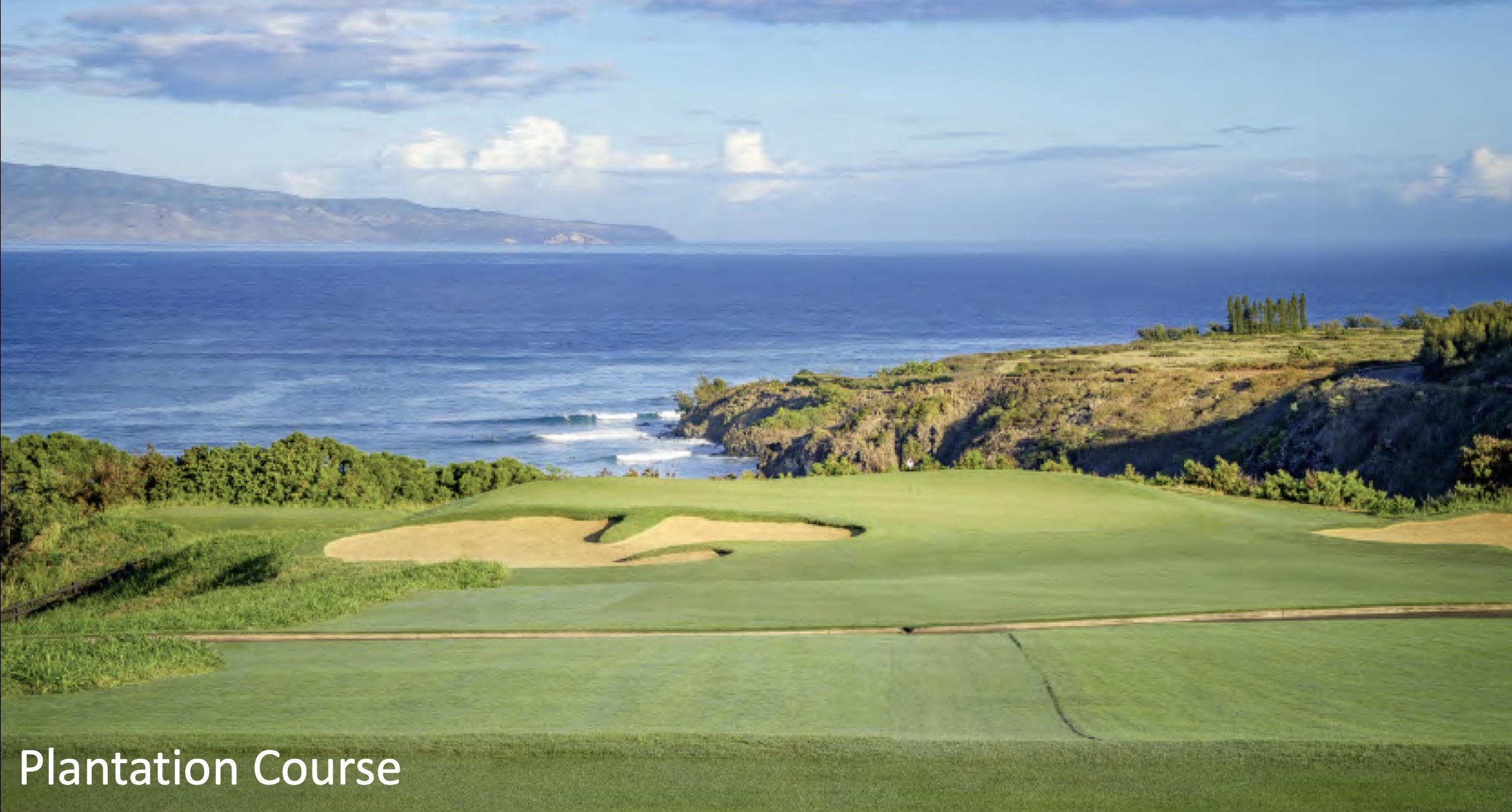
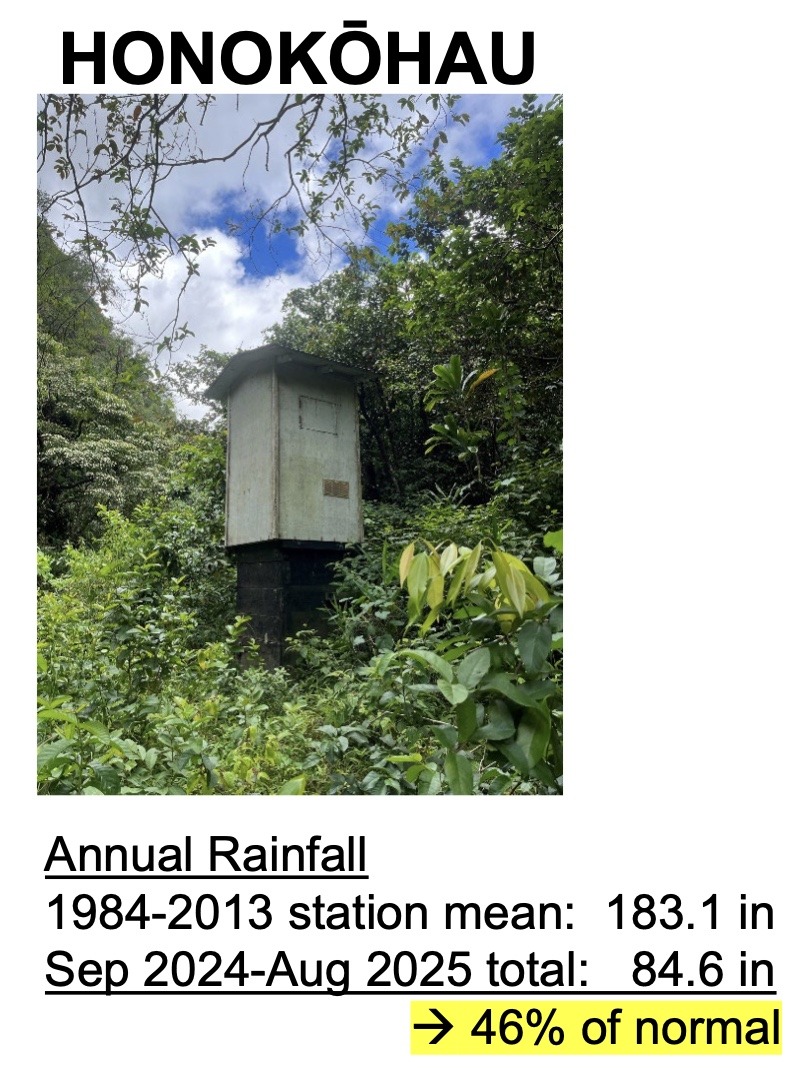
“Compounding matters, persistent drought conditions combined with the requirement to consistently meet CWRM interim instream flow standards (IIFS) have impacted non-potable water availability in the Honokōhau Ditch System. … We are not able to provide certainty that after prioritizing potable uses, there will be sufficient water to meet the needs of the Bay Course, Golf Academy, and Plantation Course,” he wrote, encouraging TY to pursue alternative water sources to meet its needs. (The Plantation course is where the PGA has usually held The Sentry tournament.)
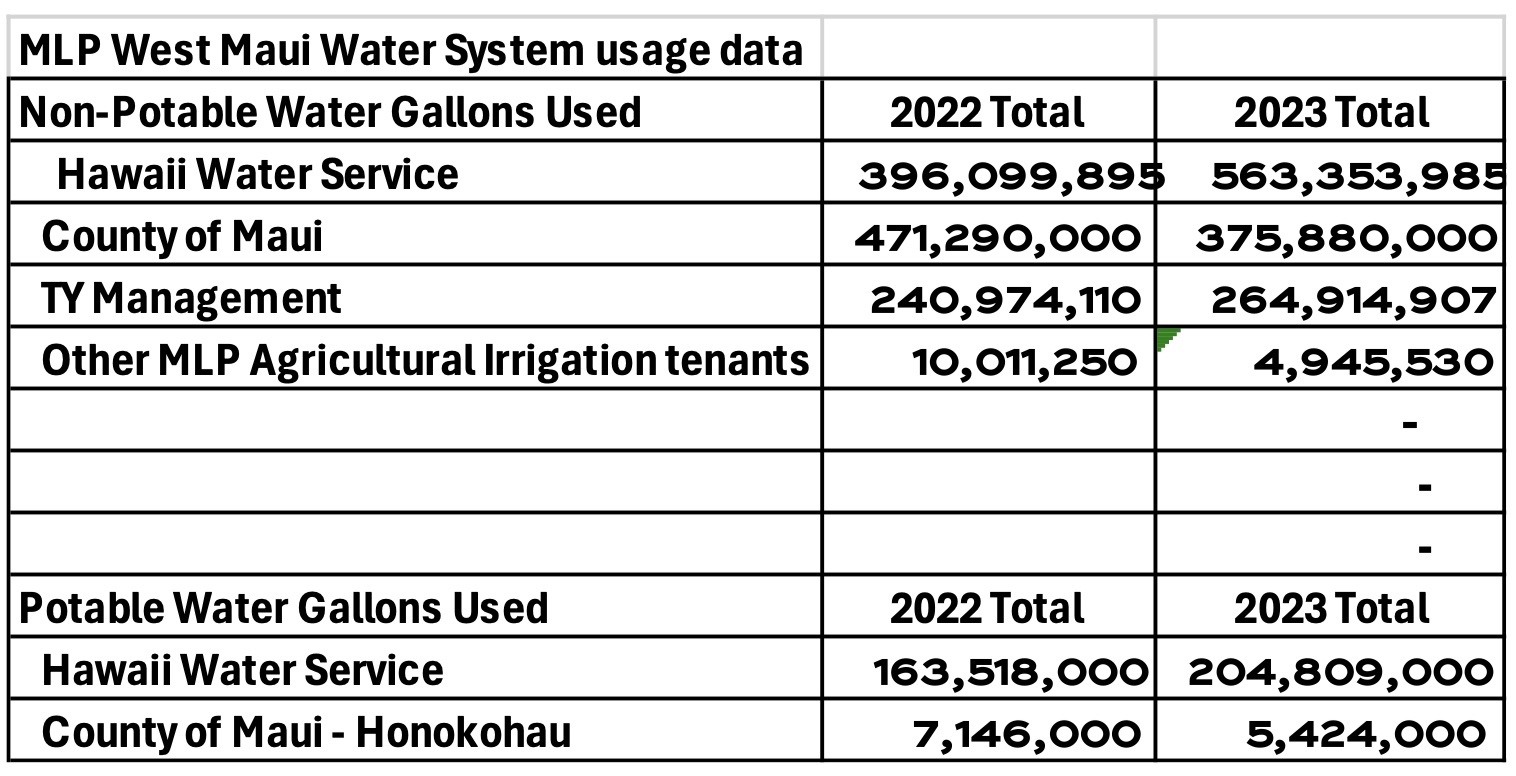
In a follow-up letter to Nakajima on October 21, 2024, Randle included a spreadsheet showing how much potable and non-potable water MLP provided to customers in 2022 and 2023. In both years, the only potable water users listed were HWS and Maui County.
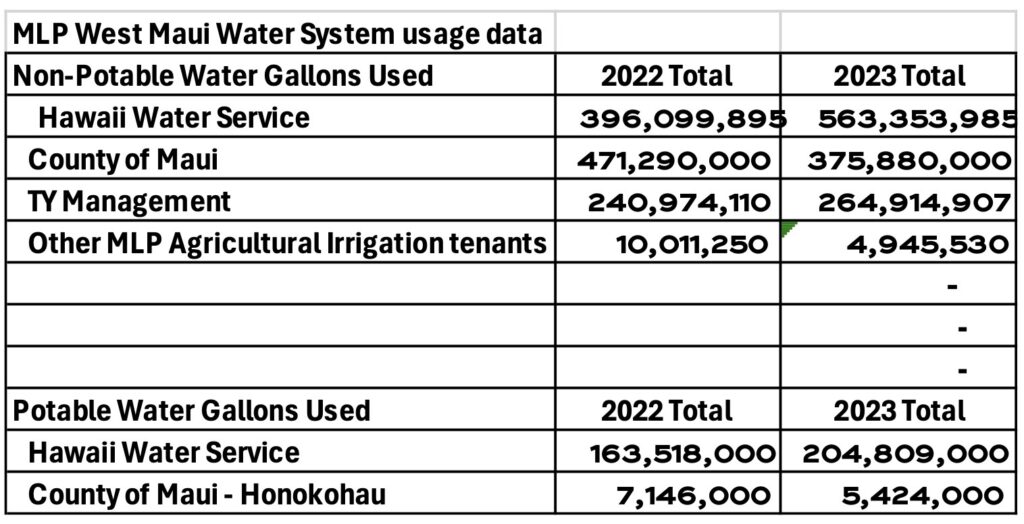
MLP’s two active groundwater wells have the capacity to provide 2.3 million gallons a day (mgd), which is far more than what the county and HWS had been using. But, Randle stated, MLP had elected not to provide well water for irrigation uses for which non-potable water was appropriate.
“Furthermore, this use would require approval from CWRM following submittal of a groundwater new use application,” Randle reminded Nakajima
On March 21, 2025, HWS issued a letter to its customers informing them that because of the lack of consistent rainfall and low flows in Honokōhau Stream, the company would implement a Tier 4 water restriction, which prohibits all non-potable water use and allows water to be used for fire protection only.
TY, apparently, did not want to comply and threatened legal action.
On April 3, Randle sent a letter to Chris Furumoto, controller for Kapalua Golf and Tennis, and TY’s Hiroyuki Uchida, responding to their March 24, 2025, email to HWS operations manager John Kadowaki and MLP’s chief financial officer Wade Kodama.
“In it, you demanded that we retract the water conservation notice and make water available for golf course irrigation, notwithstanding Hawaiʻi Water Service Company’s Mandatory Tier 4 Water Conservation Notice. You also demanded that we pump potable well water to irrigate TY Management’s golf courses to the extent non-potable ditch water isn’t sufficient to irrigate the courses. You also threaten that TY Management will make claims against us for damages if we do not comply with these demands.
“We reject your demands,” Randle wrote.
“[W]e cannot and will not deliver non-potable stream water to irrigate the golf courses when a Tier 4 notice is in effect.
“We also will not pump potable groundwater from the Kapalua wells to irrigate the golf courses when ditch water is not available. Nothing in our Water Delivery Agreements with TY Management requires us to provide water from our potable wells for golf course irrigation. While the Agreements give us the option to do so, as stated in my October 23, 2024, letter to Alex Nakajima we have not elected to do so. We are not aware of any CWRM order in effect that requires or encourages us to pump potable well water from the Kapalua wells to irrigate the golf courses,” he continued.
The next day, on April 4, 2025, Robert Strand and Onaona Thoene, attorneys for TY, wrote to CWRM chair Dawn Chang and members of the commission, asking them to order “MLP and HWS to immediately resume providing an uninterrupted and adequate supply of irrigation water to TY by using well water to supplement the irrigation water available from the Honokōhau Ditch.”
“Over the past several months,” they wrote, “MLP and HWS have issued notices stating that water shortages in the Honokōhau Ditch require that TY and other customers cease all use of irrigation water for various periods of time. These notices were issued notwithstanding the fact that both MLP and HWS have the ability to supplement ditch water with water from water wells owned by MLP in order to supply adequate water required to avoid irreparable harm to the golf course operations of TY at Kapalua. …
“In its notices to TY and possibly other irrigation water users, MLP and HWS use the interim instream flow standards adopted by CWRM to justify their decision to stop the flow of irrigation water to TY and other customers. However, reliance on the IIFS to halt the supply of irrigation water is not justified given CWRM’s recognition that irrigation water could be supplemented by well water.”
In an April 15 letter to Chang, attorneys Cal Chipchase and Darene Matsuoka, representing MLP, responded to TY’s claims. The attorneys acknowledged that there was limited water available from Honokōhau Stream for the golf courses, but told Chang what MLP had already told TY — that the water delivery agreements between MLP and TY require that potable uses of groundwater have priority during times of limited supply.
“Elevating the irrigation of golf courses above other uses, TY seeks an order from the Commission on Water Resource Management directing MLP to deliver potable groundwater from MLP’s wells to the golf courses,” they stated. “Since the wells were not being used for golf course irrigation at the time of the water management area designation for West Maui and are not part of MLP’s groundwater existing use application for the golf courses, TY effectively asks CWRM to make an exception to the process for allocating water within a water management area to prioritize the use of potable water for private golf courses.”
Before TY appealed to the Water Commission for relief from MLP’s water restrictions, “MLP reminded TY that under the water delivery agreements, MLP is not obligated to supplement pumped potable groundwater for irrigation of the golf courses and that TY could develop its own ground water well on the easements granted by MLP to TY more than a decade ago,” the attorneys wrote.
“[G]olf course irrigation is not an existing use of MLP’s potable wells. Instead, the use is a new use within a designated water management area and would require a new use groundwater use permit. … CWRM does not have authority to compel MLP to commence TY’s new use without an issued permit for the use,” they continued.
On April 25, Chang responded to the request from TY’s attorneys, noting the assertions of MLP and HWS that the private water delivery agreements govern TY’s water allocation.
“Those agreements,” she wrote, “explicitly prioritize potable uses and allow but do not require MLP to provide substitute groundwater. The commission does not have the authority to rewrite these agreements or reallocate water outside the scope of its permitting authority.
“Based on the current record and our policy priorities under the Water Code, the commission declines to intervene as requested,” she wrote.
On August 18, TY, associations of apartment owners in Kapalua, and Hua Momona Farms, LLC, sued MLP over their lack of water. By then, TY’s golf courses had dried out, threatening PGA’s The Sentry tournament that had been scheduled for January 2026, the complaint stated, adding that the event generates more than $48 million for Maui’s economy.
Around this time, apparently, the governor’s office got involved.
In a memo to Gov. Josh Green that same day, CWRM deputy director Ciara Kahahane explained that because groundwater was not being used to irrigate the golf courses in August 2022, when CWRM’s water management area designation took effect, it could not be used for that purpose now. And given the severe drought conditions in West Maui, it should not be allowed for golf course irrigation, she added.
But just a few days later, on August 21, Chang sent an email to MLP that stated — despite all of MLP’s previous correspondence about past groundwater uses — “Hawaiʻi Water Services has confirmed that, prior to designation, groundwater was used as a substitute source for irrigation purposes, including on the Bay and Plantation golf courses. This letter confirms that temporary use of groundwater as a substitute for surface water during low flow periods is allowed for irrigation uses, including at the Bay and Plantation golf courses, pending commission action on [HWS]’s water use permit application.”
But it was too late to save The Sentry. On September 16, the PGA announced that it would be cancelling that tournament, which had been set for early this year.
Even so, the next day, former CWRM groundwater program manager Roy Hardy, now a senior engineer with the consulting firm Akinaka and Associates, Ltd., sent an email to CWRM staffers Ryan Imata and Dean Uyeno that seemed to suggest the HWS’s failure to include TY’s use of groundwater for its golf courses in its water use permit application was simply an error.
“I think it’s moot now that the PGA tournament is cancelled, but would it be possible for HWS/MLP to amend their [Groundwater Use Permit Application] and/or [Surface Water Use Permit Application] to include the obviously missing [golf course] TMKs for the existing end uses before any online posting or public notice so they can continue with their real existing use until the CWRM acts? Is it worth TY management … to write in asking for this orshould they just go through the process, raise their objections that will trigger additional public hearings, and possibly a [contested case hearing] if not allowed to include the TMKs missed by HWS/MLP?” Hardy asked.
Imata replied the next day that with regard to the possibility of amending the applications, “That’s more of a policy/legal question that needs to be addressed by both our [attorneys general] and the commissioners.” And as for what course TY should take, Imata wrote that he could not provide any advice, but guessed that if TY asked in writing to amend the applications, the request would be sent to a deputy attorney general and a submittal might be prepared for commission decision-making.
Whatever TY’s past uses of potable water had been, Chang’s communications that effectively blessed the company’s use of groundwater for its golf courses alarmed attorneys at Earthjustice when they eventually learned of them.
In a November 17 letter to her and commission members, Earthjustice’s Dru Hara and Isaac Moriwake argued that her actions were unilateral and unlawful.
“Based on the chair’s communications, MLP and HWS have provided, and are still providing, millions of gallons of potable water from MLP’s Kapalua wells to irrigate the golf course since August, even while Maui Komohana continues to suffer from historic drought and kamaʻāina community members remain under strict water restrictions,” they wrote. “This water use, and the chair’s correspondence purporting to allow it, not only violates the commission’s fiduciary duties under the constitution and the state Water Code, Hawai‘i Revised Statutes Chapter 174C, it also offends the conscience of the public and Maui Komohana community members who trusted this commission to uphold the law in designating Maui Komohana’s water resources for commission management. To remedy this violation and injustice, Earthjustice requests that the chair take immediate action to rescind her prior communications.”
Chang never did rescind her statements and has since been on medical leave starting December 29, with Kanakaʻole filling in for her.
‘A False Choice’
Not long after receiving Earthjustice’s letter, which argued that Chang’s August confirmation of previous groundwater use for golf course irrigation was unsupported by any evidence, she wrote to MLP, HWS, and TY asking for proof.
She reminded them that in a subsequent letter that month, she clarified that her statement was merely a confirmation of what she was told, not an authorization by the commission. And her initial confirmation was “based on MLP’s representation that it had confirmed with HWS ‘that, prior to designation, groundwater was used as a substitute for irrigation purposes, including on the Bay and Plantation golf courses,’” she wrote.
Chang then asked the companies to provide documentation that groundwater was used as a substitute source for golf course irrigation before the water management area designation took effect on August 6, 2022.
“Upon review of all available documentation, we will determine if there remains a valid basis to support any continued use of groundwater for golf course irrigation pending final decisions on water use permit applications,” she wrote in a November 24 letter. She gave a deadline of December 8 to submit relevant documentation to Kahahane.
But when December 8 came, Chang changed her mind. In an email to the companies she wrote, “Upon further review, I will be requesting that the Water Commission schedule a formal proceeding to address these issues. Pending my formal request to the Water Commission, I am rescinding the request for historical documentation. An official letter from me will be forthcoming.”
She sent the email just before 10 p.m. Earlier that day, she had received a letter from Hara and Moriwake of Earthjustice arguing against her proposed plan of action.
“While we appreciate the follow-up gesture in response to our letter, this fact-finding inquiry is untimely and irrelevant. No party has submitted an existing use water use permit application for the use of groundwater to irrigate the golf courses, and any belated applications, addendums, or amendments are legally prohibited. Thus, any current use of groundwater for temporary irrigation purposes is unlawful and must immediately cease” (emphasis in original).
They renewed their request that she rescind her prior communications on the matter and asked her to “clarify for the record that the use of groundwater to irrigate the golf courses is not allowed or authorized unless and until the full Commission may address this issue in a formal determination based on a proper record and with due process for interested parties.”
At the commission’s February 24 meeting, staff sought guidance on how to proceed.
The staff submittal noted that under § 174C-50(c) of the Water Code, “[e]xcept for appurtenant rights, failure to apply [for a water use permit] within [one year of designation] creates a presumption of abandonment of the use, and the user, if the user desires to revive the use, must apply for a permit under section 174C-51.’”
Even so, staff wondered, “At what stage in the water use permitting process should the scope of an existing use be determined? When does that determination become enforceable? When, if at all, may an existing use permit application be clarified, supplemented, or amended after the application deadline, and what effect does this have on the scope of uses allowed to continue pending commission action?”
To determine the answer to those questions and others raised by the TY golf course matter, staff asked the commission to choose from three paths forward:
Option 1, await a petition from an interested person (i.e., an Earthjustice client); Option 2, initiate a proceeding on its own to address the questions; or Option 3, defer additional action on these issues and instead direct staff to prioritize completing the West Maui water use permit application process.
At the commission meeting, Kahahane warned that any type of proceeding to deal with the questions surrounding TY’s groundwater use on golf courses (Options 1 and 2) would divert staff time and resources away from water use permit processing.
TY general manager Kenji Yui stated in written testimony that it had only recently learned that MLP and HWS “had previously used limited amounts of groundwater to supplement the non-potable water supply in times of shortage.” TY did not indicate when that happened, for how long, or if it was, indeed, an existing use as of August 6, 2022. Yui also characterized HWS’s groundwater use permit application as incomplete and inaccurate.
(In the lawsuit filed against MLP over water availability, MLP attorneys stated that TY did use groundwater pumped from MLP’s wells into its non-potable reservoirs during water restrictions imposed in 2025, but without MLP’s consent. “TY is not contractually entitled to use MLP’s groundwater to irrigate the golf courses. TY took and used the groundwater anyway,” they wrote in a December 29 filing. MLP’s attorneys also pointed out that TY, “with the help of its legal counsel, compiled and submitted its own existing use information” for HWS’s water use permit applications. The applications listed less than 5,000 gallons of groundwater a day and nearly 800,000 gallons per day of surface water for TY’s golf courses. MLP’s attorneys argued that Hawaiʻi Administrative Rules require that, “An existing use that is waiting on a water use permit may not exceed the amount of water stated for that use in the permit application.”)
When it came time for the public to testify, Moriwake spoke to statements made in the staff submittal.
“I really didn’t appreciate how it was so confusing, how it obfuscates the issue and made things, like, way, way more complicated than it has to be. And it’s a false choice, right? Supposedly, we have to move forward for the permits OR deal with this golf course violation issue and itʻs not an either/or. And by the way, there’s an implicit threat in there: If we deal with this golf course issue, which the previous chair created with the illegal letter, then we’re not going to be able to process your permits. Well, everyone’s going to say, ‘Of course, process our permits,’ because that’s what you should have been doing these past three years.”
He added that options 1 and 2 were red herrings.
With regard to option 1, he said, “We don’t need a petitioner to come forward. We don’t need a petition. That’s not our burden. That’s not the public’s burden.”
And regarding option 2, he said, “We don’t need a contested case hearing. This is not a factual issue. We don’t need evidence.” Instead, the matter of amending a water use permit application was a legal issue that had already been decided by the Hawaiʻi Supreme Court, he said.
He also asked, again, that the commission reverse Chang’s “misstep.”
“We have this letter hanging over everyone’s head … that was issued by the chair unilaterally,” he continued.
More than a dozen members of the public testified ahead of Moriwake, most of them calling for the same things he and his fellow Earthjustice attorneys had asked for.
Karyn Kanekoa of Hui Nā Mamo Aloha ‘Āina o Honokōhau, a nonprofit that includes residents and lineal descendants of Honokōhau Valley committed to protecting water resources and restoring lo‘i throughout the valley, also called Chang’s August 2025 confirmation emails unlawful.
“I’m pretty sure we all know that already,” Kanekoa said.
“Using clean, drinkable groundwater to irrigate a golf course, especially during a historic drought, is an insult to our community. We’ve placed our trust in you with the designation of Maui Komohana. We consistently take time out of our busy schedules to show up each time to make sure decisions aren’t made without our voices being heard. And it’s getting pretty luhi (tiresome) doing this over and over and over again. … Many of us are educators, so we are away from our keiki today to fly here [to Honolulu] to testify because that’s how important this is to us,” she said.
She added, “The commission should rescind prior communications regarding this and demand that no groundwater be used for golf course irrigation without a proper permit. Why does that frustrate me? Because we are a WUPA applicant still waiting for our permits to be looked at.”
Following her was Honokōhau valley resident and kalo farmer Kalei Kauhane, who also complained about what he saw as commission staff prioritizing private uses, “like this golf course,” over public trust uses.
“We’re a public trust purpose and it’s supposed to be a priority. We don’t even need one permit under the [water] code, but we filled one out anyway,” he said.
He continued, “We had one private meeting, ya, with these guys [TY]. And you know the checkbook, they like bus’ ‘em out, you know. They do. They bus’ ‘em out thinking they can buy us. But us, we no budge. We gon’ hold steady and we gon’ eat stones before we fricken’ take their check.”
Kudo testified that the company ultimately wants to use recycled wastewater for irrigation.
He claimed that TY had unwittingly used groundwater on its golf courses.
“We receive water from a reservoir that’s on MLP property, that’s controlled by HWS. … We don’t operate the valves. We don’t know where the water is coming from day to day. We just take the water from the reservoir. …
“We never filed a WUPA for an existing use because we were not the people that developed the water, distribute the water or transmit the water. We are just the user of the water. Like a spigot.
“That doesn’t give us an excuse to use potable water. We know that. But during this time, what we consider to be a West Maui water crisis, we were using water that was delivered to us by HWS,” he said.
Kudo also repeated claims by TY’s Yui that it only recently learned that details of its groundwater use.
“When this whole situation arose and chair Chang sent out letters to the users to explain or comment on anything about existing use, it was the first time we realized there was going to be potable water being put in the thing and we were using the potable water. It was also first that time we realized, when we looked at HWS’s WUPA … that we noticed the irrigation part of it was not included,” Kudo said. (This, despite the October 2024 letter from MLP’s Randle informing TY’s Nakajima that the use of groundwater for irrigation would “require approval from CWRM following submittal of a groundwater new use application.”)
In the end, Kudo asked for the community’s forbearance.
“We respect the [traditional and customary] rights. And we want to be fair to everyone, but we also need to operate and continue to operate until we can get the R1 water to our golf course, which is all we’re asking the community to have patience that we do,” he said.
“The water code allows, in our reading of it, for flexibility for those people who earnestly committed a mistake or omission to correct those mistakes as part of the justification hearing process,” he added.
Referring to a briefing TY planned to present to the commission later that day, Kudo said, “I would like all of the community that’s present here today to truly try to listen to what our ideas of a solution are to bring more water to West Maui and to have an open mind on it.”
The Letter
Following public testimony, commissioner Hannah Springer asked acting chair Kanakaʻole whether he, on his own, could rescind Chang’s August 21 letter or whether the whole commission needed to take action. And Kathleen Ho, the state Department of Health designee on the commission, asked if commission action was required, whether it could act that day given the description of the item on the agenda that day.
The deputy attorney general advising the board replied, “That cannot be decided today because it was not properly agendized.”
In any case, commissioner Lawrence Miike said, “That’s an issue to discuss with counsel about what we can do about it. … It seems to be that the issue about rescinding that letter is something we would do in executive session and it seems we’re really not prepared until we know more from the lawyers, so I would say that we deal with the current three options.”
Commissioner Moses Haia, however, disagreed with the deputy AG’s statement. He said that under option 2 in the staff submittal, “there’s the deputy director requesting guidance on procedural questions relating to the scope of claimed existing uses, amendments to existing use applications and administration of interconnected surface and groundwater systems in the Lahaina surface and groundwater management area on Maui, including groundwater use for irrigation at the Kapalua Bay and Plantation golf courses.”
(It should be noted that missing from the information provided in the submittal are any of the responses provided by TY, HWS, or MLP to Chang’s request for documentation of preexisting groundwater use by December 8. Her email rescinding her request came well past business hours that day, and written testimony submitted to the commission last month suggests that TY, at least, submitted something. Yui’s testimony cites the company’s “December 8, 2025, response” to the commission’s request for documentation.)
Miike, however, just wanted to keep the permitting process moving. “No more delays. … All the questions about who should get water and what priority has to be held in a hearing on each of the applications. So I’m in favor of option 3.”
Commissioner Springer asked, “If we take up option 3, may we not, concurrently, address one or more of the questions in option 2, as they may arise?”
Kahahane said the two options were not mutually exclusive. “It is merely a question of the posture this commission chooses to take,” she said.
Should the commission choose option 3, she said her staff would prioritize the completion of the West Maui water use permitting process.
“I would proceed to post public notice for those [applications] that meet the minimum requirements of 174C-51 [of the Water Code], so that we can get proceedings started that trigger the opportunity to object. It triggers the potential for contested case hearings,” she said.
“To the extent that it’s not possible to publish notices for all the applications at the same time, as I suggested on the record, staff could prioritize those who checked the box on their applications for traditional and customary rights or appurtenant rights,” she added.
She confirmed that those applications make up about 70 of the 150 or so that had been submitted.
Still, Haia pressed his belief that the commission could act that day on Chang’s letter.
“This action item, in its explanation, also deals with that letter. It has to deal with that letter,” he said.
The commission then held an executive session to discuss the commission’s options. Upon returning, Kanakaʻole reported that it had received the same answer the deputy AG stated publicly. “We cannot [act on the letter] because it was not properly agendized,” he said.
The commission then voted to approve a motion by Miike, seconded by Ho, to choose option 3.
Throwing Money
Before TY representatives could start briefing commissioners on its plan to help ensure all users in the water management area have sufficient water for their needs, members of the public who needed to catch their flights back to Maui were allowed to testify.
Kauhane cursed the commission out. “We came all the way from Maui and this is what we gon’ get?” he yelled, angry that TY was being given a platform to present the commission with ideas to solve the water crisis.
“ʻAʻole pono. This no can. How come? And you guys know what I’m talking about. This guy must get his [expletive] checkbook in your face, too.”
Kanekoa testified that she appreciated TY’s proposing potential solutions, but said she had serious concerns with the way TY was going about it.
“Their proposal to throw money at the problem is for what? We hope not so they can continue to pump groundwater in exchange for whatever it is they’re offering. … That turns the law and the process on its head,” she said.
When it came time for the briefing, Kudo was joined by TY’s Yui, Ryan Toyomura from Kudo’s office, hydrogeologist Ken Kawamura from Akinaka and Associates, and Jim Gannon from the nonprofit Peace Winds America.
Yui described the plan’s four parts:
1) Acquire MLP’s Honokōhau Ditch and improve it to increase the amount of water available to end users, then turn it over to the state Agribusiness Development Corporation to manage;
2) Increase storage of excess diverted water via reservoirs and/or tanks;
3) Develop two potable wells able to provide two million gallons of water a day and dedicate them to the county in exchange for recycled (R1) water for TY’s golf courses; and
4) Help expedite the processing of the water use permit applications submitted for the West Maui ground and surface water management area.
TY hoped to complete much of its plan by 2030 with help from Peace Winds America. PWA would create an LLC that would enter into public-private partnerships with the ADC and Maui County.
“The LLC will engage professionals to act quickly on the water solutions,” Yui said.
“We are ready to provide funding support,” said Yui repeatedly during his presentation.
“It will take more than $10 million, $20 million, $30 million,” Kudo told the commission.
But as members of both the public and the Water Commission later made clear, committing funds — even the tens of millions of dollars offered — may not accomplish much, given that significant parts of the may be either duplicative or infeasible.
Attorney Cal Chipchase, who represents MLP, contested TY’s allegations that the ditch system was not being optimally managed.
“CWRM staff has previously described that system as very efficient. Indeed, it is very efficient. The idea that leaves in the intake are somehow meaningfully impacting the water that’s taken out of the stream is, I don’t think, supported,” he said.
In a presentation to the Water Commission last September, HWS representatives described various ongoing projects to improve ditch operations to make sure interim instream flow standards are met and to meet user needs.
More importantly regarding TY’s plans to acquire the ditch system and turn it over to the ADC, Chipchase and Maui DWS deputy director Kimo Landgraf informed the commission that the county is negotiating with MLP to purchase its water assets.
“We believe that we’re the best operator and manager of the water system. We have the best capacity,” Landgraf said.
In fact, when TY first mentioned its plan to turn the ditch system over to the ADC, Water Commissioner and former ADC board member Wayne Katayama seemed confounded.
The system currently serves only the golf courses, Hawaiʻi Water Service customers, and the Maui DWS. Serving non-agricultural users is “not what they do,” Katayama said of the ADC.
He pointed out that the ADC is not a public utility. “They’re basically focused on providing irrigation water for ag activities. That’s their entire project, whether it be here on Oʻahu using the Waiahole system or Kekaha system or Kokeʻe system on Kauaʻi.”
When Katayama questioned whether the state had much land in West Maui worth getting the ADC involved, Kudo said that the company was willing to purchase land for an agricultural park “and to create the fourth use.”
Given that, Katayama said the plan’s capitalization costs were getting higher, adding, “If you can do this, I think would be a monumental shift in water management.”
Kudo later added that the ADC’s “legislative charge is to be throughout the state. It behooves them to want to be on Maui. … We’ve had several meetings with them. They seem to be excited about participating in this project.”
Chipchase testified that the presentation that day was the first he or MLP had heard of TY’s plans.
As for TY’s proposal to increase water storage by building or rehabilitating reservoirs and/or installing storage tanks, Landgraf said that the county is already designing a 100-million-gallon reservoir in the area to catch the high flows off Honokōhau Ditch.
With regard to TY’s proposal to drill two potable wells and install a pipeline to provide the DWS with potable water and to receive R1 water from the county, Landgraf said the county has already decided that the R1 water from its treatment plan will go south, not north to Kapalua.
What’s more, he estimated that the county’s existing and planned wells in the Honolua aquifer “may bring us really close to sustainable yield” before TY’s proposed wells can be developed. “It’s close. I think it’s really close,” he said.
Earthjustice attorney Mahesh Cleveland also weighed in on the likelihood that the county would provide TY’s golf courses with R1 water anytime soon.
He noted that in addition to working with West Maui residents on water resources, Earthjustice also represents plaintiffs in an injection well case “where maximization of R1 reuse has been a priority of ours for going on two decades.
“I really appreciate TY’s optimism about what they can pull off according to their plan, but I think it’s a lot of sort of aspirational talk without a lot of reality to back it up,” he said.
“I appreciate they would very much like to be in a rush to bring R1 all the way up to Kapalua to use on their golf course. That would be great. The fact of the matter is, we’ve been trying to get the county of Maui to move that R1 water even just up to the top of Honokōwai in order to distribute it down to other users,” he continued.
“Whether the county would be able to move that R1 far enough up the hill in order to distribute it to Kapalua in, I think they said, two years, is, I would say, questionable, at best,” he said.
He added that the county currently distributes its recycled water to some golf courses, landscaped areas, and resorts down in the Kaʻanapali area.
“So while we would love to see none of that R1 be dumped in the injection wells to pollute the reef at Airport Beach, we just want to make sure that people are kind of looking at this in a realistic way. Could they get R1 to Kapalua in two years? Or is maybe this is just sort of an attempt to offer to throw money at anything out there just in order to get permission to keep using groundwater to water their golf courses in the meantime?” he asked.
Jonathan Likeke Scheuer, a policy consultant for the Department of Hawaiʻian Home Lands, testified that TY planned to present its plans to DHHL as well. He reminded the commission that DHHL water uses are also public trust uses. The department has water reservations from the commission for 777,000 gallons per day of groundwater from the Honokōwai aquifer and a 2 mgd reservation of surface water from the ditch system.
“When you add those together, that’s still not actually sufficient to meet our potable and non-potable needs,” he said, adding that even with an existing contract with the county’s Department of Environmental Management for half a million gallons of recycled water, “we’re still going to be short for our existing homesteads,” he said.
“This commission needs to really move forward with considering public trusts as soon as possible. And it’s going to be really … important when you guys consider water use permits that you have the full possibility of recycled water as alternate uses for various other demands in the area,” he said.
Also, he said, if the commission revisits the IIFS for Honokōhau Stream, given the drought conditions and DHHL’s rising water needs, “There may be not sufficient water in Honokōhau Stream for the county, DHHL and instream uses at Honokōhau. … much less additional uses of water.”
Like Scheuer and many others who testified, Moriwake expressed his appreciation for TY’s “can-do attitude and the solution-oriented approach.”
However, he continued, “I would respond with three questions: Number 1: How did this agenda item happen? Did someone call up deputy director Kahahane and say, ‘Hey, we want to have this presentation?’ For that matter, can anybody? Can I, on behalf of [Lahaina community leader] Kekai Keahi, for the next meeting reserve an agenda item? I think there should be some kind of public discussion. I’m not being facetious here. … As you may recall, Kekai did ask [at a previous meeting], ‘Hey, next time, let’s have the community have the platform.’ And yet these big entities keep having their dedicated presentations.”
Second, he continued, “What are we talking about? Why are we talking about this? Why do they have an audience here? And how is this helping the Water Commission do its job processing permits and what have you? …
“I have big plans, too. I can make a powerpoint, too, but I don’t have $1 billion dollars, I guess,” he said.
After the public had testified, Kahahane reported that staff hydrologist Ayron Strauch was available for any questions commissioners might have on some of the hydrologic information TY had presented and its claims that the lack of water availability from the ditch was due to mismanagement, rather than low stream flow.
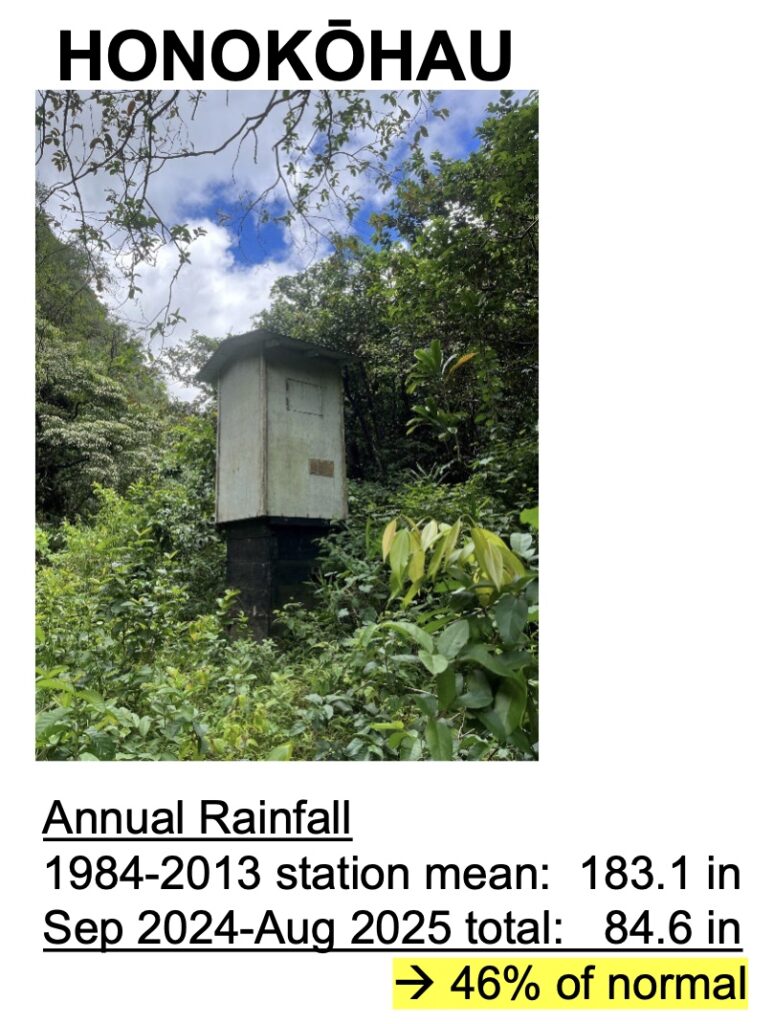
“Ayron has let me know he would be more than happy to comment on some of the information that was shown,” she said.
The commissioners, however, had no questions and did not comment on the briefing.
The impact Kanakaʻole’s March 2 letter on TY’s plans remains to be seen.
In any case, Earthjustice’s Hara stated in the release, “With the rest of West Maui living under water restrictions, the former chair threw public trust priorities out the window. She let a golf course, without a valid application, cut in line in front of everyone else, take drinking water for its grass, and take up all the commission’s attention. By correcting this misstep and putting the law and the kamaʻāina community first, chair Kanaka‘ole has set the commission back on track toward pono stewardship of Maui’s water resources.”
— Teresa Dawson