
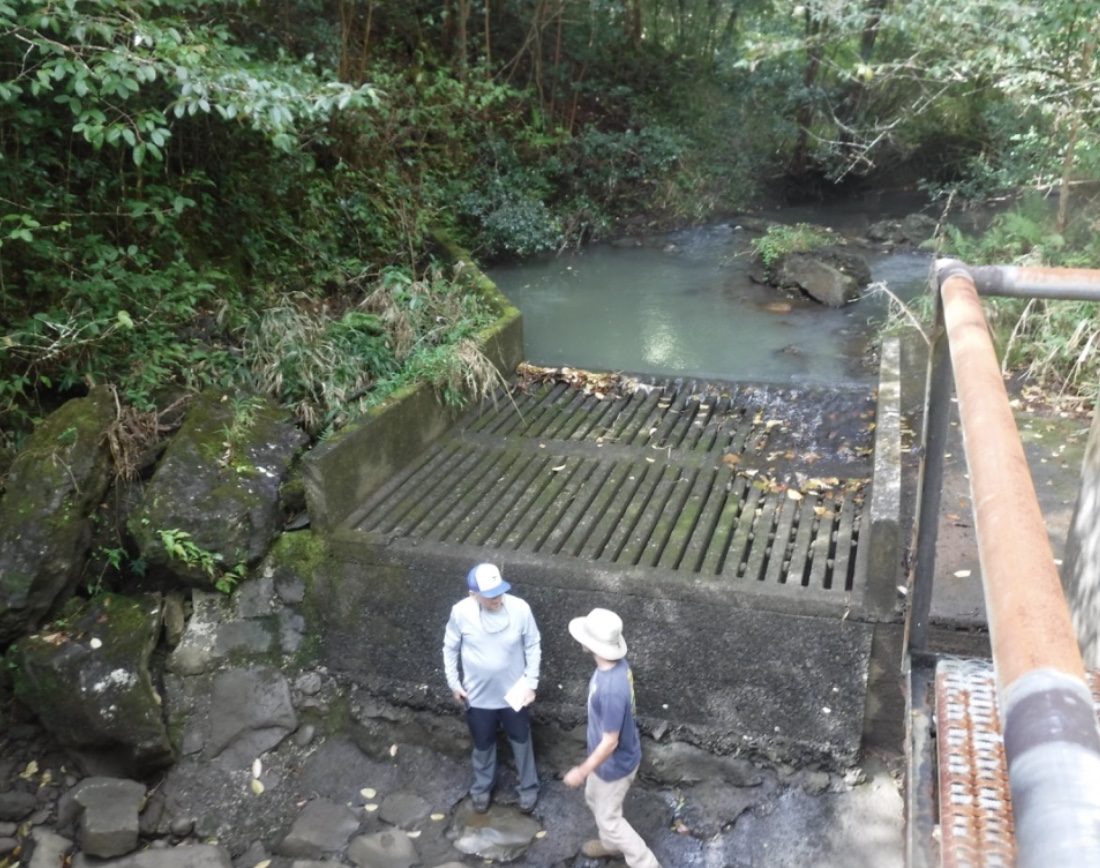
Above photo: A stream diversion in East Maui. CREDIT: SIERRA CLUB OF HAWAI‘I.
Last month, the Hawaiʻi Supreme Court granted applications for a writ of certiorari from both sides of a case involving the state Board of Land and Natural Resources’ renewal of permits to Alexander & Baldwin and East Maui Irrigation Company that allowed the continued daily diversion of tens of millions of gallons of stream water from East Maui to Central and Upcountry Maui.
Oral arguments will not be held.
In this case and older, related cases, the Sierra Club of Hawaiʻi has argued that the Land Board violated its trust duties by allowing the companies to divert more water than they need, while lower reaches of some of the East Maui streams that supply the water are left dry most of the time.
Late last year, the court heard oral arguments over an April 2024 Intermediate Court of Appeals ruling that the Sierra Club of Hawaiʻi was not entitled to a contested case hearing on permits granted to A&B and EMI by the Land Board for stream diversions through 2021, and that the Environmental Court erred in modifying the amount of water that could be diverted under those permits.
The high court had still not issued a decision when, on April 30, the ICA issued a similar ruling in a case involving the Sierra Club’s appeal of the Land Board’s November 2022 approval of permits to the companies for stream diversions through 2023, as well as the board’s denial of the group’s contested case hearing request.
The recent ICA decision vacated rulings by the Environmental Court, which had found that the Sierra Club was entitled to a contested case hearing and which had lowered the amount of water that the companies could divert in the meantime.
The ICA also reversed the lower court’s ruling that the Sierra Club was entitled to attorney’s fees from A&B and EMI.
The ICA found that the Sierra Club had standing to request a contested case hearing, but was not entitled to one.
“Here, in addition to the 2020 trial [on earlier permits] and BLNR’s 2020 public meeting discussed in Sierra Club I, Sierra Club has participated in a contested case hearing on the 2021 and 2022 permits, and presented evidence and testimony at BLNR’s 2022 public meeting and 2022 hearing on the petition,” the ICA wrote. “BLNR’s June 30, 2022 contested case order on the 2021 and 2022 permits was issued just four months before its public meeting on the 2023 permits and its hearing on Sierra Club’s [contested case] petition. BLNR considered the same issues about water usage and loss, alternative resources such as groundwater, mitigation measures such as placing liners in reservoirs, and a pending [Commission on Water Resource Management interim instream flow standards] decision, Sierra Club raises here. …
“We again conclude that the minimal additional protection a contested case would have provided to Sierra Club under the circumstances of this case are outweighed by the fiscal and administrative burdens a contested case would impose on BLNR, the County of Maui, and potentially on those living or working in Upcountry Maui. We hold that Sierra Club was not denied constitutional due process by BLNR’s denial of its petition for a contested case hearing on the 2023 permits,” the ICA wrote.
In its June 26 application for a writ of certiorari, the Sierra Club argued, “The ICA’s conclusion is primarily based on two false premises. First, the ICA erred in finding that the Sierra Club was obligated, and failed, to provide new evidence. Second, the ICA overlooked the importance of cross examination.”
David Kimo Frankel, the Sierra Club’s attorney, stated that the organization was barred from cross examining the Water Commission about new groundwater data on sustainable yields of the aquifers available to the companies and A&B about its groundwater use.
The group was also “unable to rely on cross examination to undermine the credibility of A&B’s witnesses who had previously testified falsely under oath about how much water was needed for historic/industrial uses. The Sierra Club was unable to ask questions about CWRM’s determination as to how much water was actually needed for diversified agriculture, the conflict between how much water A&B claimed was needed for diversified agriculture in 2022 and how much was actually used, how long it would take to implement the measures CWRM determined are needed to protect streams, and from which streams A&B was planning to increase its diversions. BLNR denied the Sierra Club the ability to cross examine witnesses about this new evidence, cross examine witnesses about the credibility of prior statements in light of the new evidence, or obtain information that only A&B possessed.
“Consider just this one example: BLNR’s June 2022 decision concluded that groundwater was not available to irrigate crops, but new evidence demonstrated that groundwater is being, and can be, used. At BLNR’s decision-making meeting, A&B claimed that it could not rely on groundwater. The Sierra Club was not given an opportunity to cross examine EMI’s Mark Vaught as to his false claim that groundwater information was ‘old data.’ A&B’s final EIS, published just a year earlier, contained current data and states that the sustainable yield is 32 mgd. Even more importantly, CWRM came to the same conclusion after the 2021-22 contested case hearing. A&B’s Meredith Ching complained to BLNR that ‘Mahi Pono is not the only user of that aquifer.’ But the Sierra Club was not given the opportunity to cross examine her or show that all the other users of water use less than 1 mgd combined.”
In its application for a writ of certiorari, the state, represented by deputy attorney general Miranda Steed, argued that the ICA erred when it found that the Sierra Club had standing to seek a contested case. Also, Steed argued that the Land Board lacked the authority to grant the relief the Sierra Club sought. Increasing stream flows, she argued, fell under the exclusive jurisdiction of the Water Commission, which establishes the minimum amount to water that must remain in streams.
“The ‘cause’ of Sierra Club’s alleged environmental injury is insufficient stream flow protection—not the existence of water users with Board permits. Only CWRM may increase IIFS or implement other stream protections,” she wrote.
“Sierra Club essentially seeks to have the cap [for the] amount of water for the 2023 [revocable permits] lowered. Lowering the cap would not guarantee that the permittees would divert less water from any given stream. In fact, the permittees could increase water diverted from some streams even with a lower cap. This is because the cap applies to the total amount of water diverted, not how much water may be diverted from a specific stream (as opposed to the IIFS). Thus, Sierra Club’s alleged injuries in too much water being diverted from any given stream could occur even with the cap the Environmental Court imposed,” she continued.
She stated that while the Land Board acknowledges its public trust obligations, its authority to grant dispositions for water and impose conditions “does not extend to independently regulating stream flows, system losses, and alternative sources in a manner that would effectively duplicate or potentially conflict with CWRM’s regulatory authority.”
She asked the high court to determine whether the ICA erred in concluding that the Sierra Club had standing and that it had protected property interests under the state Constitution’s article XI, section 9 as defined by Hawaiʻi Revised Statutes 171-55, the state law governing the Land Board’s issuance of water permits, and Chapter 343, the state’s environmental review law.
In the Sierra Club’s response, Frankel called the state’s application “audacious,” adding, “It demonstrates a remarkable betrayal of its trust duties.”
The Land Board was arguing that it “lacks the authority to protect our streams and require the conservation of water. Its argument is inconsistent with the law and its own practice, and demonstrates how far it has strayed from fulfilling its trust duties. The premise of BLNR’s claim that it is powerless to provide relief is flawed for nearly a dozen reasons,” he stated.
He went on to list ten reasons, first pointing out that under the Hawaiʻi Supreme Court’s 2014 decision in the Kauaʻi Springs case, in which a private water bottler sued the Kauaʻi Planning Commission, trust obligations to protect water resources “are imposed on all agencies, not just CWRM.”
“Just as the Kaua‘i Planning Commission needed to ensure that the applicant implemented mitigation measures, so too did BLNR. Just as the Kaua‘i Planning Commission was obligated to require that a commercial applicant demonstrate the absence of alternative water sources, so too was BLNR. Just as the Kaua‘i Planning Commission was required to ‘preserve the rights of present and future generations in waters of the state,’ so too was BLNR,” he wrote.
He also pointed to a 2003 decision by 1st Circuit Judge Eden Hifo, in which she held that the Land Board could not just rubber-stamp Water Commission decisions and was “obligated to make a truly independent investigation as to whether it’s in the state’s best interest to authorize the diversion of water from East Maui streams.”
And for 2016, Frankel continued, the Land Board included a condition in its approval of water permits that year for A&B and EMI that no diversion of water would be permitted from Honomanu Stream. He added that in 2007, the Land Board ordered A&B to allow 6 million gallons a day to flow in Waiokamilo Stream.
“These isolated efforts demonstrate that BLNR has the authority to protect our streams. BLNR cannot blow hot and cold. It is judicially estopped from arguing that it lacks the power to protect streams,” he wrote.
In the Land Board’s response to the Sierra Club’s opposition, Steed noted that the Sierra Club “claims injury because its ‘members live along and draw water from the streams in the license area for their own residential and farming purposes.’
“However, Sierra Club’s arguments focus entirely on how water is managed after it is diverted from streams, not on how much water remains in the streams. Sierra Club disputes how efficiently the permittees use water and whether end-users (not the permittees) should be required to line ditches. None of these measures address Sierra Club’s core alleged injury— insufficient water remaining in streams. The BLNR mandates that diverted water be put to reasonable beneficial use, but this is a separate issue from how much water remains in the streams.
“Sierra Club’s alleged injury can only be remedied by increasing the amount of water that must remain in streams—i.e., by adjusting instream flow standards. Only CWRM has authority to establish and modify instream flow standards under HRS § 174C-71. The BLNR cannot order more water to remain in streams; it can only regulate the terms under which already-authorized diversions occur.”
Although the permits involved in this case have expired, any decision by the Hawaiʻi Supreme Court may affect current and future permits. The Sierra Club appealed the Land Board’s decision late last year to grant a new stream diversion permit to A&B and EMI for 2025 and to deny the group’s contested case hearing request.
That appeal, which is ongoing, also raises the issues of new information and the need to cross examine witnesses.
— Teresa Dawson
For Further Reading
• “Water Roundup: Waihe‘e ‘Auwai Restoration, East Maui Flow Standards, and More,” October 2022;
• “Water Commission Defers Scaling Back Restoration of Three East Maui Streams,” December 2022;
• “Court Orders Reduction in Diversions Of Water from East Maui Streams,” July 2023;
• “Court, Land Board Are Set on Same Day To Deliberate on East Maui Diversions,” December 2023; and
• “State Supreme Court Hears Arguments On Whether ICA Erred in East Maui Case,” December 2024.