
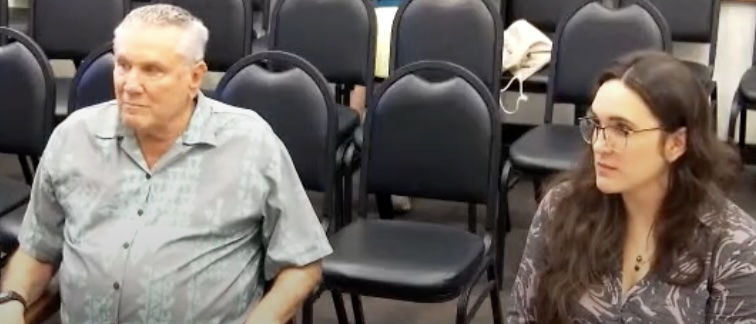
At the July 15 meeting of the Commission on Water Resource Management, director Ciara Kahahane provided a description of the funds available to support development of an Adaptive Management Plan for the Keauhou Aquifer Sector Area.
There was an unspecified amount of federal funding, which, she said, had to be spent down by the end of August.
In addition, the 2025 Legislature passed two measures providing additional support. Senate Bill 1602 (Act 189), signed into law by Governor Green on June 6, provides $200,000 over the 2025-2026 and 2026-2027 fiscal years for a project that sounds very much like the “First Generation” AMP proposed by CWRM staff. House Bill 300 (Act 250), the state budget bill, provides $4 million in the 2025-2026 fiscal year for “plans, land acquisition, and construction” of two deep monitor wells in the Keauhou Aquifer System. These wells are also part of CWRM’s plans to fill in a few of the blanks in plans for management of the Keauhou aquifer sector.
The contracts that will need to be issued to spend the recently appropriated funds are months off.
But the (mostly) federally funded agreement that was issued to GUILD Consulting and Peter Adler to develop the Adaptive Management Plan is a done deal.
And details of the financing do little to quell suspicions that the AMP is intended to facilitate housing – suspicions that may have been fueled by the fact that much of the testimony in favor of SB 1602 came from business groups whose representatives stressed the need to develop housing in the Kona area.
For example, the Chamber of Commerce of Hawaiʻi urged the Legislature to pass the measure, stating: “To expand affordable housing and address Hawaiʻi’s housing crisis, the state is launching a multi-year pilot program to improve access to reliable water in the Keauhou Aquifer System.”
No Contract
The agreement between CWRM and GUILD is not a contract. Instead, CWRM issued a purchase order for the work, with GUILD as the vendor. Kahahane signed the agreement on May 20, authorizing $148,240 in federal funds and $2,940 in general funds to be paid out for “facilitation services to organize, run, and produce report(s)and a draft adaptive management plan for groundwater resources in the Keauhou Aquifer System Area.” Documents provided to Environment Hawaiʻi do not include any record signed by a representative of GUILD agreeing to the terms of the purchase order – but, according to an unnamed CWRM staffer, “By performing and submitting invoices under the [purchase order], GUILD Consulting is deemed to have accepted the terms outlined in the scope of work.”
The starting date of the services was June 1, according to a statement by Adler at the July 15 meeting.
The proposed scope of work, which appears to have been prepared by GUILD, describes a timetable, four phases, and five milestones for fees totaling $151,180.
Notes attached to the proposal recommend “CWRM have further funds available for additional tasks that CWRM may arise [sic] or want completed. … GUILD originally estimated the whole project to be around $200,000, inclusive of contingency and honoraria, travel expenses, etc.”
Well before any agreement was signed, it was clear that CWRM was anticipating awarding the work to GUILD.
At the April 1 CWRM meeting, as Kahahane described the outline of the project to commissioners, she introduced Adler as a consultant to help facilitate the work of the working groups and advisors contributing to the development of the AMP. At that meeting, Adler told the commission that he wasn’t officially on board yet, “constrained by budget and time frame.” But, he added, he and his assistant, Stephanie Sang, were “going to work pretty fast and pretty hard to get it all done.”
Fast indeed. By June 10, just 10 days following the official start of work according to Adler, GUILD submitted its first invoice, seeking payment of $20,000 for completing “Phase I, Project Planning and Preparation.” Kahahane approved payment on June 17.
An Emergency Exemption
As a general rule, state procurement laws require agencies to bid out contract work. There are, however, several exceptions for sole-source purchases, two of which were invoked in awarding this work to GUILD.
The first exemption claimed on the purchase order form signed by Kahahane allows for “services of lecturers, speakers, trainers, facilitators, and scriptwriters, when the provider possess [sic] specialized training methods, techniques, or expertise in the subject matter.” This is provided for in Hawaiʻi Administrative Rules 3-120-4, Appendix A, exception No. 3.
The second exemption invoked is “Governor Josh Green, M.D.’s Eleventh Proclamation Relating to Affordable Housing.” That emergency proclamation expired on April 5, nearly two months before the GUILD agreement was reported to have been signed.
Since April 5, the governor has signed two more emergency proclamations relating to housing, so it may be argued that even though the eleventh proclamation expired, there’s still legal cover for CWRM referring to the proclamation, which has not changed in the two more recent versions. But the fact that the records relating to this agreement refer to the eleventh proclamation suggests that well before it expired, CWRM was anticipating the award of funds to GUILD.
Records reviewed by Environment Hawaiʻi suggest that months before the May 20 purchase order was signed, CWRM was working out the intricacies of financing this project.
In an email exchange of May 15 between Kahahane and CWRM staffer Kathy Yoda, Kahahane asks for “more PO-related assistance. I’m sure you recall this one – we wanted to use federal funds and had to create a special fund account, cancel the old PO and cut a new one.” Kahahane listed three items that needed to be changed on the “new PO:” the amount of the contract, the period of performance, a new breakdown of the distribution of funds.
In response to a question about the earlier purchase order, CWRM stated: “An initial purchase order was issued but subsequently cancelled to allow for the establishment of a special funding account for the federal funds.”
In the May 15 email, Kahahane says: “Last, I know Fiscal wanted a justification for using the Housing EP [emergency proclamation] to cut this PO.” This was followed by a two-paragraph narrative that describes circumstances and conditions that justify the housing exemption.
Among other things, Kahahane states: “The project directly supports the construction of affordable housing by addressing the longstanding conflicts over groundwater resources that have impeded well development in the Keauhou aquifer. These efforts will improve water allocation decisions, promote the protection of traditional and customary rights, and enable housing development to proceed with greater clarity and community confidence.”
The need for speed, combined with the need for housing, are factors that, she concluded, make it “in the public’s best interest to move forward without delay via this direct contracting mechanism.”
As far as the selection of GUILD to do the work, Kahahane again referred to the time constraints. “[I]t is not practicable or advantageous to procure the services required via traditional procurement methods under the current time constraints,” she wrote. Funds had to be spent by September 30, she wrote – the deadline has since moved up a month – “and traditional procurement would likely introduce delays that jeopardize both expenditure deadlines and project objectives.”
The Scope of Work
The purchase order calls for the state to pay GUILD a total of $151,180 for the services of Peter Adler to “provide facilitation services to organize, run, and produce report(s) and a draft adaptive management plan for groundwater resources in the Keauhou Aquifer System Area,” with a period of performance starting June 1 and running through November 30, 2025.
By July 15, when the Water Commission was asked to approve this project, GUILD had already been paid $20,000 for having completed the first phase of its scope of work
A second deliverable was due July 18, for which GUILD was to receive another $20,000 payment. This payment was to be for “community engagement, scoping, and commission approval.” Among other things, the work was to include holding “at least one outreach meeting for community stakeholders to comment on the expert group members, project description, and preliminary outline of elements to be included in the AMP.”
The third billable deliverable, due August 31, is to pay for “expert group meetings,” for which GUILD would “take accurate notes from each expert group discussion and prepare a report.” For this, GUILD is to be paid $37,060. The cost of travel expenses for GUILD employees or experts, plus honoraria (if any), is to be paid by CWRM and is not included in the GUILD contract.
The fourth payment is for the “first draft AMP, briefings for CWRM and the Public.” This phase includes “travel for Hawaiʻi island meetings with Native Hawaiian traditional & customary practitioners, Hawaiʻi [Department of Water Supply], Kaloko-Honokohau National Historical Park, and other stakeholders, as necessary.” Also, GUILD is to “submit a reasonable set of literature references to be attached to the draft AMP. This is due by September 30, with GUILD to be paid $37,060.
The fifth deliverable, with a deadline of November 30, is a revised plan to be presented to the commission “and others as may be needed,” with “a pre-publication draft” given to CWRM, incorporating feedback from commissioners and the public. Again, payment is $37,060.
The funds themselves were to come from a Department of Defense grant to the state Department of Business, Economic Development, and Tourism, through the DOD’s Office of Local Defense Community Cooperation. To facilitate the delivery of funds to the DLNR, the DLNR’s deputy director Ryan Kanakaole signed a Memorandum of Understanding with Laurel McAllister-Moore, director of DBED’s Military and Community Relations Office (MACRO) on April 21.
At the July meeting of CWRM, Kahahane stated that after August 31, CWRM might be able to get another tranche of federal funds, but at that time it was not certain. In late July, CWRM informed Environment Hawaiʻi that “We have confirmed that another tranche of federal funding will be available and will seek to cover the remaining balance of the PO with GUILD Consulting after August 31, 2025.”
State procurement procedures require contracts and purchase orders over a certain amount to be posted on the Department of Accounting and General Services’ HANDS website (Hawaiʻi Awards and Notices Data System). When Environment Hawaiʻi began to look into the details of this award, it did not appear on HANDS. Within a day or two of our inquiring with DAGS about possible exemptions to public posting of the award, it suddenly appeared on Friday, July 25.
“Thank you for bringing this to our attention,” CWRM stated in an email to Environment Hawaiʻi. The award has now been posted.”
— Patricia Tummons
CWRM Missing a Member; Staff Missing More than a Dozen
Terms for two members of the Commission on Water Resource Management expired on June 30.
Aurora Kagawa-Viviani completed her first term on the commission. Governor Josh Green did not nominate her to serve a second term, although she did submit her name to the CWRM Nominating Committee as it interviewed potential new commissioners.
Paul Meyer completed his second term and was prevented by law from applying for a third.
In June, the CWRM Nominating Committee met once to interview candidates for the two open seats. The meeting, on June 9, was not properly noticed to the public. The second meeting, while publicly noticed, did not comply with the state’s Sunshine Law, Chapter 92F HRS. As a result, both the scheduled June 27 and June 30 interviews were cancelled.
Kagawa-Viviani continues to serve on the commission as a holdover appointee. But the commission still lacks a fifth appointed member.
No announcement has been made as to any future meetings of the Nominating Committee. Until the committee meets, makes its selections, and forwards them to the governor, the Water Commission will continue to make its decisions absent one member.
It’s not just the commission that’s operating with less than a full complement of members. Staff also is limping along. Of the 33 authorized staff positions, as of September 30, 2024 (the last date for which figures are publicly available), just 19 were filled.
Environment Hawaiʻi asked CWRM for a more recent staffing figure, but no response was received by press time.