
While much of the January 17 joint legislative briefing was given over to discussion of the Department of Agriculture, other agencies also were given the opportunity to discuss their challenges, achievements, and financial needs.
Ryan Kanakaole, deputy director of the Department of Land and Natural Resources, told members of the House Committee on Agriculture and Food Systems and the Senate Committee on Environment and the Senate Committee on Agriculture and Environment that the DLNR’s Division of Forestry and Wildlife was in need of an appropriation almost double the $4 million included in Governor Josh Green’s proposed budget.
The money — $7.45 million — is needed to support firefighting efforts as well as fire prevention efforts, including outreach and clearing of invasive grasses.
Kanakaole went on to describe the needs of the Division of Aquatic Resources. “This past year has been one of the busiest years for rapid response” by DAR staff, he said, with “numerous outbreaks of particularly invasive soft corals and anemones,” with the primary cause of new aquatic species introductions to the state being ballast water and hull fouling.
A new law allows DAR to work with the Coast Guard in trying to intercept potentially invasive aquatics. “However, DAR lacks a team to perform these types of inspection. This gap in capacity is particularly concerning for us, because there is a growing continuing threat of stony coral tissue loss disease, which is a devastating coral disease currently present in the Caribbean.”
In southeast Florida, he added, that disease is responsible for more than a 50 percent decline in coral cover since 2015. “A boat traveling from these affected areas could easily introduce that disease to Hawaiʻi, and we know now that Hawaiian corals are susceptible to that disease.”
In addition to introductions from vessels, Kanakaole noted the role that is played by releases of species brought in to the state by the aquarium trade.
“Since 2020, DAR has responded to 20 reports of new introduced species in state waters and has removed nine of them with no new detections,” he said. Of the 20 new species, “fourteen were likely aquarium trade introductions.”
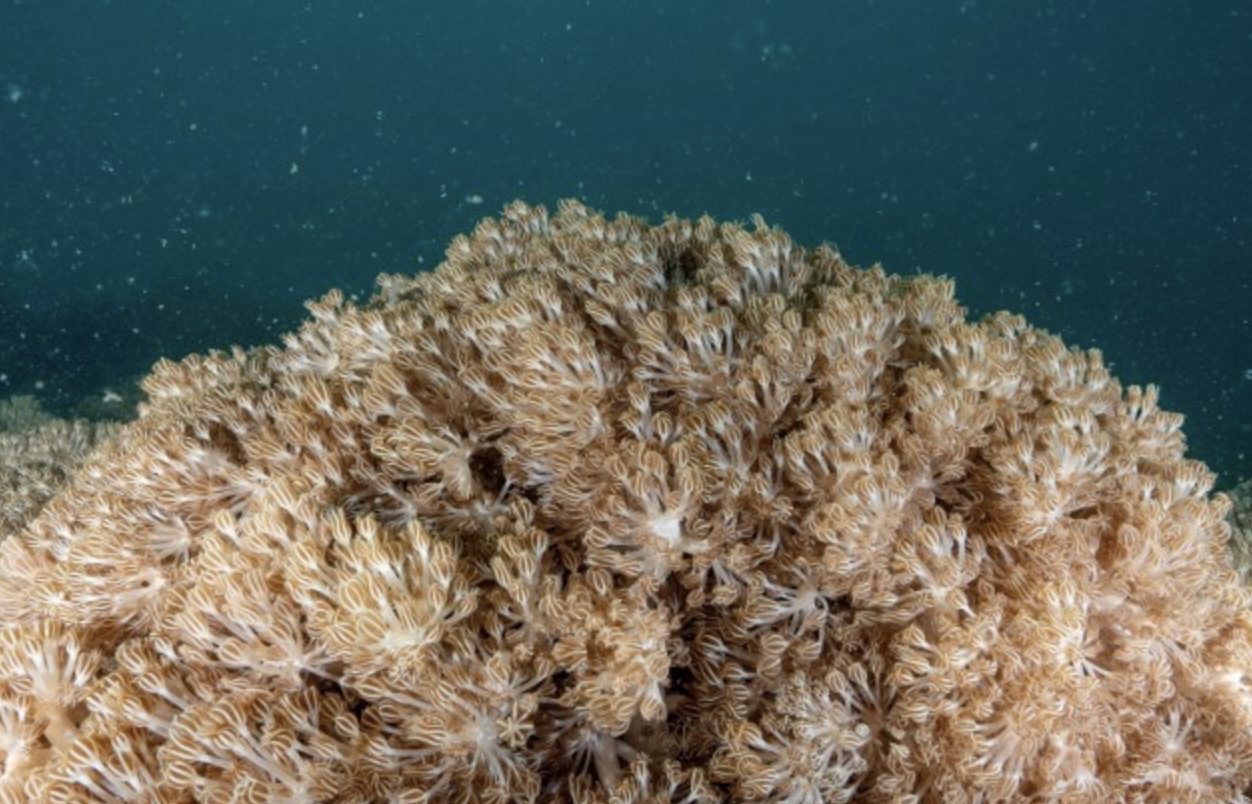
One of the worst examples he said was an invasive soft coral, Unomia stolonifera, also known as pulsing coral, which has spread over 80 acres of the seafloor in Pearl Harbor. “While that invasion is outside of the state’s jurisdiction and in federal waters,” he said, DAR is monitoring it to ensure it doesn’t spread into state waters.
Another serious invasive aquatic is the Majano anemone, discovered in Kaneʻohe Bay in 2024 at a site associated with another aquarium release. “This anemone is a high concern because it’s been observed growing on native coral. It has the potential to smother the coral reef,” he added. DAR has been working with stakeholders to develop a strategy to remove this species, and funding is needed for rapid intervention to prevent further spread, he said.
“Increasing the capacity for our DAR aquatic invasive species team, especially in our leadership roles, will allow for the team to continue and improve upon prevention and rapid response efforts. So we have a legislator-introduced bill – Senate Bill 19 – that would establish an aquatic biologist position to help oversee the aquatic invasive species team.”
Matthew Kurano, head of the Department of Health’s Environmental Health Services Division, told the committees that Hawaiʻi has “a long history of diseases that were spread by invasive species. … What is particularly of concern to us is the intersection of climate change into this as a threat multiplier.”
The DOH, he said, was not asking for very much in the way of assistance with invasive species monitoring and control this year. However, he added, “our vector control program is asking for a single position.”
The coconut rhinoceros beetle (CRB) response team from the University of Hawaiʻi College of Tropical Agriculture and Human Resources gave the last presentation of the day.
Michael Meltzer, a researcher at CTAHR with a specialty in agricultural biosecurity, reminded the legislators that CRB was first detected on Oʻahu in 2013, and by 2014, a multi-agency program had been established to attempt to stop its spread. Almost all of its funding now comes from the U.S. Department of Agriculture, with the Department of Defense adding a bit more. The money comes with strings, he added. “These are emergency funds, and they’re typically for eradication.”
On Oʻahu, he said, “some areas have tremendous damage, where we’re getting traumatic losses.” Most damage so far as been outside of urban areas, but “we’re going to start seeing it in the urban areas soon, … particularly in Honolulu and East Oʻahu.”
Eradication has been unfeasible on Oʻahu for about the last three years. As a result, funds designated for eradication dried up. “We had to pull back from activities on Oʻahu because eradication was no longer an option,” he said. Activities on Oʻahu now are limited to trapping, with a focus on ports of entry, airfields and seaports.
Funds from the Department of Land and Natural Resources have allowed his team to conduct some work on the other islands where use of federal funds isn’t allowed.
“Unfortunately, Kauaʻi is not too far behind Oʻahu. … CRB is basically widespread at this point and most estimates are that eradication is not feasible,” even though CRB was not found on the island until 2023.
The lone good news Meltzer could cite was on Maui, where 17 live CRB larvae were found on one coconut tree at a Kihei golf course in 2023. Since then, no further detections have been made.
As for the Big Island, “we still have a nascent population in Waikoloa,” he said. “Every once in a while we’ll find a beetle over there,” he added, but there’s still “a good chance at eradication.” No CRB detections have been made yet on Molokaʻi and Lanaʻi.
Metzler did not have a specific budget request for the Legislature. But he noted that federal grants require matching funds. For years the university work was supported with federal dollars, “so we never asked for state funding.”
“That changed,” Metzler said, “when our working group decided we had to pull back on what we could do on Oʻahu. … Last year DLNR supported us with about $250,000 to do some of these activities that we couldn’t do with our federal funds. … Having matching state funds is critical for pursuing some of those federal funds.”
The coconut rhinoceros beetle is known to have been spread to islands other than Oʻahu in the transport of mulch and other plant material that harbors CRB larvae.
For years the Department of Agriculture, which can restrict the shipment of plant material and invasive animals from one island to another, did not adopt rules relating to the transport of materials known or likely to harbor CRB larvae.
The first pest advisory relating to the beetle was issued by the DOA in May 2014, about five months after the first detection was made at Joint Base Pearl Harbor-Hickam. Not until 2022 were interim rules promulgated to ban the movement of plant material likely to harbor larvae or adults. Almost two years passed before the DOA adopted final rules in November 2024.
On January 20, the DOA’s final rules on CRB quarantine took effect.
— Patricia Tummons