
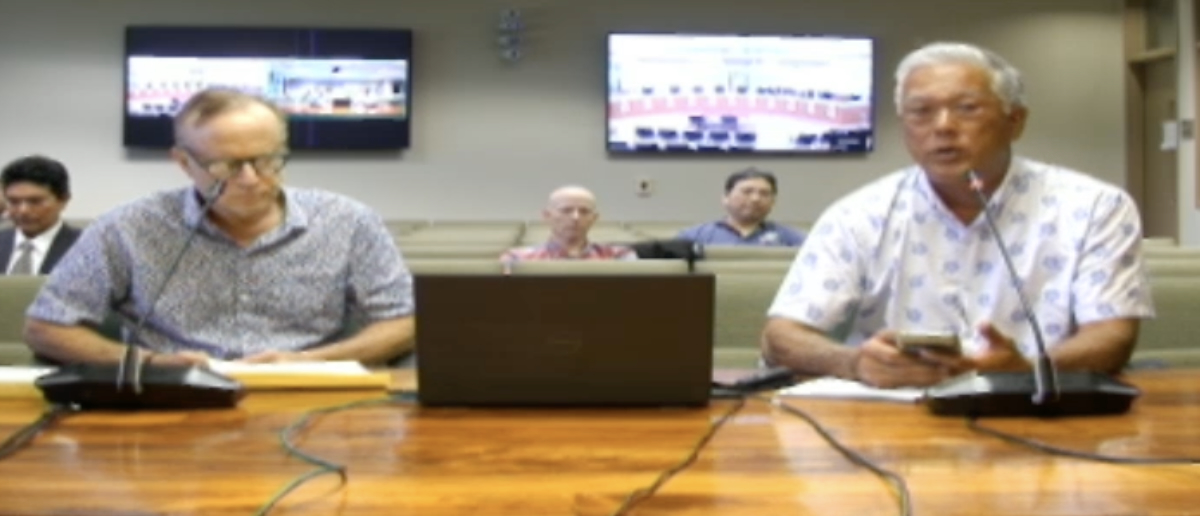
(Above photo: Danny Popkin (on left) and Jon Yoshimura plead their case before the Hawai‘i County Council Committee on Legislative Approvals and Acquisitions on September 15.)
This article has been corrected to reflect that the zoning bills would be considered again on October 6. We incorrectly stated it would be on October 6.
Danny Popkin was clearly frustrated. The proposal for a major housing development near Waikoloa Village that he and business partner Jon Yoshimura had expected to be approved September 1 by the Hawaiʻi County Council’s Committee on Legislative Approvals and Acquisitions had run into a headwind. A positive vote by the committee would mean that their project, Waikoloa Green, would next be heard by the County Council, the final step in winning approval for the rezoning needed to carry out the plan.
As the committee was considering a motion to postpone a vote on the two rezoning bills, Popkin asked to be heard.
“I was really hoping we could come out of here tonight with a vote,” he said. “And if there’s something we could do as a condition for the next reading, is it possible we could do it so we could have a vote?”
Council chair Holeka Goro Inaba responded: “I don’t think you want a vote tonight. We have questions about water, schools. If we took a vote tonight, I don’t know if it would be favorable.”
Popkin noted that an earlier scheduled hearing had been postponed by Hurricane Lala. Now he was going to have to return from New Jersey a third time.
He was reminded that he could participate online without having to travel. “No,” he said, “I’ll be back in two weeks. … I think it’s important to be here in person.”
The committee then voted to postpone consideration of the project until its next meeting, September 16.
Water
What had caused the project, which had sailed through previous steps in the planning process, to stumble? It had, after all, ticked off all the boxes required by the county Planning Department. It had received favorable votes when it was considered in June by the Leeward Planning Commission.
But on the same day the council committee met, the September edition of Environment Hawaiʻi was published, with a cover article that detailed the fact that the stated water demand of Waikoloa Green – 1.29 million gallons a day – would cause the daily draw from the Waimea aquifer to exceed 90 percent of its 16 mgd sustainable yield. At that point, one of the thresholds for control of water usage in the aquifer by the state Commission on Water Resource Management will have been crossed.
Even before publication of Environment Hawaiʻi, Jonathan Likeke Scheuer, a private consultant to various state agencies on water issues, had been in touch with several council members, pointing out the heavy demand Waikoloa Green would place on a constrained water source.
Council member John Hustace, whose district includes the more than 700 acres proposed for rezoning, said he would like “to dive into the question about water a little bit,” referencing issues raised by Environment Hawaiʻi.
Yoshimura replied: “When we were just beginning to talk about what we could do with this property, [the Hawaiʻi Water Service] was one of the first organizations we contacted.
“And we wanted to make sure that any kind of plans or ideas were going to be possible, and of course that all depended on water. …
“While that article was very complete, there were some assumptions made that were not necessarily tied to – I think there’s some sort of discrepancy between what aquifer we’re talking about and they can talk about water a lot better than I can but we really feel that because our development is a phased development and because we have – the only thing we can rely on really is the water company telling us that they have sufficient water to service us. We feel we have sufficient water to build our project for over 20 years.”
That reliance was based upon a will-serve letter from HWS, a private utility providing potable and irrigation water as well as wastewater services to Waikoloa Village and the large resort area along the coast fronting ʻAnaehoʻomalu Bay. HWS draws all of its potable water from eight wells it has been permitted to drill in the Waimea aquifer. All totaled, its wells have the capacity to pump 11.36 mgd, although according to CWRM, as of last April, its average daily draw for previous year came to just half that: 5.78 mgd.
HWS committed to an allocation of water for the project in a will-serve letter dated August 28, 2025. Based on the project description provided by Waikoloa Green, the letter stated, the water duty for up to 450 multifamily units was set at 400 gpd, for a total demand of 180,000 gpd. For 275 one-acre family agricultural lots, the utility put the demand at 1,200 gpd per lot, for a total of 330,000 gpd. For each of the 26 10-acre lots, which the utility described, on the basis of the project description, as having “multi-family potential,” the water demand was estimated at 6,000 gpd – or 780,000 gallons a day. Total estimated daily demand at full build-out was set at 1.29 million gallons.
John Pipan, the planning consultant for Waikoloa Green, then spoke to what he described as “flawed assumptions” in the Environment Hawaiʻi article.
“It refers to the Commission on Water Resource Management’s 2019 study, their plan states two different figures, in two different places, for sustainable yield for the Waimea aquifer. … In some places 16 million gallons a day, in other places, 24 million gallons a day.
“There was pretty robust discussion when CWRM was putting forward this plan. Experts including Tom Nance testified it was an underquoting of the sustainable yield of this aquifer. Potentially 10 mgd from Kohala wasn’t accounted for per day.”
Hustace interrupted: “That’s surface water, correct?”
Pipan acknowledged he wasn’t sure. “But,” he continued, “furthermore, the aquifers aren’t necessarily exactly like they’re drawn on the map. It’s an oversimplification. Those lines don’t exist on the ground. Just to the south of this property lies the ʻAnaehoʻomalu aquifer. It has a much larger sustainable yield, 30 mgd sustainable yield — barely even tapped. Some isotope studies indicate these aquifers are actually mixed, so they’re not segregated.”
Pipan went on to say that CWRM has not designated the Waimea aquifer as a water management area, nor has anyone submitted a petition for that. “We believe, should that happen in the future, they would evaluate much more thoroughly and scientifically the actual sustainable yield of this aquifer and find it is not nearly as close to its maximum sustainable yield as Ms. Tummons [Environment Hawaiʻi’s editor]
contends.”
Appendix F of the Water Resource Protection Plan, the element of the overall state Water Plan that addresses sustainable yields, identifies the sustainable yield for the Waimea aquifer as 16 mgd. The previously adopted figure was 24 mgd, but that was lowered by a third in the 2019 plan. In a footnote, there is a statement that “staff is considering amending the boundaries of the Mahukona, Waimea, and ʻAnaehoʻomalu aquifer system areas.” The SY estimates, it continued, “are preliminary until further confirmation.” In the meantime, the 16 mgd figure for the Waimea aquifer holds; there is no second figure of 24 mgd. In adopting the WRPP, the commission specifically rejected a proposal to increase the Waimea sustainable yield.
Yoshimura and Popkin then put forward Kanani Aton, another consultant that they felt could speak knowledgeably about water resources in the area. Aton worked for several years as the public information officer for the county Board of Water Supply.
Aton said that in Hawaiʻi, “for our style, our land formation, it’s really hard to apply textbook hydrology.” Referring to her involvement in a series of meetings that ended with CWRM denying a petition to designate the Keauhou aquifer as a water management area, Aton suggested that any problems having to do with water use could be resolved short of regulation. “We have a robust community, like our testifiers, like those that are concerned, but we also know how to collaborate and talk through those issues.”
Council member Jennifer Kagiwada pressed further on the water issue: “Based on what I’ve heard today,” she said, “you seem to be saying, as a team, yes, a lot of what she [Tummons] said was true, but maybe some of the assumptions weren’t 100 percent for sure … regarding the whole issue of 16 mgd sustainable yield or 24 mgd.
“But you don’t know for sure that the higher amount is true either, it sounds like.”
Yoshimura replied, saying that the whole issue was “still foreign to me. … Before we even thought about having homes on our site, we wanted to find out about water.” The will-serve letter from the water utility, he said, “we thought satisfied our requirement. But obviously there’s other things involved with water usage, yield, all of this other stuff. I think that’s sort of outside of our – don’t want to say responsibility, but it was not something we said we gotta do a deep dive into hydraulics and all this stuff — it took us a little by surprise.”
Kagiwada said she was concerned with “maybe reaching sustainable yield, what this means for other development in the area that might already be planned.”
Yoshimura then spoke of his time working as a journalist and talking with Kazu Hayashida, former head of the Honolulu Board of Water Supply. “He told me, you know, Jon, we take the cheapest water available, okay. If we need more water, and we need to look at things like desal, reverse osmosis, or what have you, then the water gets a little bit more expensive. He said the water is there. Right now people just use the cheapest water available. Take it out of the aquifer. … The thing I learned was that water is available. It’s just at what cost you can get it. You can get potable water. It’s just a matter of how much you’re going to have to pay for it.”
He went on to foist responsibility off onto the Hawaiʻi Water Service. “I hope the water service would be proactive — and then plan for the future. Because really it’s kind of their responsibility.”
Council member Rebecca Villegas seemed taken aback by Yoshimura’s position. “Water is going to be the tipping point for me. … If you got millions or billions, you can make water out of seawater. You can do all kinds of things.
“I know you’re saying this is 20 years out, what not, but I’m trying to hold myself personally responsible for the decisions we make here. I feel responsible for seven generations out, and how that will change the footprint of Waikoloa. As much as we need housing this is a massive project.”
Apparently, this was the first time Yoshimura had thought about decisions lasting far into the future. “I really like what you said about you being responsible for seven generations out. That’s really cool. I like that.”
Council member Matt Kanealii-Kleinfelder noted that when he looked at Waikoloa, “it’s an area that’s bone dry.” Then he asked how much water the average unit would be using.
Pipan replied that the average unit would be consuming 400 gallons a day, while the one-acre lots would be expected to use about 1,200 gallons a day. “This is a very conservative planning estimate,” he said, adding that it “represents the worst-case scenario. … We’re not looking to use anywhere close to 1.29 mgd. But this is what Hawaiʻi Water Service has to use to be confident that their system is basically wrong-proof.”
Council member Ashley Kierkiewicz wanted to learn more about water. “I love everything we’ve heard so far,” she said. “It’s a critical place. So many people on the east side travel daily on the Saddle Road to work on the west side. Having housing closer is important.
“What gives me pause is, it’s in a very dry area of our community. You can refer to a will-serve letter. You can tell us all day long that water will be there.”
She wanted to hear from a disinterested third party. “Who is it to assure they haven’t maxed out water? Who is the oversight body on the state side that keeps private water companies accountable?”
After a motion was made to postpone decision-making on the rezoning bills, council chair Inaba said he would be inviting Scheuer as a “water resource person” for the next meeting. “Is two weeks adequate for you?” he asked Yoshimura and Popkin.
Aside from water issues, council members voiced concerns over emergency evacuation routes in the event of fire, the possible use of housing credits to satisfy affordable housing conditions, and the effect adding 700 housing units would have on Waikoloa schools.
Revised Figures
On September 16, the Legislative Approvals and Acquisitions Committee of the Hawaiʻi County Council gathered once more to consider the two bills that would authorize the Waikoloa Green development.
After receiving testimony from members of the public and from University of Hawaiʻi professor Don Thomas — who repeated his hypothesis that deep under the basal aquifer lie limitless volumes of fresh water — Jon Yoshimura once more began to plead the case for Waikoloa Green.
“This isn’t the same project as last time,” he told council members. “We’ve re-evaluated our proposal. Talked to engineers. They confirmed we overestimated water use. We made a mistake. We have a new, detailed will-serve letter from Hawaiʻi Water Service that projects 362,000 gallons per day at full buildout, a 72 percent reduction.
“That old designation of 1.29 million gallons a day we had for more than a year. Water wasn’t a question we were concerned with. We were comfortable with the fact that we had this water that could be available to us,” Yoshimura said.
Now, though, this adjustment, along with water conservation measures, “will ensure that the impact of Waikoloa Green to the aquifer is within applicable standards,” he added.
At the invitation of Inaba, Jonathan Scheuer was asked to give an impartial, expert overview of water law in Hawaiʻi. Scheuer, who for eight years was a member of the state Land Use Commission (four years as its chair), started out with a cautionary tale: the planned community of Pulelehua near the Kapalua airport in West Maui. Although it received LUC approval in 2006, before it could be built, withdrawals from aquifers serving the area exceeded sustainable yields, resulting, finally, in the entire West Maui area being designated a water management area in 2022. It remains unbuilt.
Scheuer went on to describe the history of water regulation in the islands, the court decisions holding that water is a public trust, the development of the state Water Code, and the way in which the Water Code functions. Speaking to the triggers for designation, Scheuer pointed out that the Commission on Water Resource Management has an affirmative duty to designate if the resources in an area may be threatened, with the first of seven criteria for designation being if an increase in water use or even authorized planned use “may cause the maximum rate of withdrawal from a ground water source to reach ninety percent of the sustainable yield.”
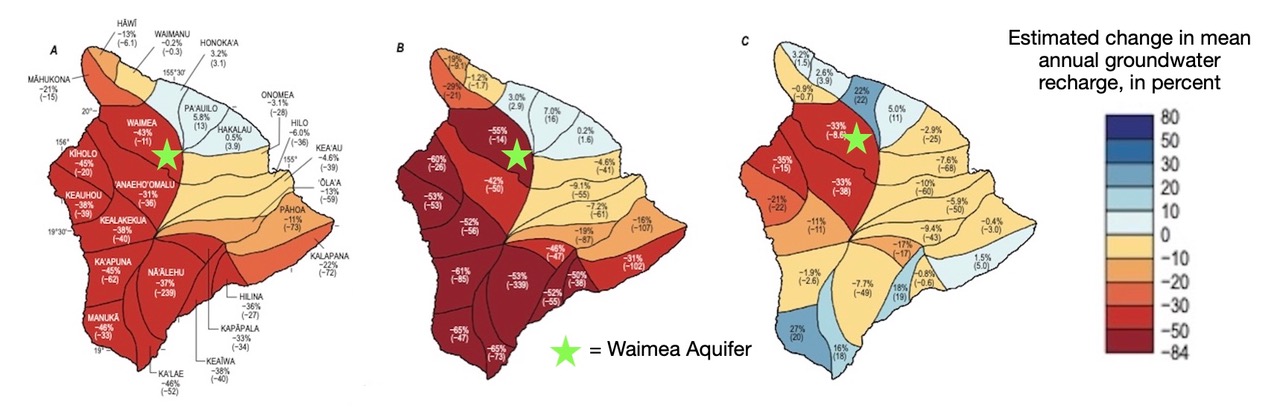
Scheuer also noted, in closing, that in 2023, the U.S. Geological Survey had examined climate change scenarios for rainfall and recharge in all aquifer sectors across the state. “There’s three main scenarios. … Of these, the best-case scenario, for the end of the century, is that the Waimea aquifer has a third less groundwater recharge. The worst-case scenario, there’s 55 percent less.”
Three scenarios for the future of groundwater on the island of Hawaiʻi. Credit: Estimated Groundwater Recharge for Mid-Century and End-of-Century Climate Projections, Kaua‘i, O’ahu, Moloka‘i, Lāna‘i, Maui, and the Island of Hawai’i USGS, 2023
Amendments
Council member Hustace began discussion of the merits of the development, stating he was seeking middle ground. “We can’t say no to every project, but at the same time growth has to occur responsibly.”
He offered amendments to address drainage and flooding risks, make Waikoloa Green more fire resistant, and reduce water demand in keeping with what the developers proposed.
Yet he rejected the idea that the council had any business limiting water. “Our responsibility ends with determining whether water can be supplied,” he said; the will-serve letter from the water service was apparently sufficient for Hustace.
His amendment “requires a water conservation plan. It also recognizes that agricultural water is different, and it emphasizes the use of non-potable water” for agriculture. “It is not intended to resolve the larger question regarding sustainable yield.”
Council member Dennis Onishi was wanting to know more about the agricultural plans of the developer. The water provided by Hawaiʻi Water Service would be more expensive than that provided by the county, he noted, adding, “Farmers need water. How you folks going to do that?”
Popkin said that they were planning “community gardens” so that residents of the 400 multi-family units could have small plots.
“That’s home use,” Onishi said. “But you guys are also looking at production.”
Popkin then addressed the “275 one-acre ag lots” — using air quotes around the phrase. “Hopefully, multi-generational families live in a house like that and have a plot – remember, we’re in a very difficult — Class E, very poor soils. It’s hard to grow anything other than dragon fruit. People will have to have raised beds, do something like that. Certainly it’s not a commercial grow operation.”
But Onishi reminded him that he and Yoshimura had talked about “farming, providing food for the community. So this is not like regular farm land. You’re talking about individual families growing their own food, if they have the time. If they purchase a home, they have to work multiple jobs to pay for it. They might not even have time to do farming.
“So when you folks did your presentation — I felt it might be production, tonnage, or at least hundreds of pounds of food — you mentioned there’s always going to be a food hub? It doesn’t make sense if it’s basically for home use.”
Yoshimura began to respond, saying that the one-acre lots would receive 600 gallons of water a day, “that’s 200 gallons more than –”
Onishi stopped him. “Just the farming part. You made a presentation about farming, producing food. You didn’t say for home use only. So.”
Yoshimura: “Generally speaking, the vast majority of these one-acre lots, I see them growing things outside their home much like a lot of us may do. … If they want to have larger activity on their one-acre lots, we’re going to try to work with Hawaiʻi Water Service to get access to recycled, partly brackish water. We will make that available to these people who want to grow more.
“There may be some people who want to say to a farmer, hey, I want you to take half my lot, half my neighbor’s lot, effectively one acre, and let you farm my property. Then work with those people to get them adequate water.”
Where was this in the plan, Onishi asked.
“We didn’t detail that,” Yoshimura said. “This is the idea about how we would accomplish that. Generally speaking, 99 percent of people, maybe they’ll be growing just basil and rosemary. Other people who want to grow more, we’ll work with them to get non-potable water.” At the food hub, he added, “we’re planning to do aquaponics there.”
“Who’s we?” Onishi wanted to know.
Popkin jumped in: “The food hub does not produce food. It’s possible somebody could do hydroponics or aquaponics. If they do it, it would be reverse osmosis, recycled water.”
But it wouldn’t be grown on your property? Onishi wanted to know.
Popkin nodded yes.
“But your presentation –” Onishi replied.
“It’s a little over-embellished,” Popkin acknowledged.
Authorized Planned Use
Council member Kanealii-Kleinfelder was not satisfied with the amendments offered by Hustace. The one regarding water conservation, he said, fell far short of what needed to be done.
Addressing Scheuer, he said, “the articles that came out talked about other areas that are having projects that are sizable, including the Waikoloa Land Company’s 1,000 timeshares. I was reminded that there are a number of projects that have the ability to draw a huge amount of water.”
Scheuer responded. “The duties that this body has at this particular point don’t end with the will-serve letter. You’re already aware there are other demands in this service area. What you really need to know is not how much water is being pumped now, which is 89.6 percent. What you want to know is that, plus authorized planned use, plus this project.
“Somebody has written a lot of checks, and they haven’t all been cashed. So you can’t just look at the account balance now, when there might be a lot of other checks coming in.”
At this point, Kanealii-Kleinfelder addressed Planning Director Jeff Darrow.
“The council passed a law requiring the Planning Department to bring us all of the other projects, planning, to show us all projects pending approval and build-outs. … Can you get that to council members?”
Darrow said he thought it was included in the documents presented to the Planning Commission, but said he would provide it again.
Council member Kagiwada asked Scheuer to explain the county’s obligations under the Kauaʻi Springs court decision.
Scheuer gave a brief history of the litigation, which concerned the Kauaʻi Planning Commission’s refusal to approve a water bottler’s plans to draw water from a spring. When it got to the Supreme Court, he said, the court upheld the Planning Commission’s decision.
“The court … said we’re going to summarize everything for you agencies — state or county. … If a body is going to make a decisions that will impact water, the applicant should show actual needs. … The standard is called reasonable-beneficial. … Are they impacting any public trust uses of water, which include five uses which are always supposed to have priority: water that supports ecosystems, water used in traditional and customary native Hawaiian practices, water reserved for DHHL, water for domestic needs of the general public, water for farming on kuleana parcels.
“There are a whole bunch of duties that approving agencies need to make findings about. You would need to do some of these analyses to fulfill your public trust duties.”
Postponement
By this time in the hearing, it was clear the committee was unlikely to reach a decision before adjourning.
Kagiwada asked Pipan if other water sources were available. Yes, he said, referring to brackish water that HWS pumped from wells in the ʻAnaehoʻomalu aquifer. “We intend to pursue similar sources.”
Would that reduce your demand further, she asked.
Again, Pipan agreed.
“What was the reason that wasn’t in your original plan?” Kagiwada wanted to know. “Just because you already got the okay for the water you wanted, or is this a more expensive, challenging way to go?”
“Primarily the first,” Pipan said. “We got the will-serve letter. … But it’s only come up in the last couple of weeks that we’re aware of these alternative sources being available. Kind of new information.”
Kagiwada acknowledged Hustace’s work on amendments. That, she said, “carries a lot of weight. But I still have concerns about what I’ve heard here about public trust and our responsibility for making sure we don’t go further than we should with the water commitment. I’m still really on the fence.”
Council member Ashley Kierkewicz also wanted to know more about water availability, suggesting the committee hear directly from the Commission on Water Resource Management. Referring to Scheuer’s statement, she said, “Lots of checks have been written, but we don’t know if the bank is going to be able to cash them.”
Kanealiʻi-Kleinfelder said he wanted to know details about agricultural use. “I’ve heard ag, renewable energy — a beautiful project on paper, then the reality of what we’re going to build,” he said.
“Sharpen up those pencils, and come back with the project as you actually plan to build it,” he told the developers.
And not just about water, he continued. “The plight of Waikoloa is incompetency from past councils and developers, leading to what we have today. Schools, traffic, roads, a thousand timeshares, and the DHHL’s inability to get water for its own projects,” he said. “And here we are with another project, There are a lot of question marks out there. This is going to be a difficult decision for me.”
Committee chair Heather Kimball said she would try to arrange for someone from CWRM to come to the next meeting.
With that, motions to postpone further consideration of both rezoning bills was postponed, to be taken up once more on October 6.
Building Wildfire Resiliency into the Plan
The question of the availability of water to support the proposed Waikoloa Green development was front and center at the Hawaiʻi County Council’s September 15 meeting.
Yet that was far from the only issue raised by the public and considered by the council.
The sufficiency of emergency evacuation routes in the event of fire has been raised for months by Wildfire Safety Advocates. Its executive director, Matt Chalker, has for months argued that the council should approve no further development in Waikoloa unless and until the ability of Waikoloa Village residents to evacuate quickly and safely when fires rage over the parched land is secured.
In testimony September 15, Chalker notes the close connection between aquifer capacity and firefighting capacity. “Peak demand on this water system will occur during a wildfire, during the exact conditions in which power is most likely to be shut off, and we have previously raised with the Public Utilities Commission our concern that the operational limits of the West Hawaiʻi water system will impair the capacity to fight fire here.”
WSA offered a series of amendments to the enabling ordinances in the event the council wanted to move forward with approvals, all having to do with increasing the community’s resilience in relation to wildfire safety.
Yet it made no secret of its preferred alternative action: to have the council require Waikoloa Green to prepare a full environmental assessment.
— Patricia Tummons
For further reading
The September cover article in Environment Hawaiʻi had a more detailed discussion about water availability in the Waimea aquifer. See “Waikoloa Green Project Wins Favor with County, but Water Issues Loom.”