
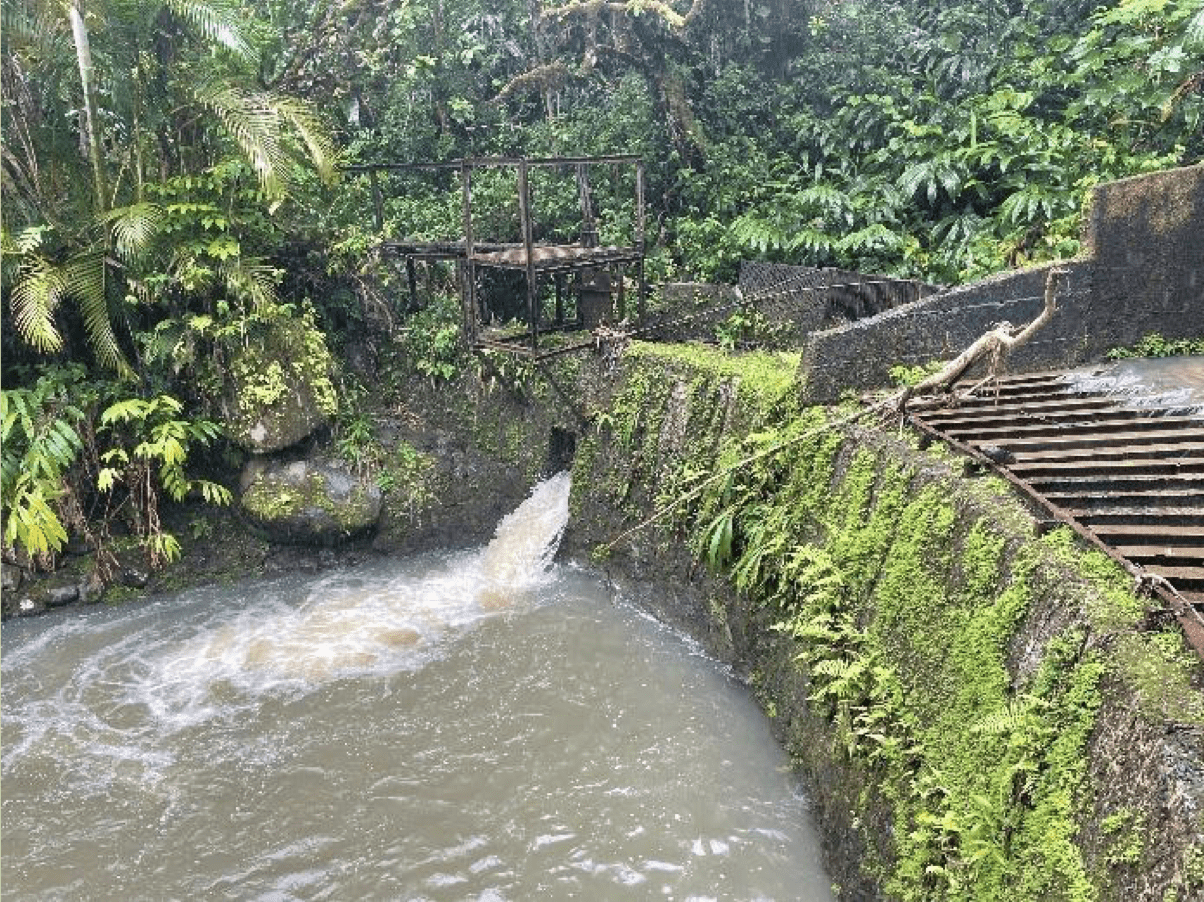
“My career has spanned quite a while. In that time, I have seen the weather patterns change so dramatically, it takes all the historic data and throws it away, because it’s just no prediction for tomorrow. A great example of that is last year. The drought we experienced last year, I think, was the worst in 105 years.”
That’s what Mahi Pono, LLC water resources director and East Maui Irrigation Company manager Mark Vaught told the state Commission on Water Resource Management at a briefing last month on the companies’ efforts to comply with the agency’s 2018 and 2022 interim instream flow standard orders, which required modifications to EMI’s system so that more water stayed in East Maui streams.
The briefing addressed a near-term conundrum regarding a revocable permit the state Board of Land and Natural Resources granted to Mahi Pono and EMI last December allowing them to continue diverting tens of millions of gallons of water a day from East Maui to its thousands of acres of agricultural fields in Central Maui, and to the county in Upcountry.
The discussion that followed explored the larger questions that Vaught’s comments raised, mainly, how should the waters of East Maui best be managed to meet instream and offstream uses in a changing climate?
Permit Delays
Two months before the Land Board’s December decision, 1st Circuit Judge Lisa Cataldo had instructed the board to ensure that future permits to divert East Maui streams 1) required the implementation of practical system loss reduction measures, 2) made sure that the Water Commission’s IIFS orders were fully implemented before allowing more water to be taken, and 3) rendered necessary findings regarding traditional and customary practices.
The Sierra Club of Hawaiʻi, plaintiff in the case before Judge Cataldo, had argued at the December Land Board meeting that Mahi Pono and EMI had not fully completed the system modifications required by the Water Commission’s IIFS order, and, therefore, should not receive a permit allowing the diversion of more than 23 million gallons of water a day, which was approximately what the companies diverted in 2025. Mahi Pono had pushed for 41.55 mgd.
The Department of Land and Natural Resources’ Land Division had recommended at that time approval of a permit allowing the diversion of up to 41.72 million gallons a day (35.22 mgd for Mahi Pono’s agricultural uses in Central Maui and 6.5 for Maui County municipal uses and the Kula Ag Park).
Recognizing the requirements imposed by Judge Cataldo, the division stated in its board submittal that its staff had consulted with Water Commission staff “and was informed that the applicant’s diversion of water was compliant with the IIFS. CWRM staff also noted that the applicant was working in good faith to obtain numerous regulatory approvals to remove outstanding diversions in the Huelo region to comply with the 2022 IIFS decision.”
The board ultimately approved the Land Division’s recommendations and denied contested case hearing requests from Nā Moku Aipuni O Koʻolau Hui and the Sierra Club. They appealed the decisions in 1st Circuit Court, and in March, Judge Cataldo granted the Sierra Clubʻs motion for a partial stay of the board’s decision. Now, instead of being allowed to divert 35.22 mgd, Mahi Pono may only divert 30 mgd this year, until she decides otherwise.
The Land Board and Mahi Pono/EMI have appealed Cataldo’s October ruling, which was formally issued in January.
In the meantime, Grant Namaka, Mahi Pono’s senior vice president of operations, reported to the Water Commission at its May 19 meeting that all of the 235 permits necessary to complete all of the modifications required under the 2018 and 2022 commission orders had been applied for; 174 had been approved.
He reported that permits were required from the Water Commission, the DLNR’s Office of Conservation and Coastal Lands and state Historic Preservation Division, the state Land Use Commission, and the U.S. Army Corps of Engineers.
Water Commission deputy director Ciara Kahahane noted that her agency had issued its permits to the companies for the remaining diversion modifications in October and November of last year, following the receipt of SHPD concurrence, which had been pending for years.
She added that in January, her office had formally requested written reports from Mahi Pono about the outstanding permits and approvals, as well as the modifications made.
“Staff is reviewing them. We will request other documents, if necessary,” she said, adding that they asked the company for the briefing that day to make sure the matter “remains visible to the commission and the public.”
Nakama did not specify when all of the companies’ permit applications were submitted, although Vaught noted that they had not applied for an OCCL site plan approval for an off-stream system modification until January of this year.
For the 130 diversion modifications called for in the Water Commission’s orders, 79 have been completed, while 51 are awaiting permit approvals, he said.
For the modifications called for in the 2018 commission order, Mahi Pono has 23 permit applications pending with the USACE and 11 with the OCCL. For the 2022 order, the company has another 23 permits pending with the Army Corps.
Nakama noted that for 11 sites where modification approvals are pending, Mahi Pono and EMI have voluntarily installed measures restoring more stream flow than is required by the commission’s IIFS orders.
Storage
With all the talk of the efforts to restore more water to the streams, Water Commissioner Lawrence Miike asked Nakama, “Are you okay with the water you’re getting?”
Nakama said that was a question that arises every year with the Land Board’s renewal of the water diversion permit. The court’s reduction of the 2026 allocation of 35 mgd to 30 mgd was “not ideal, but we don’t really have a choice,” he said. “We are just getting by.”
Before detailing the modification efforts, Nakama had described the scope of Mahi Pono’s diversified agriculture operations on the island. Of the company’s 35,000 acres in Central Maui, 12,900 acres were either planted with crops or grazed by cattle. That acreage required 33 mgd, he said, adding that what could not be supplied by East Maui streams was supplied by pumped groundwater.
He noted that 18,322 tons of what was produced was consumed in-state, including 667 tons of beef and 3,550 tons of watermelon.
“Even if we were to take the rest of the water after all other instream uses are satisfied, the municipal uses are satisfied, there’s still not enough water to plant all our acres. So I think we’re limited in terms of the amount of acres we can plant,” he said.
He added that there will be a time when it cannot plant any additional crops under the current IIFS.
Commissioner Moses Haia asked Nakama what alternative water sources Mahi Pono was considering, noting that it was in the community’s best interest to leave as much water in the stream as possible.
First, Nakama pushed back on what Haia thought was in the community’s best interest.
“I don’t think it’s in the community’s best interest to leave as much stream water as possible in the streams. I think the intent is to comply with the order to restore water as ordered and use the remainder for beneficial uses for the community at-large,” Nakama said.
To Haia’s follow-up question about whether recycled water was being looked at, Nakama said it was.
“R1 sources are being discussed at several levels. Without disclosing too much … I would generally say Mahi Pono would be open to using … R1 water and we are engaged in those discussions actively,” Nakama said.
Commissioner Juanita Reyher-Colon asked whether Mahi Pono planned to pursue water-saving technologies.
Nakama replied that for some of the crops, each plant has a micro-sprinkler; weed mats that preserve soil moisture are also emptied.
Generally, he said, the irrigation system is very efficient, with an on-farm system loss of just 5.4 percent.
Mahi Pono is able to achieve such a low system loss rate because it avoids using its unlined reservoirs, the seepage from which could be considered waste.
If the company were to fully exploit its reservoirs, filling them all, they would provide a 10- to 20-day supply of irrigation water, Nakama said. “So that’s not a long period of time. For efficiency purposes, we’ve chosen to bypass our reservoirs,” he said.
Vaught said they may not receive enough water to make using the reservoirs worthwhile. “If you’re allotted 28 mgd, if we need 28 mgd, there’s nothing left over … to store,” he said.
Commission chair Dawn Chang, however, countered, that the water from the large rain events that have become more prevalent with climate change are not being captured and taken advantage of.
“I completely agree,” Nakama said. But he added that regulatory and permitting restrictions stood in the way. “A lot of rules in place restrict our ability to operate,” he said.
Commissioner Wayne Katayama asked what Mahi Pono’s total storage capacity was.
Vaught said it was 120 million gallons, compared to 350 million gallons when the area was cultivated for sugarcane.
Nakama blamed the limited duration of the annual permit for impeding investments in reservoirs.
“It would always help if the commitment was longer-term,” he said. (Mahi Pono is seeking a long-term license from the Land Board to continue to divert East Maui water to Central Maui.)
Even so, Chang suggested that requiring the use of reservoirs should become a standard condition to capture the heavy rains. “I do see due to climate change we have these very extreme conditions and we’re not prepared,” she said.
“If there were a theoretical requirement to use reservoirs … that would come at the expense of our system loss number,” Nakama said.
Former Water Commission hydrologist Roy Hardy, a consultant for Mahi Pono, noted that aquifers are reservoirs. If a reservoir is leaking, it’s recharging the aquifer, he said.
The use of aquifers is another concern, Chang replied. “When you don’t have enough [surface water], you use groundwater. That doesn’t help the health of the aquifer,” she said.
Haia later added, “with respect to [Hardy’s] statement about reservoirs, to be clear, it all depends on where it sits, whether it’s going to provide water to the aquifer.”
Nakama said that Mahi Pono typically uses only three to five of its reservoirs with a total capacity of 50 million gallons in a given quarter.
And the water just goes in and comes out, Vaught said. “We reduced our dependence on reservoirs because it inflated the system loss number. … we were getting dinged on that.”
To address Chang’s concerns about the need to store more water, Maui Department of Water Supply deputy director Kimo Landgraf stated that the county was in the design phase for of a 140-million-gallon reservoir at its Kamaole Water Treatment Facility and that it was looking at acquiring and refurbishing one of Mahi Pono’s reservoirs with a capacity of about 100 million gallons. Landgraf also mentioned that the county would be acquiring a 100-million-gallon reservoir in West Maui from Maui Land and Pineapple, part of a sale of MLP’s West Maui water assets announced last month.
“They all will be lined because we don’t want to lose any of the water,” he said.
Sierra Club of Hawaiʻi director Wayne Tanaka also advocated for Mahi Pono to line its own reservoirs. He said he was also glad to hear that the company potentially had 20-30 days of backup supply water if its reservoirs were lined.
“That’s a huge amount of potential certainty compared to, for example, the East Maui kalo farmers and others who’ve been forced to shoulder far more than their share of the burden during low-flow periods over the last century or so,” he said.
He also took issue with Nakama’s claims that the one-year permit made it difficult to commit to lining its reservoirs.
“Just to the lining issue and the one-year permit excuse, I wanted to point out that Mahi Pono has planted crops that take years to mature and signed a $60 million deal with Alexander & Baldwin for decades worth of water delivery. So the one-year limitation on the permit really has not prevented them from making long-term investments, except I guess when it comes to lining reservoirs and saving our public trust resources,” Tanaka said.
What’s Next?
What happens as a result of the appeal by the Land Board and Mahi Pono of Judge Cataldo’s decisions remains to be seen. In the meantime, the Sierra Club and Nā Moku Aupuni O Koʻolau Hui have sought a court declaration that the Land Board is barred from issuing a long-term water license to a private party.
In their complaint, also before Judge Cataldo, the groups point to the same concern Vaught and the water commissioners had raised, that climate change and variable weather patterns make it impossible for the Land Board to guarantee the ability to divert a set amount of water from East Maui streams.
“BLNR wants to enter into a long-term disposition of water with a private party. It has been working for years towards a long-term disposition of water. And it is poised to do so,” the groups state in a court filing. They argue that they are seeking declaratory relief “to prevent the attempt to vest rights to use water to a private party. What is a long-term disposition that vests no rights? An empty gesture? Moreover, to the extent that any disposition would not grant any such rights, its only purpose is to remove the issue from BLNR’s agenda for years, thereby effectively preventing members of the public from raising concerns to the entire board.”
Judge Cataldo had not ruled by press time on a motion by the Land Board to dismiss the groups’ complaint.
— Teresa Dawson