
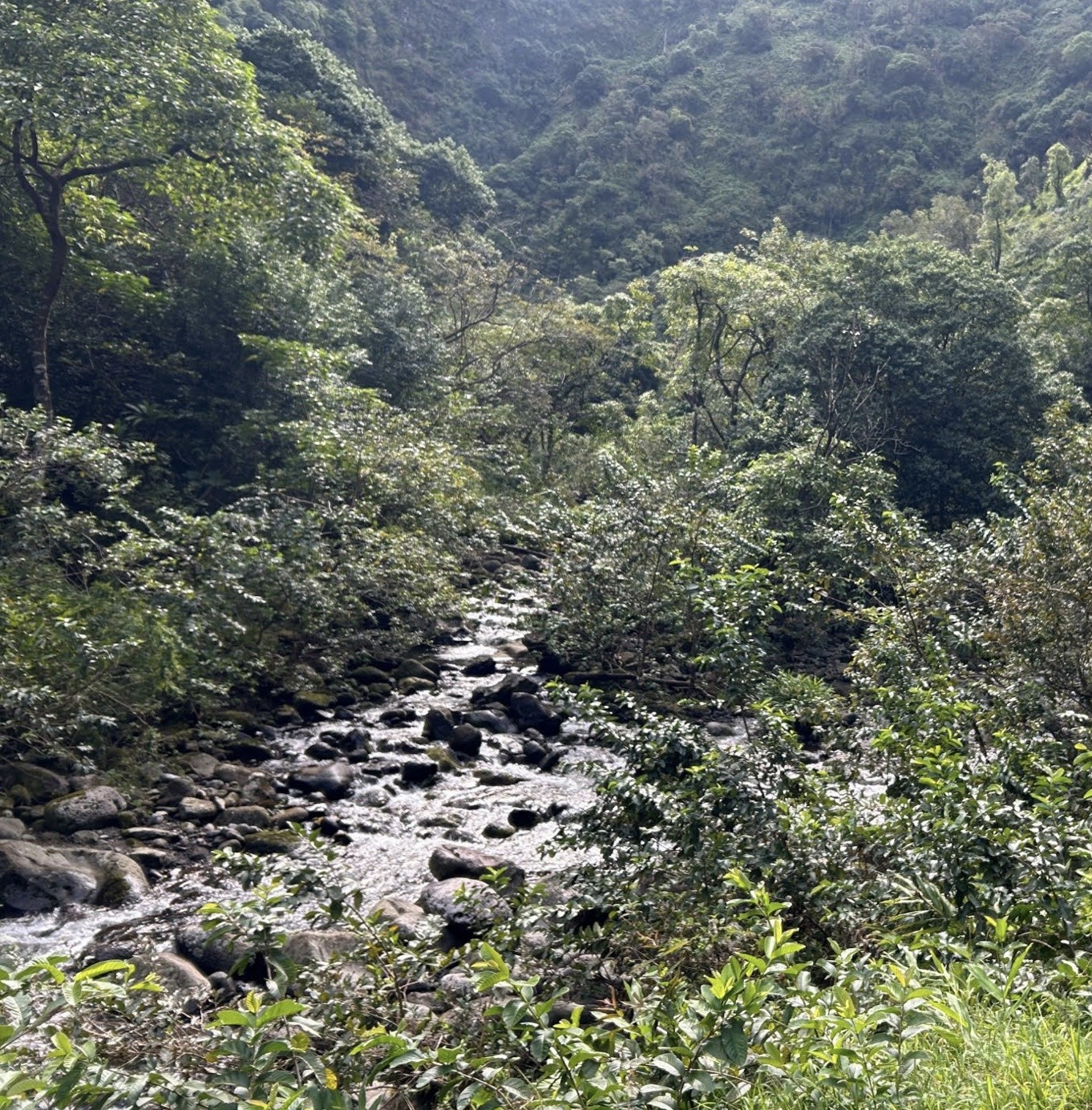
Above photo: Honokōhau Stream below Aotaki Weir. Credit: CWRM
At its February 24 meeting, the state Commission on Water Resource Management directed Honokōhau ditch owner Maui Land and Pineapple Company to pay for a new U.S. Geological Survey stream gauge in Honokōhau Stream, in lieu of paying a $140,000 fine assessed in December for interim instream flow standard violations.
At the commission’s December 16 meeting, commissioners found that MLP had violated the IIFS of 13.3 cubic feet per second on 28 days from January 1 through August 14 of last year.
The $140,000 fine reflected the maximum penalty allowed by law, $5,000 per violation.
Rather than simply requiring payment, the commission allowed MLP to offset its fine by submitting a proposal for physical system improvements based on feedback from Honokōhau Stream users, excluding ditch users.
After holding meetings with community members earlier this year, MLP returned to the commission with a proposal to fund the installation of a USGS gauge in the ditch and a USGS gauge in Honokōhau Stream below Aotaki Weir, also known as intake 770. It also proposed to install cameras at various stream and ditch points that will allow community members and CWRM staff to monitor flows in real time via an online dashboard.
The total cost of the three projects came to an estimated $150,680.
In its submittal to the commission, staff stated that it did not support the proposal for a USGS gauge in the ditch, since it seemed to fall within MLP’s existing obligations as a water diverter.
The proposed stream gauge, however, “would provide a benefit to the commission’s monitoring and enforcement programs,” and would be consistent with penalty guidelines.
“The cameras may provide some benefit,” CWRM deputy director Ciara Kahahane told the commission.
Several members of the public testified that they believed the $140,000 fine was too light.
“Give these guys one harder slap next time they break the IIFS,” Honokōhau resident Kalei Kauhane said.
When it came time for the commission to make a motion, Kahahane said, “I would be fine with money just going into the [CWRM] special fund. But to the extent you want consider a settlement in lieu of that $140,000 fine, from staff’s perspective, the USGS gauge in the stream right below intake 770 would help with enforcement of IIFS.”
There was some discussion among staff and commissioners over whether MLP should put $140,000 into CWRM’s special fund to pay for the USGS stream gauge or whether the company should directly negotiate an agreement with USGS to fund installation and temporary operation of the gauge.
CWRM hydrologist Ayron Strauch noted that if the money came through CWRM’s special fund, any project expenditures would need commission approval first. “It might be quicker if MLP deals with USGS,” he said.
If MLP fails to get the stream gauge installed, Kahahane said the commission could always revert back to imposing the fine.
Even with MLP taking the lead, by all accounts, it could be two or three years before the USGS is able to obtain all necessary permits and approvals and to install and begin operating a new stream gauge.
The commission ultimately voted to approve Kahahane’s recommendation to direct MLP to enter into an agreement with the USGS for the stream gauge.
Kahahane said that after the gauge installation, there would likely be enough money leftover to cover three to four years of operation before the $140,000 fine is fully offset.
Community members noted that during discussions with MLP, they had prioritized the removal of a bridge that years ago got clogged during a heavy flow and damaged the stream.
A February 5 letter from attorney Cal Chipchase, who represents MLP, stated that in “MLP’s discussions with residents of Honokōhau Valley, there were several requests that MLP assist the county with the removal of the county’s bridge debris above MacDonald’s dam. Although such assistance does not fall within the scope of CWRM’s order that ‘physical improvements to the system’ be proposed in lieu of fines, MLP will assist the county with removing the county’s bridge debris from the valley once the county removes the bridge debris from the Honokōhau Stream. MLP and the county have been coordinating on this effort.”
— Teresa Dawson