
Board Issues Fine, Orders Removal
Of Erosion Control Material in Lāʻie
On December 12, the Land Board hit James and Rhodette Greig with a $234,000 fine for violations stemming from their non-compliance with a September 2017 Emergency Conservation District Use Permit for a temporary erosion control structure fronting their Lāʻie property. But they may end up paying as little as $25,000 in the end, depending on how much it costs to remove what remains.
The wall of sand-filled burritos that was installed to stabilize about 250 feet fronting the Greigs’ and their neighbor’s properties was to have been removed by September 14, 2020. An inspection by the DLNR’s Office of Conservation and Coastal Lands the next day found the structure “was dilapidated and unmaintained with liberated materials posing a nuisance and hazard to the nearshore environment,” an OCCL report states.
What’s more, the landowners also failed to meet the requirement of the emergency permit to provide the OCCL with a plan for long-term erosion management.
The OCCL followed up with a notice of alleged noncompliance on October 11, 2021, but the Greigs did not respond, the report states.
More than three years later, on April 7, 2025, the governor’s office forwarded a complaint to the DLNR about the derelict erosion control structure. Following another site inspection, the OCCL issued a notice of alleged violation.
Finally, in in May, the Greigs met with OCCL to discuss a removal plan, but none was forthcoming. And despite assurances from the Greigs that they were removing surface materials from the beach, subsequent site inspections by OCCL found no active work being done to remove the nuisance structures. (The Greigs’ neighbor, however, did remove the offending materials fronting their land.)
The OCCL then issued a second notice of violation on August 11. OCCL administrator Michael Cain later notified the Greigs that his office intended to present the matter to the Land Board.
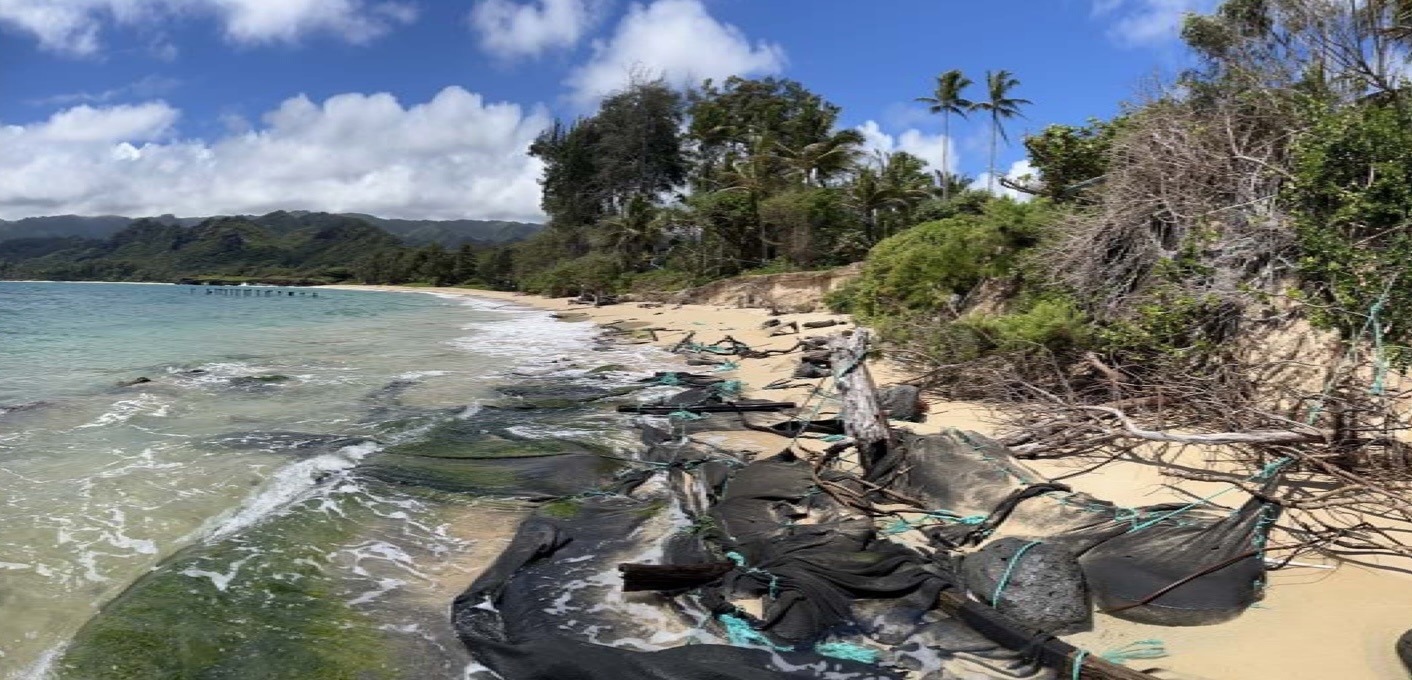
The OCCL brought the case to the Land Board on October 24, with recommended fines totaling $213,000: $183,000 (based on the maximum fine of $1,000 a day) for their failure to remove the encroachments after receiving the April 24, 2024, notice of violation, $15,000 for installing the burritos in the Conservation District, and another $15,000 for violating the terms of the emergency CDUP.
But at the request of the Greigs’ newly hired counsel, Tim Irons, the matter was deferred until the December board meeting to give him more time to “get up to speed.” In granting the deferral, the board instructed Irons to work with deputy attorney general Danica Patel and the OCCL on a solution in the meantime.
Again, no removal plan or long-term solution was forthcoming.
The OCCL’s December 12 report to the board noted, “[D]uring the Greigs’ requested May 5, 2025, meeting, Mr. Joshua Greig (son of James and Rhodette) stated that he ‘managed a landscaping company,’ had access to machinery, and could remove of the expired and unauthorized erosion control devices in a timely manner. The meeting concluded with OCCL understanding and expecting that the Greigs would be submitting their removal plan in the next week or so.
“At the time of writing this submission, the Greigs have not submitted their removal plan and more importantly have not resolved matters by removing the expired and unauthorized erosion control structure and devices.”
Given that, the OCCL recommended total fines of $243,000 at the board’s December meeting.
That day, Irons explained that the Greigs had misunderstood what was required of them after the May meeting and believed that they could not proceed with removal work without a right-of-entry permit from the Land Board. He said they also thought that the OCCL had agreed with their long-term solution, which was to push sand from other parts of the beach to restore the dunes fronting their property.
“My clients want the same thing. They want to remove the sandbags … but not threaten their property or the neighboring property in the process,” he said.
With regard to the proposed fines, he asked that they be reduced. “We’d much rather have the money spent on the long-term solution [that’s] gonna eventually protect Pounder’s beach,” he said.
He asked that the Greigs be allowed to do the sandbag removal and the sand push concurrently, since they would occur at two different areas of the beach. However, in a meeting with the Greigs before the Land Board meeting, the OCCL informed them that it cannot legally process an application for a use in the Conservation District when there is a violation pending. Removal would need to happen first and the OCCL would need to confirm with site inspections that everything had been removed.
Hawaiʻi island board member Riley Smith asked OCCL staff about the likelihood that it would approve the Greigs’ proposal to have the sandbag removal and sand push occur at the same time.
Cain showed photos that staff planner Trevor Fitzpatrick had taken just a month earlier showing materials, including torn bags and rope, littering the beach.
“This is a derelict structure. This is, in our minds, debris on the beach. … I don’t see any value in delaying cleaning this up. It’s not protecting the property,” he said.
Regarding the feasibility of beach nourishment, he said he would rely on expert engineers to determine that. “I don’t have enough information [on] what is practical here or not,” he said, before reiterating, “We are not allowed to process applications for parcels with open enforcement.”
Fitzpatrick added that the Greigs would have to identify a source of sand.
“The beach is deflated here. There’s not enough sand to push,” he said. He added that he did not know if by March, when removal would be expected to be complete, whether enough sand would return to the degree that they want.
He noted that there are few available sand sources. There’s a moratorium on sand sources from the land and going offshore to get it would probably be “very costly and would have to go through a permitting process,” he said.
Board chair Dawn Chang also wanted removal to happen as soon as possible. Referring to the recent photos Cain and Fitzpatrick showed, she said, “This is dangerous … to marine life, to people walking on the beach. … If it looks anything like this, this is an extreme liability for the state.”
After the board met in executive session, Chang informed the Greigs that she would recommend approving the OCCL’s recommendations, but would allow up to $218,000 of the $243,000 fine to be offset by removal costs that are verified by a third party, such as a contractor.
The deadline for removal would be March 12.
“All we want is some independent assessment of your sweat equity,” she said.
The OCCL would do an initial inspection in March and another in November to confirm that all of the bags were removed.
To this, Joshua Greig argued that the derelict sandbags do, indeed, provide some protection to his family’s home. He told the board, “If we remove in March and are not able to process a [sand push] plan until November, then we’re doomed. We have no protection. … We’ll be one storm away from the loss of the home.”
Chang replied that the proposed motion was “as good as it gets.”
After receiving a note from a deputy attorney general, Chang walked out of the meeting, returning with a clarified proposal: The Greigs would need to submit three bids from contractors on what it would cost to remove the bags. If the OCCL finds after its March inspection that the bags were removed, “we will then close that violation and permit you to submit an application to OCCL for the long-term solution,” she said.
OCCL would continue to monitor the beach and if, at any point, it found residual debris, it would notify the Greigs and give them an opportunity to cure the violation, she continued.
“It could jeopardize a future CDUP if you don’t clear in a timely fashion,” she said.
When Joshua Greig and Irons raised different scenarios about the timing of violation notices and cure periods, Chang told Irons, “I don’t want to get into this at this hour, nitpicking, because we will never leave here.” The agenda item was the last of the day.
Irons then suggested that his clients could just request a contested case hearing and in the interim work on a settlement agreement.
Patel shot that down immediately.
“Once we start contested case proceedings, OCCL is unlikely to want to renegotiate a settlement agreement, particularly because this is an extremely favorable offer that OCCL would not have made, but the board is clearly making it. So if you want a contested case hearing, we’ll go contested case hearing, but OCCL is not going to continue to make offers,” she said.
Chang made her motion to approve the fines, which could be offset by verifiable removal cost estimates, and to allow the Greigs to file an application for small-scale beach nourishment after the OCCL’s initial follow-up inspection at the end of March. (Depending on the scope of the proposed beach nourishment project, the OCCL or Chang could approve it without bringing it to the Land Board.)
Also, the Land Board’s action would be recorded with the Bureau of Conveyances.
The motion was approved.
Board Approves Acquisition of A&B’s Coastal Land on Maui
On October 24, the Land Board unanimously approved acquiring three parcels from Alexander & Baldwin subsidiary East Maui Landholdings, LLC, (EML) totaling 651.77 acres. It also approved the post-closing issuance of a management right-of-entry to DLNR’s Division of Forestry and Wildlife, as well as permission to hold a public hearing on the addition of those lands to the Koʻolau forest reserve.
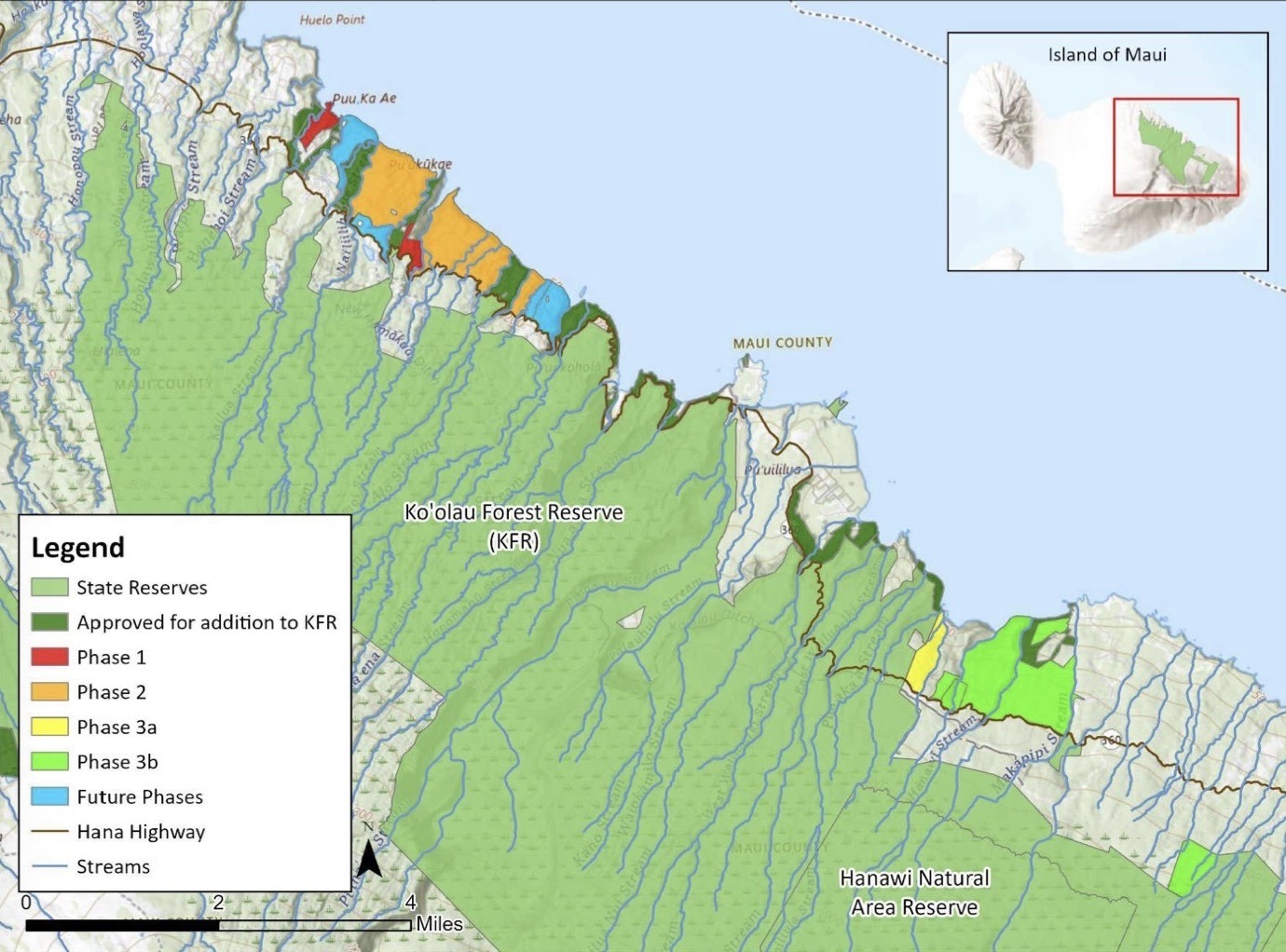
According to a DOFAW report to the board, this is the second phase in the East Maui Coastal Rainforest acquisition, “an ambitious, multi-phase initiative to safeguard one of Hawaiʻi’s most treasured landscapes. Through acquisition and donation of fee title, this request aims to secure three additional parcels, totaling more than 650 acres, that are directly threatened with subdivision and private development. These Phase 2 parcels encompass undeveloped coastline, freshwater streams, endangered species habitats, and lowland wet forests. They are strategically located next to existing state lands, creating stronger mauka-to-makai and coastal connections and preserving public shoreline access. Protecting them will also safeguard water quality, nearshore fisheries, and habitats for rare native species. …
“EML is currently in the process of selling non-core land assets, including the subject parcels. Private subdivision and development are the greatest threats to the lands along this treasured coastline.”
The lands are zoned for agriculture and conservation and are largely vacant, with some licensed for pasture. Those leases will be terminated prior to the land transfer to the state.
The Land Board approved the first phase in the acquisition project in May 2024. The lands were finally acquired on March 21, 2025.
DOFAW’s report states that $1.5 million in federal funding to acquire one of the Phase 3 parcels has been secured, as well as $300,000 in state Legacy Land Program funding for other Phase 3 parcels.
“The division is currently seeking additional federal, state, and private funding to acquire the remaining parcels,” it states.
The funding source for the Phase 2 acquisition is all private, DOFAW administrator David Smith told the board. DOFAW Maui branch chief Scott Fretz added that there was an urgent need to acquire the lands.
“A&B does plan to sell these lands. We know what happens from experience … They tend to be purchased by investors and developers. We know that results almost always in loss of public access, loss of shoreline access. … We have this rare opportunity,” he said.
The acquisition received support from the Trust for Public Land, which is facilitating the acquisition.
“TPL will continue to partner with DLNR/DOFAW to complete the project over multiple phases and years to protect up to 1,750 acres of coastal land in East Maui,” the organization stated in a project overview submitted to the board.
The /Aha Moku representative for the Koʻolau region, Na Moku Aupuni o Koʻolau Hui, the Sierra Club Maui Group, the state Commission on Water Resource Management, Maui County’s East Maui Water Authority, Mayor Richard Bissen, state Rep. Mahina Poepoe, and others also provided letters of support.
— Teresa Dawson