
To Protect Native Species, Habitat at Marconi,
Land Board Seeks Revised Settlement Agreement
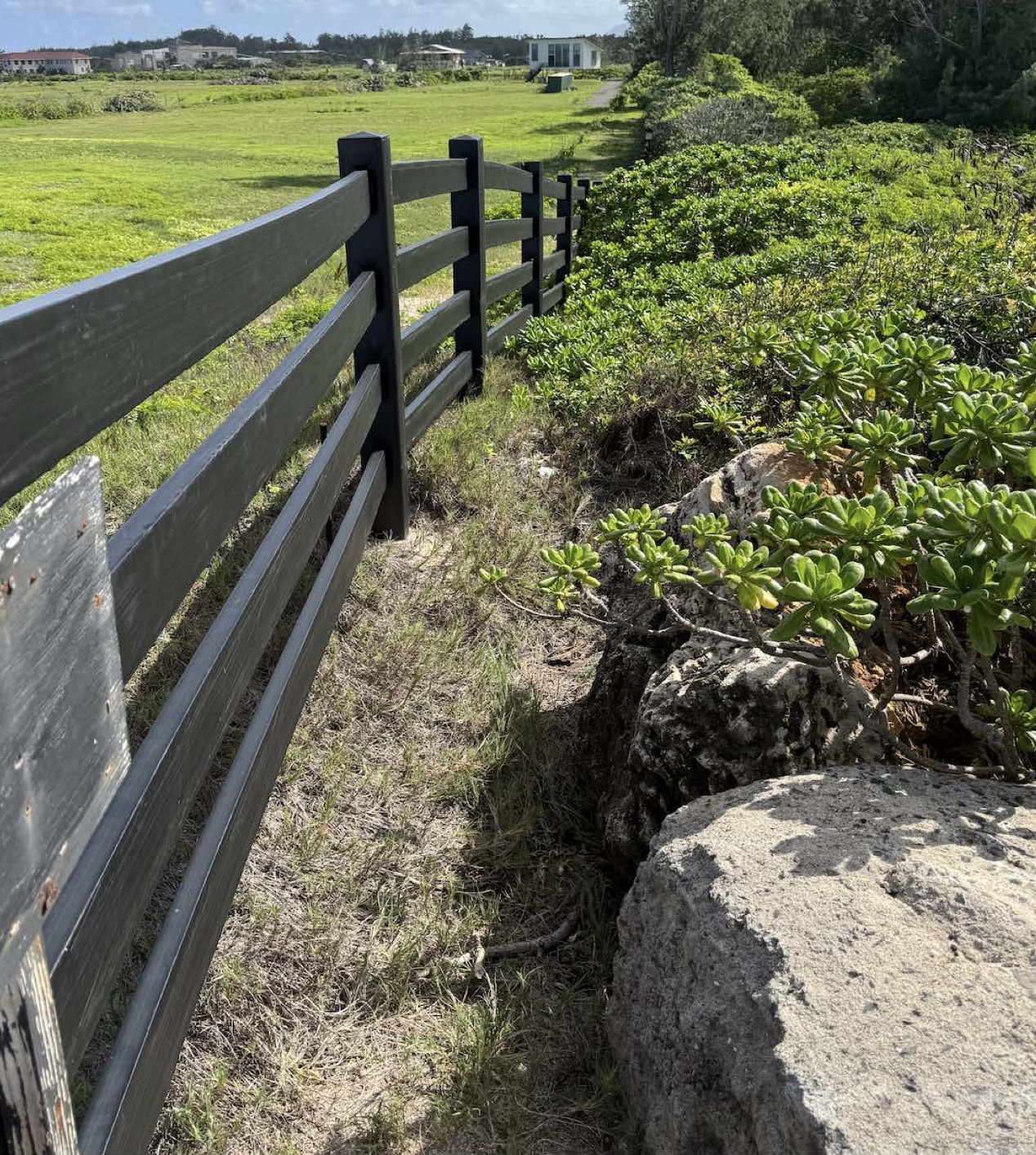
Complete removal of an unauthorized fence in the Conservation District at Marconi Point may not be the best outcome for the surrounding habitat and protected species in the area.
That’s according to public comments presented to the Board of Land and Natural Resources at its May 8 meeting. And the Land Board ultimately agreed, refusing to approve a settlement agreement that would have required that the Association of Unit Owners of Marconi Point Condominiums remove the offending 150 feet of fence.
In a May 3 letter to deputy attorney general Danica Patel, Denise Antolini, on behalf of the community group Aloha Marconi Alliance, noted that the fence “is useful to prevent damage from ATV/vehicle/Ebike access across the Turtle Bay [Resort] and Marconi parcels and the public shoreline. Preventing such vehicles access is a high priority to protect the integrity of the beach and Mōlī [Laysan albatross] habitat (as well as turtle nesting) and thus serves a public and wildlife protection purpose. The fence also protects the Marconi (including [North Shore Community Land Trust] Unit 1) and Turtle Bay properties from trespassers and property damage.”
The fence does, however, inhibit lateral public access across a coastal trail. Antolini suggested that the association replace the 10-15 feet of fence closest to the shore with fixed posts that would allow pedestrian access, but prevent ATVs, vehicles, and Ebikes.
The fence is an extension of one that developer Makai Ranch, LLC, built years ago along the boundary between its condo project and Turtle Bay Resort. Around the time the fence was extended, Antolini states, boulders and large chunks of concrete were also placed alongside it.
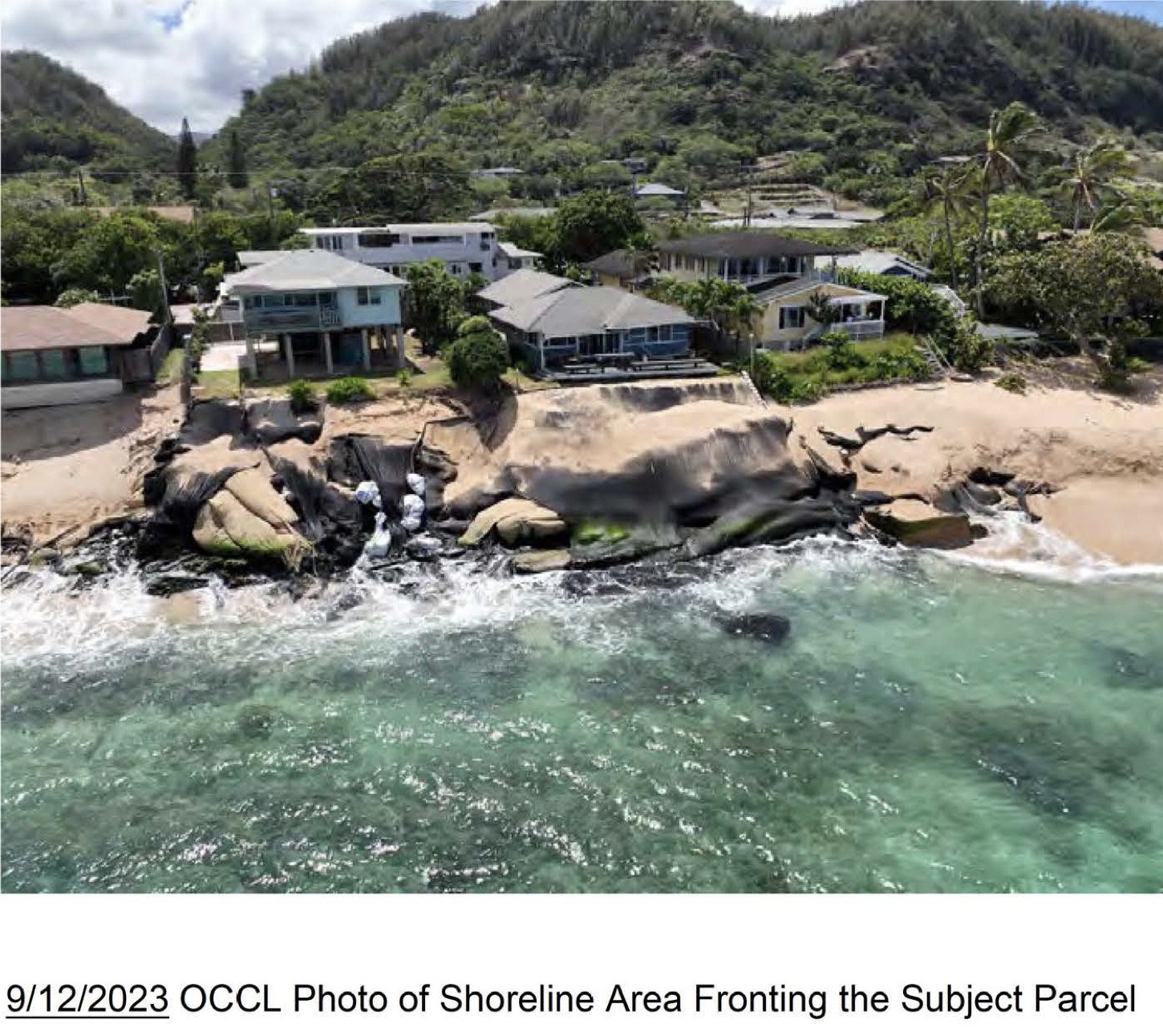
In late 2023, while investigating other potential violations along the coastline fronting the condominium project, the Department of Land and Natural Resources’ Office of Conservation and Coastal Lands discovered that the original fence had been extended into the Conservation District without permits.
In April 2024, the OCCL recommended that the board fine the unit owners’ association and/or Makai Ranch $15,000 for unauthorized fence construction in the Conservation District. The OCCL also recommended that the fence portion be removed.
Rather than pursue a contested case hearing over the OCCL’s proposed penalties, attorneys for the agency and for the association negotiated a settlement.
In the interest of transparency, the OCCL and Patel presented the proposed agreement to the Land Board at its May 8 meeting for approval. According to OCCL administrator Michael Cain, settlement agreements are usually not brought to the board at its regular public meetings.
The agreement called on the association to remove the fence in a manner that doesn’t disturb the Laysan albatross or other species in the area. The proposed fine would be waived.
Patel, representing the OCCL, told the board that the fence was the least egregious of the violations the DLNR had identified at Marconi Point.
She explained that the decision to waive the fine in exchange for removing the fence reflected the parties’ efforts to “push the needle forward.” She added that the unit owners’ association had probably spent more than $10,000 in legal costs.
Patel acknowledged that removing the fence portion could open the area up to vehicular trespass, endangering the albatross that nest on the resort and CPR properties.
She recommended that the Land Board accept the settlement, which would resolve the OCCL violation case. The association could then apply for a permit to install educational signage and to construct a symbolic fence — posts with simple ropes strung between them — that would allow for pedestrian access along the shore, but prevent vehicles from traversing the area, where the North Shore Community Land Trust is restoring native habitat.
“OCCL can’t process applications for a parcel until violations are resolved. We’re not opposed to symbolic fencing if done correctly,” she said.
Attorney F. Palakiko Chandler IV, representing the unit owners’ association, testified that if the Land Board were to add to the proposed settlement agreement any terms requiring symbolic fencing, he would need the association’s approval.
In Aloha Marconi Alliance’s written testimony, Antolini suggested that the existing fence could remain, “so long as the boulders/concrete impediments to [albatross] movement are relocated and vegetation is kept cleared to allow multiple pathways under the fence at appropriate intervals – maintained at least 18” wide.” She noted that that work could be done with volunteer labor. Also, she stated that the lowest fence rail may need to be removed as well, to allow albatross to traverse the property boundary unimpeded. “This modification could be determined by NSCLT and wildlife experts once the boulders/concrete and vegetation are cleared.”
She recommended that the parties be required to post signs — approved by DLNR, NSCLT, Turtle Bay, Marconi Point Condominiums, and the U.S. Fish and Wildlife Service — on both sides of the boundary fence near the shoreline with information noting that the area is “essential habitat for protected native wildlife including the Mōlī, green sea turtles, yellow-faced bee (Hylaeus anthracinus and logicepts), and monk seals; no ATV/vehicle/Ebike access and no dogs are allowed; and visitors should stay more than 30-feet away from any wildlife or nesting areas.”
She stated that the partnership on signage would “help move the parties past prior conflict and toward the common goal of wildlife habitat conservation.”
With the money saved by not having to pay a fine or completely remove the fence, Antolini suggested that the unit owners’ association should donate $50,000 toward the construction of a predator-proof fence being considered for the area by the NSCLT, the USFWS, and the resort landowners.
Chandler told the Land Board that the unit owners’ association was likely amenable to Aloha Marconi Alliance’s ideas about what to do with the fence, “whether it is partial removal or half a removal of a fence.”
The alliance’s suggestion of a $50,000 donation for the predator-proof fence would have to be presented to the association’s board. “We currently don’t know how much it would cost to do any kind of fence removal,” he said.
Patel noted that the boulders were located on Turtle Bay Resort’s property.
Regarding her suggestion that symbolic fencing be installed after the 150 feet of unauthorized fence was removed, Maui Land Board member James Carpio asked whether any consideration had been given to using the existing fence posts to avoid further ground disturbance.
Cain pointed out that the proposed settlement agreement contained no provisions for a symbolic fence. Patel’s suggestion was only in response to public testimony.
Antolini, testifying via Zoom, explained that the Aloha Marconi Alliance had first opposed the settlement flat out when it was set to be brought to the Land Board in April. But with the boulders being on the Turtle Bay Resort side of the fence and the North Shore Community Land Trust owning the condo unit immediately adjacent to the fence, the Alliance revised its recommendations to better protect the increasing number of albatross that nest in the area.
She seemed skeptical about whether a symbolic fence like the one Patel had described would solve the ATV access problem. With the solution the alliance proposed, “I really see a streamlined win-win. The only hiccup is having a fence in the Conservation District that is not permitted. … It would be a legalized fence with the bottom rail removed,” she said.
Oʻahu Land Board member Denise Iseri-Matsubara asked Cain for his thoughts on the alliance’s proposal. Cain replied that his office’s preference is that unauthorized structures be removed from the Conservation District.
Patel added that they would gladly follow up with Turtle Bay to see if they would help to remove the boulders.
Like Carpio, Hawaiʻi island board member Riley Smith was interested in limiting impacts to the sensitive area and applauded the community members for devising a reasonable solution. Perhaps the board could let a modified fence stay a year or two year, or require that only one rail be left to prevent vehicle access, Smith suggested.
After the board met in executive session to discuss some legal questions, Iseri-Matsubara made a motion to decline to accept the settlement agreement and ask that the parties “come together on a revised settlement that better addresses the issues facing the critical habitat in the area.”
The board unanimously approved her motion.
Settlement Cuts $1M Fine to As Little as $50,000
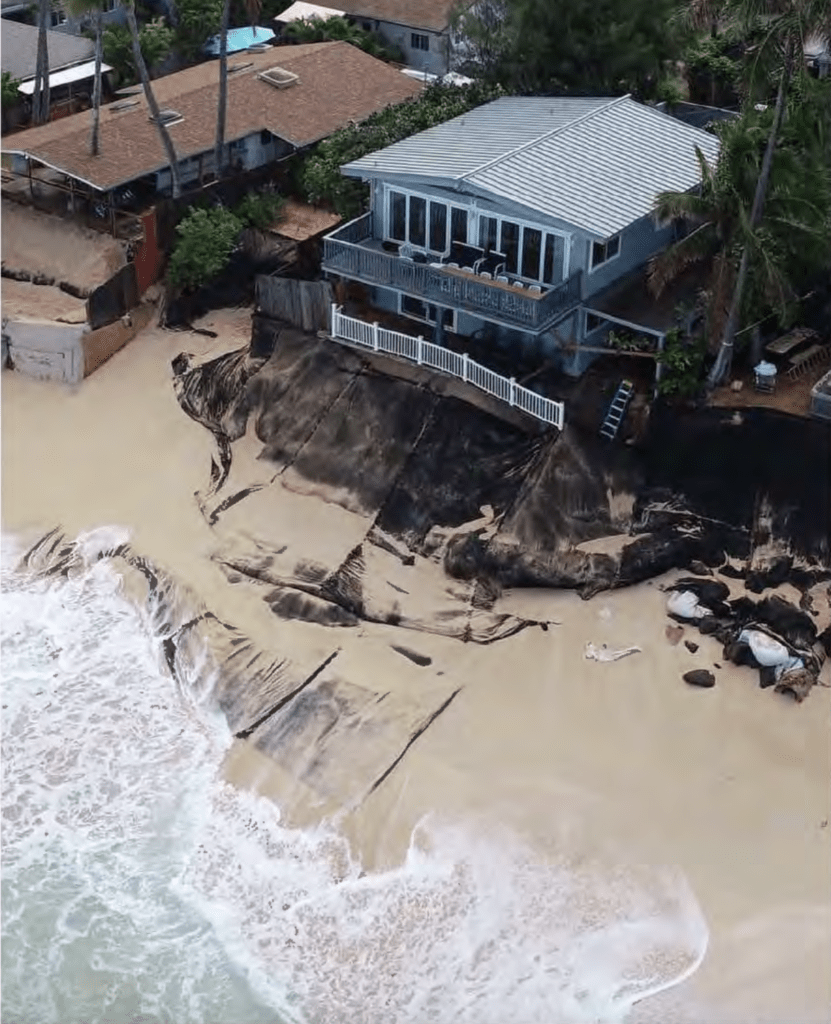
On May 8, the Land Board voted to accept a slightly amended version of a settlement agreement signed in July 2025 regarding Conservation District violations by Eric and Moniza Freeman, who own a home on Sunset Beach.
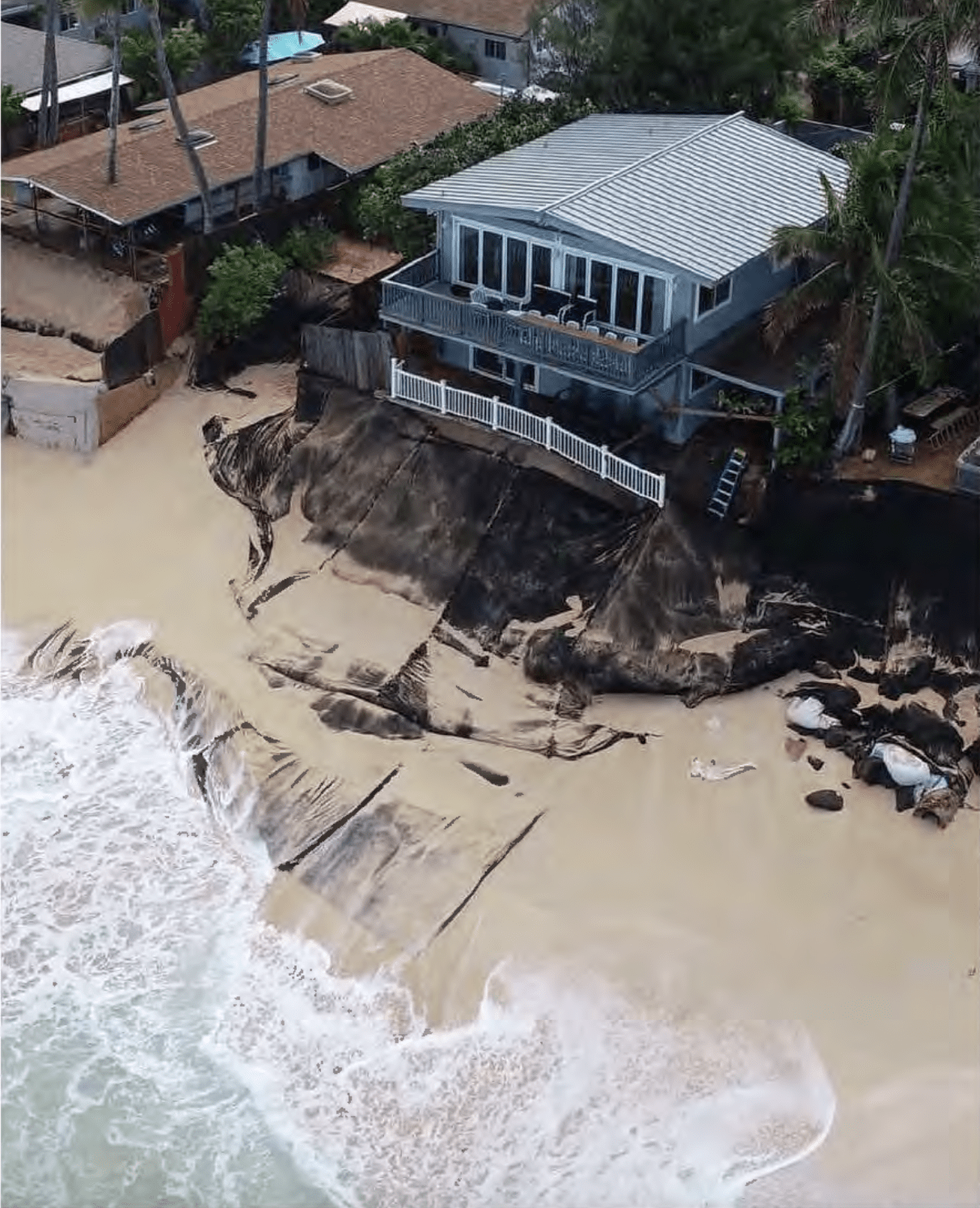
On December 7, 2023, the Land Board had fined them $937,000 for illegal erosion control work on the eroding beach fronting their vacation rental on Ke Nui Road.
A report to the board that day by the DLNR’s Office of Conservation and Coastal Lands explained that despite oral and written warnings about their unauthorized activities starting in January 2022, the couple “failed to remove debris and past unauthorized erosion control structures” and “willfully continued to allow unauthorized work within the Conservation District in the subject area on at least twenty-two separate days or occasions.”
The Freemans requested a contested case hearing on the board’s decision to accept the OCCL’s fine and removal recommendations, but before hearings began, they started negotiating a settlement agreement with the state.
In July 2025, deputy attorney general John Dubiel and the Freemans signed a settlement that, once approved by the Land Board, would do the following:
It would require the Freemans to move their house to the back of their lot and remove all debris, foundations, shoreline protections and any other structures on state lands fronting their property by December 31, 2025. If they applied for all necessary work permits by October 1, 2025, the Freemans would be allowed to request a one-time extension of up to six months to complete removal so long as they showed that they would not receive a required permit in time, or that “despite reasonable efforts they would be unable to safely complete the removal work due to weather.” The agreement would also require the Freemans to plant vegetation and restore the dune no later than December 31, 2025.
The fine would be reduced to $510,000 once they did what was required. The fine could then be reduced further on a dollar-for-dollar basis to as little as $10,000, based on what they proved was reasonably spent on correcting their violations.
If they failed to comply by December 31, 2025, the full $937,000 fine would become due and owing.
The agreement was not binding until the Land Board approved it. However, it seems that a six-month extension was at some point granted, given that the OCCL did not bring the settlement agreement to the board for approval until its May 8 meeting, where Dubiel noted that the Freemans had just two months to meet all their requirements under the time-extended agreement. (The matter was originally on the agenda for the board’s April 10 meeting, which was cancelled.)
In explaining why the fine had been so drastically reduced, Dubiel told the board last month that he just wanted the matter resolved. “I didn’t want it to go to a contested case and have it drawn out forever,” he said.
He said the Freemans moved their house about 40 feet back from the shoreline last year, but work to remove the encroaching sandbags and sand-filled “burritos” didn’t start until a week before the board’s meeting.
He noted that the work generated concerned calls from the community.
“They did not do an adequate job of informing the community. They also did not get the permit from the [Honolulu] Department of Parks and Recreation to block the right-of-entry [adjoining their property],” Dubiel said, adding that they have since obtained that permit.
With regard to the Freemans’ plan to restore the dune, Dubiel said “we had significant comments. … Until that can be done, they won’t be in compliance with the settlement agreement.”
In response to community members who had expressed their displeasure with the proposed settlement terms, Dubiel again said he just wanted to get things moving as fast as possible.
Attorney Eric Robinson, representing the Freemans, testified that the couple was amenable to providing monthly reports to neighbors and the community to address their concerns. He said that they were working on completing a dune restoration plan and that he was “optimistic we can get this resolved in time.”
Land Board member Riley Smith noted his concern about public testimony regarding the proposed new fine.
Denise Antolini, North Shore resident and retired professor and associate dean at the University of Hawai`i Richardson School of Law, had stated in written testimony, “The $10k minimum cash fine is shockingly low and should be rejected given the record of knowing noncompliance and the continuous major illegal work in the shoreline. I do not oppose the use of the ‘dollar for dollar’ method for reducing the proposed fine of $500,000 based on the cost of relocation of the house and the removal of shoreline materials – if documented properly and verified, and disclosed publicly in this proceeding (but that information has not been provided …).”
She added that the fact that the Freemans’ home was a $1,037/night vacation rental “makes the cash fine absurd.” The minimum fine would be roughly equivalent to a ten-night stay, she continued,“only about 3 percent of the potential one year of rental income at that rate ($378,505). The Freemans have owned the property since January 2021 – so, in theory, they have had five years of that very high rental income – potentially $1,937,525. Even if the actual income is a portion of that advertised amount, it is still substantial and, if there is a dispute about that, then the Freemans should document their rental income for the board and the public as part of this settlement.”
She recommended that the board set a minimum cash fine of at least at 10 percent of the proposed fine, which would be $97,300.
“I wish I could be enthusiastic about this proposed settlement as I recognize the importance to OCCL and the AG – and of beachfront landowners — of settling cases that result in the mauka relocation of a beachfront home along the ‘Kammies’ shoreline. I believe that this is now the sixth house to be relocated or demolished at Kammies due to severe coastal erosion and illegal shoreline materials. However, it is precisely because this shoreline is so important and because these illegal shoreline materials are so damaging to the public beach that this settlement has to be done right, not rubber-stamped,” she wrote.
Ke Nui Road resident Randall Myers also stated in written testimony that “the potential for a reduction to $10,000 is a slap on the wrist and dilutes the consequences to the Freemans and the many other beachfront owners … who choose rogue mitigation efforts.”
In addressing Smith’s concerns about the reduced fine, Dubiel said, “I understand it’s frustrating. We have these huge fines that never get collected on. I would rather see a low fine get collected than a high fine that exists in the ether.” He noted that he had previously worked as counsel for the Honolulu Department of Planning and Permitting. “We worked on a lot of the fines that would never get collected,” he said.
Robinson later added that the Freemans had spent between $800,000 and $900,000 on efforts to comply with the board’s orders.
Land Board member Kaiwi Yoon expressed skepticism of Dubiel’s rationale for reducing the fine. “What data set is informing the opinion that BLNR fines aren’t going to be exacted upon as compared to what DPP is doing?” Yoon asked.
Dubiel said he did not have a data set.
“That was my concern,” Yoon replied, explaining that the Land Board had only recently, within the past four to six years, “taken a very strong advocacy position on this issue. It’s not as though we had a long run on this.”
Board member Denise Iseri-Matsubata asked why the burritos were still there.
Dubiel tried to explain that the delay was due in part to not being able to get removal work — which requires an excavator — going before the North Shore high surf season started or after the surf season ended.
“Had they not had three years?” Iseri-Matsubara asked.
Dubiel said that the parties were in a contested case in 2025, but began settlement negotiations during pre-hearing procedures.
During public testimony, Antolini said she supported the way the Freemans moved their house back, the removal of all the material in the shoreline, and dune restoration.
Things were moving in the right direction, but the board was being provided with insufficient information on compliance, she said.
“I really think that the information is insufficient for you to make an informed decision,” she said.
Maui resident Kai Nishiki testified that the community there is facing situations similar to those on Oahu’s North Shore. She said she consistently testifies before the Maui Planning Commission, “I beg them not to accept these really minimal settlements that come out of these negations. … Often the damage that is done is irreparable. We need to enforce these large fines. … People need the spankings to happen.”
After meeting in executive session to discuss legal matters, Smith asked OCCL administrator Michael Cain whether he thought the Freemans could comply with the agreement’s terms by June 30.
Cain said he believed they could.
Iseri-Matsubara made a motion to approve the settlement agreement with an amendment increasing the minimum fine from $10,000 to $50,000, which must be paid by June 30.
“Part of our responsibility as a board is to set the tone. … What happened and the length of time it existed is not okay. We still think that is a reasonable amount. We want to make to this settlement,” she said.
She asked how requiring a performance bond would affect the settlement agreement. Dubiel said that because they were two months from the deadline for compliance, “it would be hard.”
Robinson stated that he and the Eric Freeman were agreeable to the $50,000 minimum.
With that, the board approved Iseri-Matsubara’s motion.
Board Declines Settlement Of Kernot Violation Case
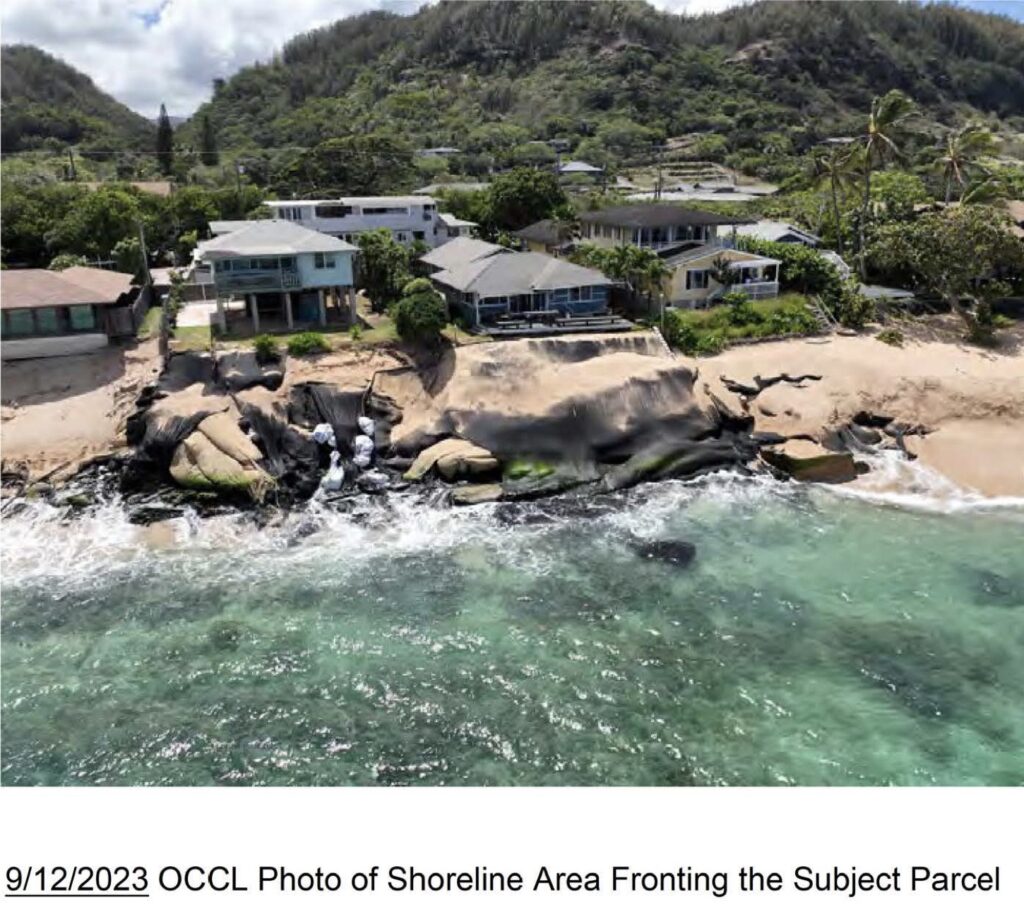
A last-minute proposal by the owners of another Ke Nui Road property to delay for another year the removal of unauthorized erosion control structures scuttled the Land Board’s approval of a settlement agreement that would have resolved a Conservation District violation case that has dragged on for years.
The property is owned by Sunset Oasis LLC; Willam and Melinda Kernot are its members.
On January 12, 2024, the Land Board approved a recommendation from the Office of Conservation and Coastal Lands to fine the company and the Kernots $948,000 for noncompliance with an emergency erosion control permit, construction of a shoreline erosion control device, and encroachment on state land.
The office had sent the Kernots three warning letters regarding the violations that occurred between December 2020 and January 2024.
Although the Kernots requested a contested case hearing after the board’s vote approving the OCCL’s recommendation, they ultimately sought to settle the matter.
At the Land Board’s May 8 meeting, deputy attorney general Danica Patel and OCCL administrator Michael Cain requested that the board approve a settlement agreement that was drafted some time last year.
Under the proposed agreement, the fine would drop to $500,000 if the Kernots moved their house from the shoreline and removed all encroachments on state land fronting their property by July 31. The agreement required them to pay $20,000 of that fine by April 1, 2025, and another $34,000 by July 31, 2025.
The remaining $446,000 could be further reduced based on verified costs the Kernots incurred to correct the violations.
“We do acknowledge it took a while to bring this matter to the board,” Patel said, noting that some deadlines have already passed.
Attorney Bernard Bays, representing the Kernots, reported that they are not as close to compliance as the Freemans are. The Kernots have redesigned their house for the move mauka, and the architectural work is being reviewed by the Honolulu Department of Planning and Permitting. He added later that May is the month when it would be safe to remove the shoreline protection structures. Given that this wasn’t going to happen that month, he proposed pushing the removal deadline to next year.
Bays prepared a revised settlement agreement that would change the deadline to move the home and remove the encroachments to May 31, 2027. Also, by October 1 of this year, the Kernots would pay the $54,000 in fines that they were set to pay last year.
Bays said it was probably going to cost the Kernots $900,000 to $1 million to comply with the board’s orders. “That’s a lot of money. I think they are getting hurt a lot,” he said.
Acting Land Board Chair Ryan Kanakaʻole asked Cain whether his office was amenable to the changes. Cain deferred to Patel, who said, “That would be another year of unlawful use of state lands in a dangerous condition, so this may be appropriate for a performance bond or an increase in fines.”
Bays agreed with the need to increase the fine to account for the continued occupation of state land. The fine was based on cases where the department had charged $1,000 a month for the use of state land.
Board member Denise Iseri-Matsubara asked Cain his thoughts on the proposed timeline.
Cain did not mince his words. “They received their initial notice of violation on January 13, 2021. We have been struggling with them for five years and five months to have these unauthorized structures removed from state land. I’m very uncomfortable agreeing to another year delay given how much of a fight it has been just to reach this point,” he said.
Iseri-Matsubara then questioned Bays about when the Kernots applied for their permit to move the house. Bays said he did not know.
“My concern is the application was not put in until recently,” she said, adding that she didn’t think tacking on an additional $1,000 a month fine over the next year was sufficient.
North Shore resident Denise Antolini pointed out that the house is close to one that fell into the ocean and another that had to be demolished. “It’s a vulnerable area. Time is of the essence,” she said. She also pointed out that the Freemans are doing erosion control structure removal now. “I don’t know about this idea that May is the month to do removal. … The summer months are completely sufficient to get this done,” she said.
She also agreed that the proposed fine was insufficient. As she did regarding the Freeman case, she recommended in her written testimony that the fine be at least 10 percent of the initial fine amount of $948,000 “— that is, a cash fine of at least $94.8k.”
After meeting in executive session, the Land Board approved a motion by Iseri-Matsubara to decline to accept the settlement agreement and to request that the parties devise a new one in which the fine was more commensurate with the delays, and that considers requiring a performance bond.
— Teresa Dawson