
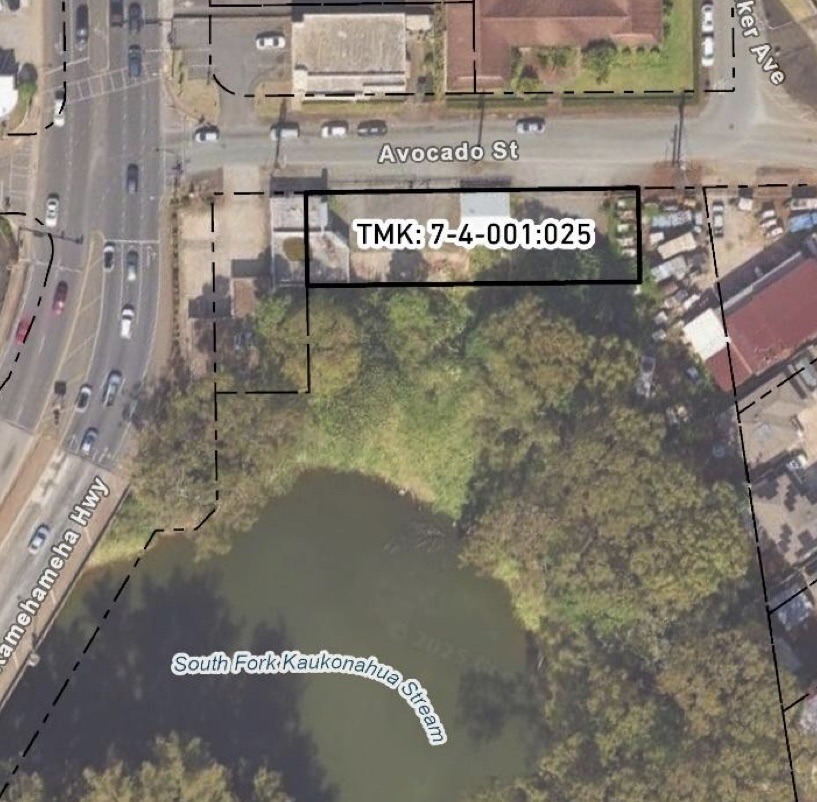
The state is one step closer to turning a parcel in Wahiawā that has long been a public health and safety concern into a new substation for the Department of Land and Natural Resources’ Division of Conservation and Resources Enforcement.
On April 24, the Board of Land and Natural Resources unanimously approved a recommendation from the department’s Land Division to condemn a 9,288-square-foot commercial-residential lot on Avocado Street owned by Angelo’s Auto Body & Detailing, LLC.
The business, owned by Angelo John, was administratively terminated by the Department of Commerce and Consumer Affairs in December 2020. By then, the Honolulu Department of Planning and Permitting had issued a Notice of Violation for prohibited signs (2016) and for unpermitted building alterations (2018).
The property sits at the edge of the Wahiawā reservoir (also known as Lake Wilson), which the Land Board and the board of the Agribusiness Development Corporation recently voted to acquire.
“Because of the property’s location in Wahiawā and proximity to the North Shore, the department believes that it is a suitable, central location for a DOCARE substation. Currently, DOCARE officers servicing Wahiawā and the North Shore operate out of their main station located in Pearl City,” a Land Division report to the board states.
It notes that the department sent a letter to John on November 22, 2024, indicating its interest in acquiring his lot, while acknowledging that it was aware he was not interested in voluntarily selling it. By this time, the DPP had issued three more notices of violation: two for occupation by homeless and one for demolition and alterations without a building permit.
John did not respond to the DLNR’s letter. Even so, on February 14 of last year, the Land Board approved a memorandum of agreement with the University of Hawaiʻi for preliminary planning for a DOCARE base at the property.
In the meantime, the city was taking steps to address the growing community concerns surrounding the property.
On August 20, the Honolulu City Council’s Committee on International and Legal Affairs passed out a resolution authorizing legal action to demolish the unsafe structures on the property.
Then on August 24, “a homeless man was mauled by a pack of dogs on the property and later succumbed to his injuries. This attack further prompted the need for action by both the city and the state,” the Land Division report states.
The following day, Matt Weyer, City Council member representing Wahiawā, introduced a resolution to have the city take steps to acquire the property, including, if necessary, initiating eminent domain proceedings. The resolution stated that the property, apparently abandoned, had “attracted squatters and unsheltered individuals, been vandalized with graffiti, and been the location of alleged criminal or illegal activities.”
“[T]he City Council believes that the city’s acquisition of the property would resolve ongoing public health and safety issues exacerbated by the property’s continuing state of disrepair and further deterioration due to its seemingly abandoned nature and the owner’s failure to maintain the property,” it stated.
Ultimately, however, “it was determined that the state would move forward with the condemnation process, while the city would move forward with emergency demolition of one of the structures deemed to be a public safety hazard,” the Land Division report states.
The DLNR sent John another letter on October 3 again indicating its interest in acquiring his property, this time noting the city’s resolution and the public health and safety concerns. The letter indicated that the state would pay John up to the estimated appraised market value of $720,000 and initiate condemnation proceedings if John refused to sell voluntarily.
John’s reply on October 8 asked the DLNR to cease its efforts to acquire and access his property, arguing that he had complied with all orders from DPP and other agencies. He also noted that he had demolished unsafe structures, improved the property, eliminated illegal activities, and was providing ongoing security.
Even so, the DLNR pressed forward, “in the best interest of the public,” the Land Division states.
A Phase 1 environmental site assessment and hazardous materials assessment of the property had already been done in August of last year. According to the Land Division report, those assessments identified several concerning environmental conditions:
In addition to the environmental risks posed by the observed “vagrant activities,” the ESA noted that the property’s multiple outfalls and drainage systems posed a risk by “discharging runoff over solid waste, potentially contaminating nearby water bodies, including Kaukonahua Stream, which flows into the Wahiawā Reservoir.”
Also, the facts that the property had been used as an auto repair facility and used car lot, and that the adjacent Island Power lot also has a long history of unauthorized industrial uses (i.e. storage of generators), raised concerns about potentially contaminated soil, surface water, and groundwater.
Because the buildings on the site were built in the 1940s and 50s, there were also concerns about the presence of asbestos, canec, lead paint, and PCBs from fluorescent light fixtures.
In January, acting DLNR director Ryan Kanakaʻole accepted a final environmental assessment for the acquisition and new DOCARE substation prepared by G70.
The EA noted that a Phase II ESA will be conducted once the state acquires the
property. The Phase II assessment will include geophysical and underground surveys.
“Due to the likely presence of hazardous materials associated with the former commercial auto shop business, trained technicians will remove hazardous material in accordance with the Occupational Safety and Health Administration standards for asbestos, canec, lead, and fluorescent lighting containing PCBs and mercury. The Indoor and Radiological Health Branch will be consulted, as necessary for the handling of asbestos and lead containing material,” it stated.
In its April 10 report to the Land Board, the Land Division noted that a new appraisal had been commissioned to account for the changes to the site that occurred since the last appraisal. That appraisal will be finalized once access to the property is obtained.
At the board’s meeting, John and one of his sons pleaded with the board to hold off on condemnation, insisting that they just wanted to restart their business. They argued that permitting delays at the DPP were partially to blame for the lack of improvements over the years.
“Why can’t we all come together? … If we can all come to an agreement, I’m just looking to fix my place,” John said.
To their concerns that the state’s initial offer was too low for a commercial-residential property, Hawaiʻi island board member Riley Smith reminded them that the government has the authority to condemn property to serve the best interests of the state and assured them that the new appraisal will take into account the recent improvements the Johns said they have made.
“That all is calculated into how much they would offer you to take over the property … I understand there’s some other government properties nearby, that this is part of a larger acquisition to provide government facilities. So it’s sort of like the last property,” Smith said.
He added, “As much as I think we all sympathize without your situation, the process has sort of started and this is the last process. I don’t see a public reason why we wouldn’t approve this. I think the benefit to you is that everything that you’ve done will be reflected in the value.”
Kanakaʻole noted that while John’s counsel had requested a continuance of the board’s decision, the matter was kept on the board’s agenda because the state has its own timelines to acquire the property.
The board then approved a motion by board member Denise Iseri-Matsubara to approve the Land Division’s recommendation to authorize condemnation proceedings, to delegate to the chair the authority to resolve litigation decisions raised by the Attorney General, and to approve other terms and conditions prescribed by the chair to best serve the state’s interests.
Although no other members of the public testified at the board meeting, Wahiawā residents Keoni and Nahoku Ahlo stated in comments on the draft environmental assessment for the condemnation, “This property has been a longstanding issue in our community for more than a decade. Despite countless attempts by residents to reach the owner and seek resolution, the site has remained abandoned, poorly managed and increasingly unsafe. It has become a dumping ground and a location occupied by informal residents, raising ongoing concerns about health, safety, and the general well-being of Wahiawā. …
“Transferring the property to DLNR DOCARE for the Wahiawā substation will not only eliminate the current nuisance conditions but will also bring much-needed enforcement presence and the stability to the area. Properly managed facilities at this location would serve the community far better than the neglected state we have endured for too long.”
— Teresa Dawson