
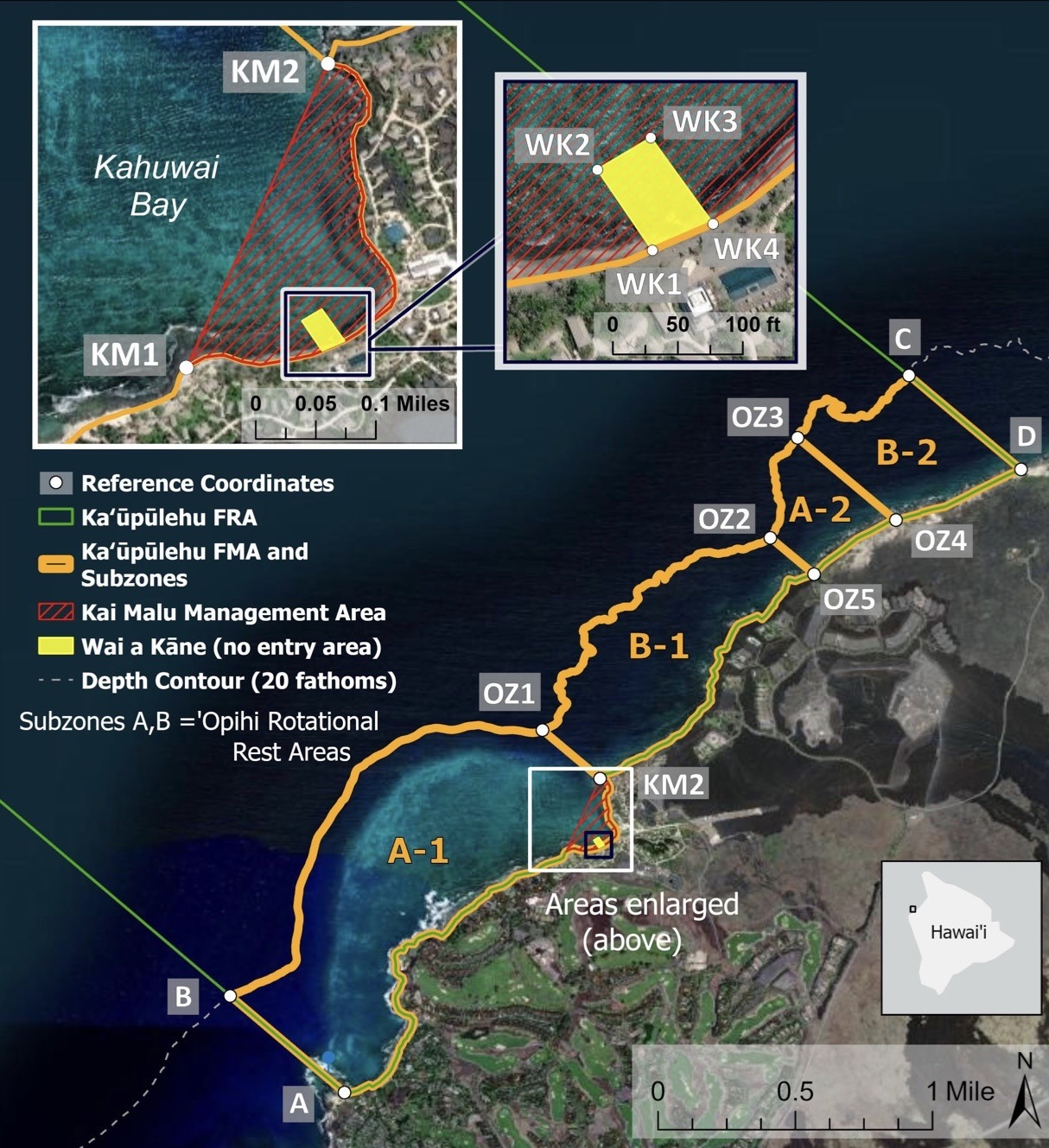
The waters off Kaʻūpūlehu are slated to reopen to fishing after a ten-year rest that, according to Hui Kahuwai executive director Rebecca Most, has resulted in twice as much fish biomass in the area compared to “any other area in Kona.”
But first, new fishing rules need to be in place.
On February 27, the state Board of Land and Natural Resources approved a recommendation by the Department of Land and Natural Resources’ Division of Aquatic Resources to hold public hearings on proposed rules to designate the Kaʻūpūlehu Fisheries Management Area to “create, restore, perpetuate, maintain, share, and protect culturally and ecologically important resources and ensure a socially and ecologically sustainable subsistence fishery at Ka‘ūpūlehu and Kūki‘o that aligns with traditional resource management practices,” according to a staff report.
The proposal includes amendments to Hawai`i Administrative Rules “to repeal rules for the Kaʻūpūlehu Marine Reserve (KMR), to re-establish the Kaʻūpūlehu Fish Replenishment Area (KFRA), and to make other housekeeping amendments. The proposal as a whole aims to foster a co-management relationship between the department and Hui Kahuwai, the community stewards of the nearshore marine resources of Kaʻūpūlehu and Kūkiʻo, as reflected in the Kaʻūpūlehu fisheries management plan and any co-management agreement or other memorandum of agreement or understanding entered into between the [DLNR] and the community stewards of the Kaʻūpūlehu FMA in furtherance of the purposes outlined in the chapter,” it adds.
In the early 2000s, “scientific studies beginning in the early 1990s documented more than a 50 percent decline in coral cover and up to a 75 percent decline in highly prized food fish in the region, reinforcing the observations of kūpuna and other longtime residents,” according to testimony by Kalani Quiocho, Hawai`i island marine program director for The Nature Conservancy of Hawai`i and Palmyra.
In July 2016, DAR’s report stated, the Land Board amended the KFRA, creating the KMR for a period of 10 years.
“Commonly referred to as ‘Try Wait,ʻ the 10-year rest period for nearshore harvest of marine life along the 3.6 miles of coastline of the original KFRA (from Kīkaua Point to Kalaemanō), from the high-water mark out to 20 fathoms (120 feet), was established to give the marine life time to replenish from decades of observed decline. The KMR also outlined the process for the end of the rest period when fishing will resume, noting the closure ‘shall be effective until June 30, 2026, or until the effective date of rules implementing a comprehensive fisheries management plan as developed by the department in consultation with the Kaʻūpūlehu community and other interested parties, whichever occurs later,” DAR’s report states.
According to new research by Kaikea Nakachi and Rebecca Most of Hui Kahuwai; Chris Teague and Ashley Wills of DAR; Kalani Quiocho, ʻAlohi Nakachi and Eric Conklin of TNC; and Mary Donovan of Hawai`i Monitoring and Reporting Collaborative and UH Mānoa, during the rest period, resource fish biomass increased both inside and adjacent to the protected areas for shallow bench, shallow coral, and complex-high coral habitats.
“Resource fish biomass inside the Kaʻūpūlehu Marine Reserve is 118 percent higher than reefs across other areas of the North Kona moku, and 42 percent higher than reefs adjacent to the reserve of similar habitats,” a summary of their work states.
DAR’s recommendation to hold public hearings on the proposed rules received overwhelmingly supportive written and oral testimony from individuals and organizations including Kamehameha Schools, the Office of Hawaiian Affairs, the Sierra Club of Hawai`i, the He`eia National Estuarine Research Reserve, Hawai`i Wildlife Fund, Moana `Ohana, and more.
“Ten years of resting was worth the wait,” said Hannah Springer, president of Hui Kahuwai, which lead the development of the proposed fisheries management plan for the area.
Most noted that poaching in the area had died down after the rest period first began, but spiked in 2025. “Word is getting out there’s more fish,” she said.
According to Quiocho’s testimony, “The Kaʻūpūlehu FMP establishes a balanced, adaptive framework that includes comprehensive bag limits, gear restrictions, size protections, ʻopihi rotational management, and sensitive-area protections such as the Kai Malu cultural and nursery zone. These approaches work together to safeguard abundance while honoring subsistence traditions and respecting fishing practices that are appropriate for the place. Additionally, the plan invests in ongoing monitoring, community education, and adaptive management, ensuring that the fishery at Kaʻūpūlehu can remain healthy for future generations.”
Some fishermen, however, have expressed their opposition to some of the plan’s bag limit and fishing gear restrictions. And as a result, in making his motion to approve DAR’s recommendation, Hawai`i island board member Riley Smith amended it to require DAR and Hui Kahuwai to collaborate with other users and to authorize DAR to amend the proposed rules accordingly before they go out to public hearings.
— Teresa Dawson