
Fate of ʻEwa Feedlot is Still Unclear Despite Moves to Facilitate Solar Project
A trucking company that had been occupying state land near Oʻahu’s slaughterhouse in Kalaeloa without a formal lease for possibly a decade or more has finally moved.
That move, reportedly to property owned by the Department of Hawaiian Home Lands, was prompted in part by the state Department of Land and Natural Resources’ desire to lease most of a 110-acre property known as the ʻEwa feedlot to a renewable energy developer. As of press time, however, it was not clear what the land will now be used for. The trucking company, American Hauling, reportedly occupied about nine acres of the property.
According to a July 12, 2023, declaration by owner David Brian Kaʻahaʻaina, his company, American Hauling, had been invited decades ago to occupy the area by the Hawaiʻi Livestock Cooperative, which owned the adjacent slaughterhouse from the early 2000s until 2016.
It’s unclear exactly where on the ʻEwa feedlot his company began its operations and when it started using the property. A June 2008 Phase II Environmental Site Assessment report on the feedlot property prepared for the state Department of Business, Economic Development and Tourism characterized the land as vacant.
In any case, in 2016, after Kunoa Cattle Company bought the slaughterhouse, Kaʻahaʻaina states that he was “instructed to provide a new certificate of insurance” naming as insured Hawaiʻi Livestock Cooperative, Kunoa Cattle Company, LLC, and Hawaiʻi Land & Livestock, whose affiliate, Hawaiʻi Meats, eventually took ownership of the slaughterhouse from Kunoa Cattle Company.
“My company’s services by this time included (a) hauling cattle arriving from the neighbor islands for processing in special containers built by my company, (b) transporting breeding cows to the Animal Quarantine station in Halawa, (c) fixing hoses, repairing gate, cleaning sediment ponds, (d) repairing equipment owned by Kunoa Cattle Company, (e) dumping livestock waste at the landfill, and (f) burying livestock waste on the property,” Kaʻahaʻaina’s declaration states.
He claims that after HL&L secured a long-term lease from the state Department of Agriculture for the feedlot property in December 2019, HL&L manager Robert Farias (formerly of Kunoa) “informs me … that he will grant me the right to use and occupy a portion of the property for the entire duration of their lease term in exchange for my continuing to provide services to them, which consists primarily of refilling their diesel generators and transporting animals.”
Initially, the Department of Agriculture (now the Department of Agriculture and Biosecurity, or DAB) consented to HL&L letting American Hauling occupy a portion of the lot. By all accounts, there was never a formal sublease agreement between HL&L and American Hauling.
A June 24, 2025 report by the DAB to the Board of Agriculture and Biosecurity (BAB) states, “In August 2020, [the Agricultural Resource Management Division] became aware that a trucking company called American Hauling, Inc. was using a portion of the lease premises to stage trucks, trailers and other equipment. When ARMD staff questioned HL&L about American Hauling’s presence on the premises, HL&L explained that it used American Hauling trucks to transport products, that American Hauling fabricated cattle shipping containers for HL&L, and American Hauling also supplied large forklifts needed to load and unload containers. Initially ARMD accepted this explanation and raised no objection to American Hauling’s presence, but when it became apparent from inspections that American Hauling was storing many more vehicles and pieces of equipment than needed for HL&L’s operations, ARMD required HL&L to remove American Hauling from the premises.”
In March 2023, HL&L filed a complaint in 1st Circuit Court seeking American Hauling’s eviction, as well as damages. A few months later, the court granted HL&L’s request for a writ of possession. On August 12 of this year, after American Hauling had moved out, a stipulation to dismiss all claims and parties without prejudice was filed with the court.
By that time, the BAB had voted to cancel the Land Court transfer certificate of title for the lot, which also included two other lots, and issue each lot a separate transfer certificate of title. The board also voted to deregister the feedlot parcel from the Land Court system to make it easier to subdivide.
“Basically, what this submittal is about is to prepare the land for a future disposition regarding a renewable energy project. … [HL&L] requests only … 10 acres. … The other 100 acres is proposed to be withdrawn from the lease and given back to DLNR so DLNR can issue a renewable energy project lease,” Kevin Moore, new agricultural program manager for the ARMD told the board in June. Moore formerly worked for the DLNR’s Land Division.
Despite all the controversy over American Hauling, DAB director and board chair Sharon Hurd noted that HL&L “will still have the need to move cattle. … American Hauling seems a likely candidate to continue that service. … The relationship is probably going to continue with someone. Maybe American Hauling, but we don’t know. That’s to be determined.”
At the BAB’s August 26 meeting, when asked by member Jimmy Gomes about the proposed solar project, DAB staff seemed to no longer know what the DLNR was proposing for the property. A DLNR representative stated in an email to Environment Hawai`i that the department was “not at liberty to respond” to questions about renewable energy development on the parcel “until we’ve briefed the BAB (formerly BOA) and BLNR. We anticipate briefing them at the October or November meeting.”
Also at that meeting, the board approved the removal of Farias as part-owner of HL&L and the addition of Jeff Rivera, who has worked for Kauaʻi Ranch since 2000.
“As a result, the owners of HL&L will be Jeff Rivera, owning 75 percent interest, and Hawaiʻi Sustainable Beef, owning 25 percent interest,” a DAB report states. Hawaiʻi Sustainable Beef is managed by Riverbend Management, whose director is Melaleuca founder Frank VanderSloot.
State Close to Finalizing Agreement For Wahiawa Spillway Purchase
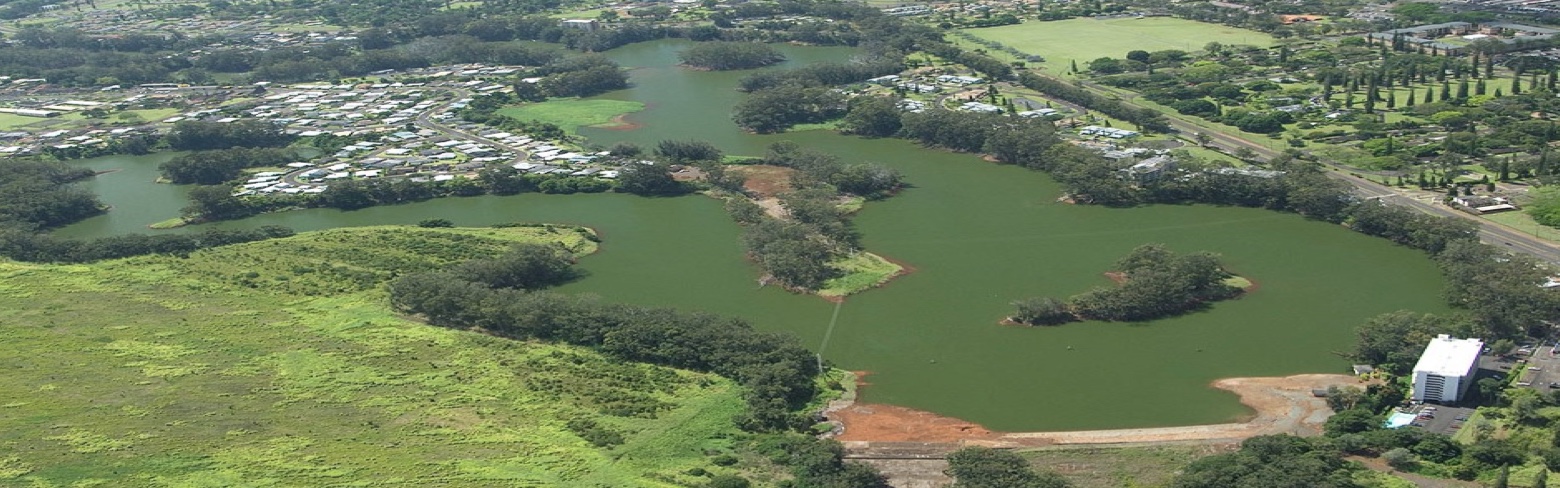
On June 25, the Board of Agriculture and Biosecurity unanimously approved a recommendation by DAB staff to delegate to the board’s chair the authority to negotiate and execute the purchase of the Wahiawa dam spillway on Oʻahu, which the Hawaiʻi Legislature authorized and funded in 2023 (Act 218).
According to Act 218, Dole Food Company, Inc., had listed the Wahiawa Irrigation System for sale for $20 million. “The Dole portion of the system includes the Wahiawa reservoir, Wahiawa dam, and ditch system. The spillway, owned by Sustainable Hawaiʻi, LLC, is also an integral component of the irrigation system. Dole has offered to donate its interests to the State of Hawaiʻi in exchange for the state’s agreement to repair the spillway to meet and maintain dam safety standards. …
“The purpose of this act is to authorize the Department of Agriculture, Department of Land and Natural Resources, and Agribusiness Development Corporation to acquire the Wahiawa irrigation system, on terms negotiated and agreed upon by the office of the governor, or by eminent domain, and to purchase, repair, and maintain the associated spillway.”
The act appropriated $26 million for those purposes, including $5 million for the spillway purchase.
The irrigation system has long been eyed as a secure source of water for thousands of acres of agricultural land the state has purchased in the Whitmore area, mostly from Dole, over the years. But it has also long been in disrepair, falling far short of dam safety standards.
Act 218 appropriated the funds for purchase of the spillway to the DOA, even though the agency does not have the statutory authority to hold title to real property. The state Agribusiness Development Corporation, on the other hand, does.
So in February, the BAB authorized its chair to negotiate a memorandum of agreement with the ADC that would allow the agency to acquire the spillway on behalf of the DAB. The DAB would provide the funds to the ADC. After the purchase was complete, the ADC would then make the land available to the DAB to complete repairs and modifications to bring the spillway into compliance with dam safety standards. That MOA was finalized in April.
By the BAB’s June meeting, the terms of a purchase and sale agreement had largely been worked out, although a few provisions were still being negotiated, according to a DAB report to the board.
“[T]he provisions are unlikely to substantively change or affect the transaction and are more legal in nature,” the report stated.
Under the agreement, the state would purchase 143.116 acres from Sustainable Hawaiʻi for $4.9 million in “as is, where is” condition.
Section 3.6 of the agreement regarding “Removal of Vagrant Activities,” notes that an April 10, 2024, Phase 1 Environmental Site Assessment prepared by Element Environmental, LLC, “identified certain ‘vagrant activities’ on the property, which include the ‘littering and illegal dumping and burning of waste materials, including hazardous substances such as chemicals, electronic waste, and construction debris’. … Seller agrees that it will use commercially reasonable efforts to remove the trespassers on the property engaging in said ‘vagrant activities’ as described in the Phase 1 ESA prior to closing.”
The closing date would be the earlier of May 29, 2026, or ten days after the closing of the state’s purchase of the part of the irrigation system owned by Dole.
— Teresa Dawson