
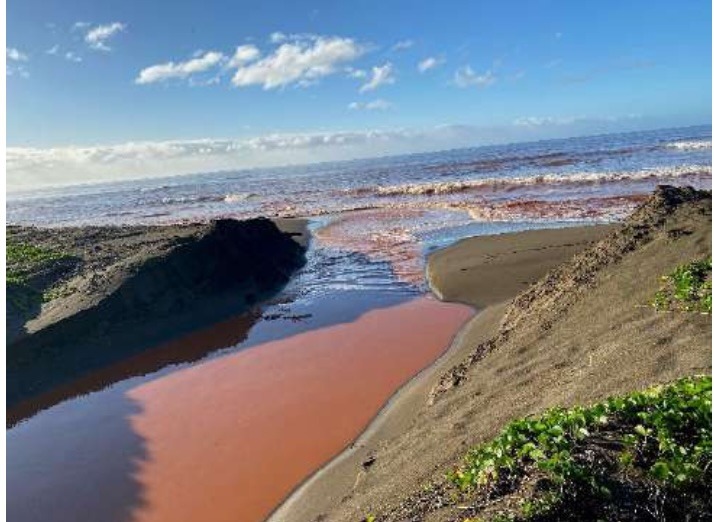
Above photo: A discharge from the Cox Drain in 2021, looking seaward. The drain is one of the outlets whose discharges are regulated under the NPDES permit issued in October.
A decade ago, the state Agribusiness Development Corporation let lapse a permit, issued under the federal Clean Water Act, that allowed it to release runoff from ADC properties into waters of the Pacific Ocean in West Kauaʻi. The runoff, contaminated with pesticides and other pollutants, is collected in 40 miles of unlined ditches dating back to the early days of sugar cultivation in the area. On average, the ditch system discharges between 20 and 30 million gallons a day into the ocean.
The decision prompted three environmental groups to sue the ADC along with the state Department of Health, which administers the Clean Water Act. The first suit, filed in 2016, was withdrawn in 2017, but a similar one was filed in 2018.
In July 2019, U.S. Circuit Judge Derrek K. Watson found that the ADC was in violation of the CWA, prompting the agency to work with the plaintiffs, represented by Earthjustice, on a settlement.
By the end of the year, the parties had reached a settlement, and in early 2020, it was officially entered into the federal court record. Among other things, it called for the ADC to apply for a new NPDES permit with a more rigorous water sampling program, to improve its roads and thereby reduce runoff, and to inspect tenant improvements made to minimize offsite drainage.
Judge Watson authorized the plaintiffs to recover costs associated with the litigation, which amounted to $131,849.52.
That expense, approved by the Legislature and paid for out of general funds, was only the beginning of costs associated with the state’s efforts to evade compliance with the limits set by the DOH in the new permit, which was finally issued in August 2025.
Terms of the permit govern discharges from seven ocean outfalls extending along the coast from Kīkīaola Harbor to Barking Sands Beach. Six are operated by the ADC and one – the Kīkīaola Harbor drain – operated by Kauaʻi County.
Of the six ADC outfalls, five are opened during heavy rainfall to prevent flooding on adjacent lands. The sixth, Kawaiʻele outlet, runs continuously, discharging an average of 19.5 million gallons a day through a pumping station.
The permit went into effect October 1. Since then, the ADC has already violated limits set for enterococci, nitrogen ammonia, nitrogen, phosphorus, and turbidity at the Kawaiʻele outlet.
The ADC Digs In
In 2020, following the federal court ruling and filing of the settlement, the ADC engaged Stantec, an environmental and engineering consultant, to “develop a water quality monitoring and best management practices program for the ADC-owned lands in Kekaha, Kauaʻi.” Cost of the contract over five years, running through September 2025: $2,258,685.71. (Earlier this year, the ADC awarded another contract to Stantec for $650,000, covering unspecified services statewide.)
Four years later, the DOH held hearings on a draft permit. In November 2024, Stantec’s Benjamin Berridge outlined to the ADC the effects it would have on ADC operations, warning that it “signals the beginning of the end of agriculture in Hawaiʻi.” Permit conditions would constitute regulations on streams similar to those imposed on industrial facilities, he informed the ADC board.
ADC and Kauaʻi County could either “prepare to comply with the permit,” Berridge said, which would cost up to $100 million to implement and between $1 million and $2 million a year. Or, he continued, it could adopt a “more cost-effective” approach by working “with HDOH through public comment, elected officials, legal challenge, and other avenues to persuade a more reasonable and effective regulatory strategy.”
Having apparently decided to go along with Berridge’s advice to dig in its heels, the ADC is continuing to fight the DOH over permit terms. Representing the agency in this effort is Kevin Minoli, an attorney with the multinational law firm of Alston & Bird, headquartered in Atlanta. Last year, the Department of the Attorney General had retained the firm to “provide services to ADC … with respect to a variety of possible issues and documentary requirements related” to the NPDES permit. The contract authorized payment of up to $150,000 through May 8, 2027.
(In 2020, the New York Times reported that it had obtained evidence that Alston & Bird had made a $1 million contribution to the group Project Veritas. According to the newspaper, a spokesman for the firm said it had “never contributed to Project Veritas on its own behalf, nor is it a client of ours.” The spokesman would not disclose to the Times on whose behalf the contribution was made.)
At an ADC board meeting in January, Minoli provided what was described in the agenda notice as an “informational update” on the status of administrative hearings on the permit. Because the board heard his report in a long executive session, closed to the public, whatever information and advice Minoli provided has not been made public.
However, at the same meeting, the board gave its executive director, Wendy Gady, authority “to execute a supplemental contract for legal services” in relation to the NPDES permit. Gady advised the board that bringing the matter to a conclusion would probably cost $500,000, including around $400,000 for legal services related to a formal contested case.
When asked where the funds would come from, Gady suggested that funds paid to ADC to operate and maintain pumps could pay for all but around $60,000 of the anticipated costs.
Contested Case Request 1
The Department of Health held hearings in last year on a draft permit. In August, it issued the final permit, to take effect October 1, requiring ADC to test more frequently and for a broader range of pollutants than it had done previously, among other things.
On September 19, Minoli, on behalf of the ADC, filed a request for a contested case or, in the alternative, modification of the permit. The permit, he wrote in his filing, “is inconsistent with the requirements of both state and federal law as it failed to address the legal and factual deficiencies of the original proposed permit and the updated proposed permit.” He also claimed that the department had not complied with requirements for holding a public hearing and had failed to “respond to significant comments provided by ADC and other commenters.”
The permit holds to account both the ADC and Kauaʻi County, which Minoli says means that both are jointly responsible for all pollutants reaching the Pacific Ocean from the Mana Plain “regardless of whether ADC or the County of Kauaʻi are the source of those pollutants or play any roll [sic] whatsoever in the pollution reaching the ocean.”
Nothing in the court decisions, he continued, “mandated that DOH (1) only issue one NPDES permit, (2) cover all discharge points in the same permit, (3) subject both permittees to all permit terms (4) make ADC responsible for discharges from discharge points for which it is not the owner or operator, or (5) include any of the other problematic provisions contained in the permit.”
Contested Case Request, 2
Three days later, Earthjustice also requested a contested case hearing on behalf of Nā Kiaʻi Kai and Surfrider Foundation. Their clients (“community complainants”) rely on the West Kauaʻi shoreline “for swimming, surfing, subsistence fishing, and other traditional and customary practices,” the request stated.
“Over the years, the Kawaiʻele outlet and connecting ditches have been associated with a number of fish kill incidents. … During the 2016 incident, thousands of dead fish were found at the mouth of the Kawaiʻele outlet and along Barking Sands Beach,” it continued.
As for the Kīkīaola Harbor drain, “the county currently leases some of these lands to a seed company and a gravel and asphalt plant. … The county also operates the Waimea Wastewater Treatment Plant, which has discharged wastewater from its storage reservoirs to the ocean through the Kīkīaola Harbor drain.”
The complaints, the request went on to say, “seek to challenge the final permit for several reasons … including because it: (1) fails to include monitoring for relevant pesticides and TPH [total petroleum hydrocarbons]; (2) requires monitoring for toxic pollutants only once per year; (3) fails to include any best management practices (BMPs) that lessen the need to discharge from the system; (4) lacks any flow limits for the Kawaiʻele or Nōhili outlets; (5) fails to include limits and monitoring for chlorophyl a, nitrate-nitrite dissolved oxygen, and temperature; and (6) lacks provisions to address and prevent fish kills at the Kawaiʻele outlet.”
Where Things Stand
Last month, Mike Wallerstein, hearing officer for the DOH, granted the request of yet another party, E Ola Kākou, to have its concerns included in the contested case. It joins those parties already admitted: the ADC and the community complainants, Kauaʻi County and the Kekaha Agricultural Association.
— Patricia Tummons