
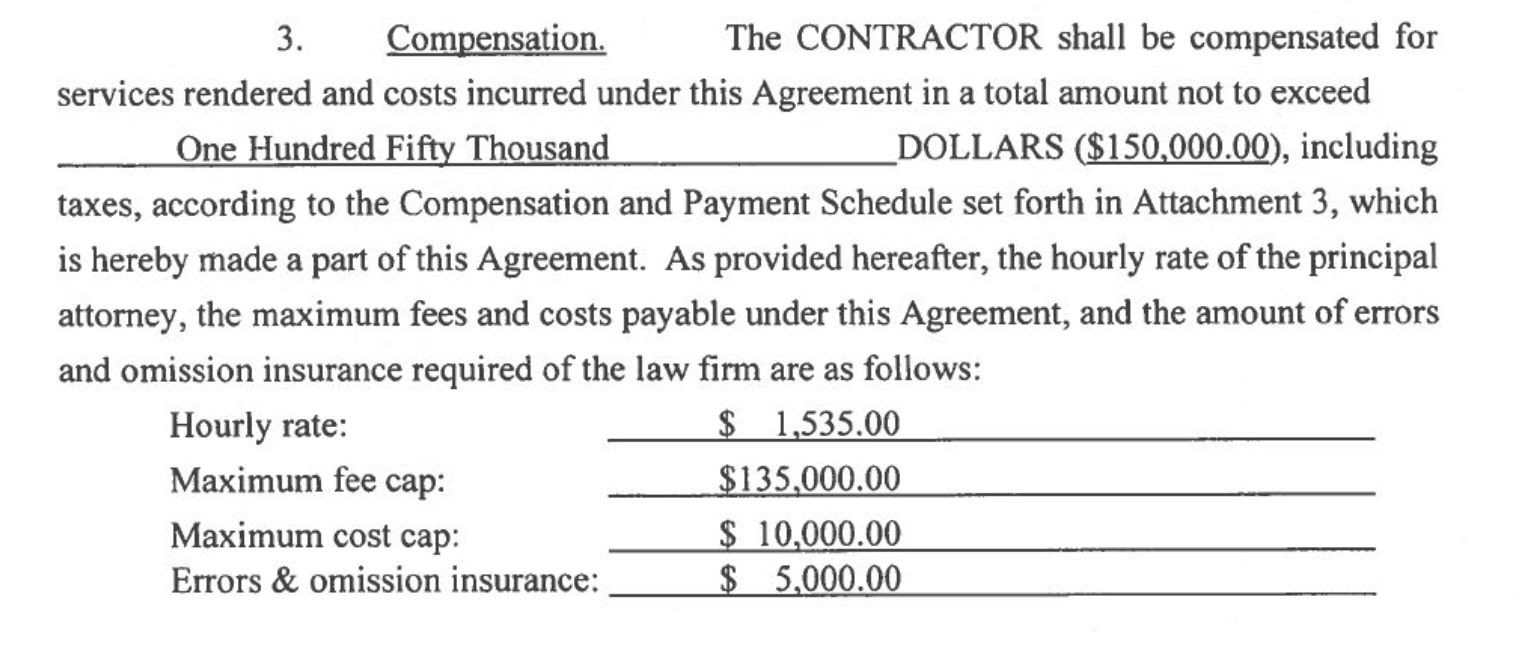
(Above photo: From the state’s contract with Alston & Bird.)
Environment Hawaiʻi received detailed breakdowns of invoices submitted by the law firm of Alston & Bird to the Agribusiness Development Corporation. Here’s what we learned:
The first invoice, dated July 31, 2025, was for $74,294. This reflects 48.4 hours of lead attorney Kevin Minoli’s time, at $1,535 an hour. With a ceiling of $135,000 for attorney fees in the April contract with Alston & Bird, this invoice eats up more than half that. One might think someone at ADC might have noticed that the billings were barely going to last two months at this rate, not the two years anticipated in bid documents.
The next invoice bears the date of September 17, 2025, and was for $2,555. Most of the charges were racked up by a paralegal researching the requirements for registering Alston & Bird as a legal partnership in Hawaiʻi. The hourly rate for the paralegal was $705, not the $500 stipulated in the contract. Lead attorney Kevin Minoli billed the state $1,074.50 for 42 minutes (.7 of an hour) for his work “confirming deadline for the Department of Health to issue the final permit.”
On October 7, the next invoice arrived, for $70,917. This represented September billings, consisting of 46.2 hours of work from Minoli alone. Among other things, he spent 1.3 hours for “arranging and participating in call with County of Kauaʻi;” 1.1 hours “responding to a question from the County of Kauaʻi,; 2.1 hours “reviewing contested case filing submitted by the County of Kauaʻi;” half an hour “meeting with attorneys for the County of Maui regarding” a matter so delicate it had to be redacted; 18 minutes “responding to a question from the County of Kauaʻi;” 24 minutes “communicating with counsel for the county;” and nearly three hours “drafting a common interest agreement specific to the contested case requests filed by the client and the county, and providing a copy of the same to the attorney for the county to review. Considering request from the county to also include KAA.” (KAA is the Kekaha Agricultural Association. Its members are ADC lessees.)
The remaining billings show the Alston & Bird attorneys continuing to address questions raised by other parties, as well as engaging in long discussions among themselves. For example, an order by the hearings officer’s decision in March prompted more than five hours of discussion between Minoli and associate Ke Zhang, for which the state was billed $6,696.
Again in March, billings show that Minoli spent 5.7 hours preparing for and finally meeting, on March 16, with the director of the Department of Health. Cost to ADC: $8,749.50. While the subject matter of the meeting is not specified, if it dealt with the NPDES permit, then it would seem to be an effort to put a thumb on the scale of the contested case process. If the meeting had nothing to do with the NPDES permit, then why should ADC be billed for that?
As the invoices mounted up, the ADC executive director sought the assistance of the governor with help finding a way to pay the bills, a fact brought out as a grievance in a meeting of the ADC’s Administration Committee, upset that it was not consulted. This, too, is documented in the hourly billings, showing that on February 19, Minoli billed ADC for nine-tenths of an hour (54 minutes, or $1,381.50) for a “call with the client and assistance with communication to the Governor’s Office.”
At the June 26 ADC Administration Committee meeting, executive director Wendy Gady was asked whether additional billings had come in since the one on May 5. No, she said, and indicated she didn’t expect one either, since the ADC had not reached out to Alston & Bird with any queries. Three days later, at the meeting of the full ADC board, she announced that on June 26, Alston & Bird had submitted yet another bill, for $3,428.50, raising the outstanding balance to $849,045.50.
Outstanding, indeed.
— Patricia Tummons